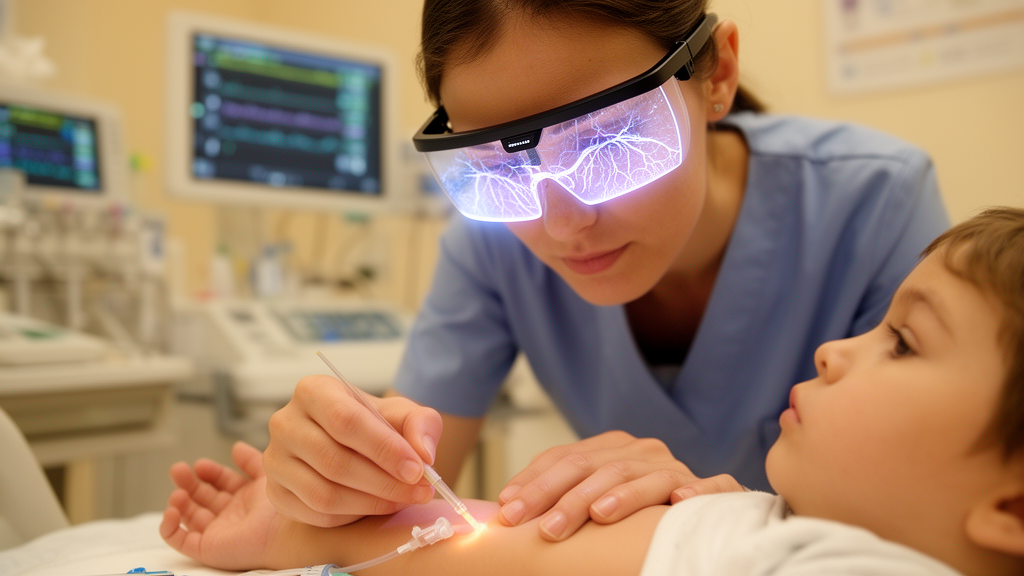
A new randomized controlled trial, published in BMC Anesthesiology, reports that pairing point-of-care ultrasound with wireless mixed-reality smart glasses significantly improved first-attempt success in pediatric radial artery catheterization compared with conventional ultrasound guidance.
In this randomized, controlled trial, 128 children aged between 2 and 18 years who required radial artery catheterization under general anesthesia were allocated to either the conventional ultrasound group or the wireless ultrasound group. The trial randomized participants to the conventional ultrasound group or the wireless ultrasound group. In the wireless ultrasound group, the ultrasound image was transmitted wirelessly to smart glasses worn by the operator, allowing the image to remain in the line of sight throughout the procedure.
The primary outcome was the first-attempt success rate. Catheterization succeeded on the first attempt in 86.0 percent of children in the smart-glasses group, compared with 70.3 percent in the conventional ultrasound group. That corresponds to a relative risk of 1.222 with a 95 percent confidence interval of 1.013 to 1.474 and a P value of 0.033, indicating a statistically significant advantage for the wireless mixed-reality approach.
The secondary outcomes focused on what the investigators called intraprocedural maneuverability, essentially how much the operator had to move, turn and readjust during the puncture. Children whose operators wore the smart glasses required significantly fewer head rotations during the procedure. The median number of head rotations was zero in the wireless group versus two in the conventional group, with a median difference of minus two and a 95 percent confidence interval of minus three to minus two, at P less than 0.001.
Two other measures of procedural coordination also favored the smart-glasses group. Ultrasound probe repositioning events showed a median of zero in both groups, yet the difference was statistically significant, with a median difference of zero, a 95 percent confidence interval of zero to zero and a P value of 0.022. Needle redirections likewise had a median of zero in the wireless group versus zero in the conventional group, again reaching significance with a median difference of zero, a 95 percent confidence interval of zero to zero and a P value of 0.010. The reported medians and confidence intervals for these two measures appear as published in the trial report.
The trial's secondary outcomes included intraprocedural maneuverability, procedure duration, and complication rates. The published abstract reports the significant findings for first-attempt success and the coordination metrics described above, and the authors conclude that integrating smart glasses with wireless ultrasound technology significantly improved first-attempt success rates and intraprocedural maneuverability during radial artery catheterization in this population.
The study was registered at the Chinese Clinical Trial Registry (ChiCTR) under the number ChiCTR2500096195 on 20 January 2025. The study was conducted as a randomized, controlled trial, and the article was published as open access on 26 October 2026. The published version notes that it is being shared early to provide faster access to peer-reviewed, accepted research and is subject to further edits before the final version of record.
Several caveats are worth keeping in mind when interpreting these results. The trial involved a single procedure, radial artery catheterization, in children under general anesthesia, and the reported confidence interval for the primary outcome, while statistically significant, sits close to the boundary of no effect. The maneuverability findings for probe repositioning and needle redirection show significant P values despite median values of zero in both groups, a pattern that reflects the distribution of these count data and should be read as reported rather than overinterpreted. The abstract does not report absolute complication rates, so the clinical significance of the maneuverability gains beyond first-attempt success remains to be established in broader populations and settings.
Even with those limitations, the findings add to a growing body of work on hands-free imaging displays in vascular access. Related studies listed alongside the article include trials of smart glasses combined with ultrasound for radial arterial catheterization and laser guidance delivered through smart glasses, suggesting sustained interest in freeing operators from the ultrasound screen. For pediatric anesthesiology, where small vessel diameter makes every puncture count, the trial’s central result, an absolute improvement in first-attempt success from 70.3 percent to 86.0 percent, offers a concrete, measured benefit for wireless mixed-reality ultrasound guidance in this specific setting.
Subject of Research: Wireless mixed-reality smart glasses combined with point-of-care ultrasound for pediatric radial artery catheterization
Article Title: Application research of POCUS based on wireless mixed reality ultrasound imaging technology in pediatric arterial catheterization
Article References: Xu, J., Wang, Y.-L., Li, C.-J., Tu, W.-J., Yao, W.-D., Chen, Y.-Q., & Wang, B. (2026). Application research of POCUS based on wireless mixed reality ultrasound imaging technology in pediatric arterial catheterization. BMC Anesthesiology. https://doi.org/10.1186/s12871-026-04386-7
Image Credits: AI Generated
DOI: 10.1186/s12871-026-04386-7
Keywords: point-of-care ultrasound, smart glasses, mixed reality, pediatric anesthesia, radial artery catheterization, randomized controlled trial, first-attempt success, wireless ultrasound, vascular access, BMC Anesthesiology, Application, research
News Source: Ophelia Keating. (October 28, 2026). Smart Glasses With Wireless Ultrasound Boost First-Try Artery Catheterization in Children. Scienmag.