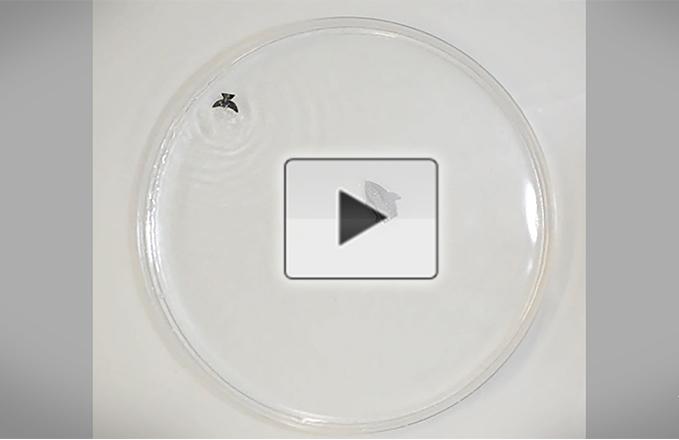
Credit: American Chemical Society
Living tissue can heal itself from many injuries, but giving similar abilities to artificial systems, such as robots, has been extremely challenging. Now, researchers reporting in ACS’ Nano Letters have developed small, swimming robots that can magnetically heal themselves on-the-fly after breaking into two or three pieces. The strategy could someday be used to make hardier devices for environmental or industrial clean up, the researchers say. Watch a video of the self-healing swimmers here.
Scientists have developed small robots that can “swim” through fluids and carry out useful functions, such as cleaning up the environment, delivering drugs and performing surgery. Although most experiments have been done in the lab, eventually these tiny machines would be released into harsh environments, where they could become damaged. Swimming robots are often made of brittle polymers or soft hydrogels, which can easily crack or tear. Joseph Wang and colleagues wanted to design swimmers that could heal themselves while in motion, without help from humans or other external triggers.
The researchers made swimmers that were 2 cm long (about the width of a human finger) in the shape of a fish that contained a conductive bottom layer; a rigid, hydrophobic middle layer; and an upper strip of aligned, strongly magnetic microparticles. The team added platinum to the tail, which reacted with hydrogen peroxide fuel to form oxygen bubbles that propelled the robot. When the researchers placed a swimmer in a petri dish filled with a weak hydrogen peroxide solution, it moved around the edge of the dish. Then, they cut the swimmer with a blade, and the tail kept traveling around until it approached the rest of the body, reforming the fish shape through a strong magnetic interaction. The robots could also heal themselves when cut into three pieces, or when the magnetic strip was placed in different configurations. The versatile, fast and simple self-healing strategy could be an important step toward on-the-fly repair for small-scale swimmers and robots, the researchers say.
###
For more of the latest research news, register for our upcoming meeting, ACS Spring 2021. Journalists and public information officers are encouraged to apply for complimentary press registration by emailing us at [email protected].
The authors acknowledge funding from the Defense Threat Reduction Agency, the Charles Lee Powell Foundation and UC-MEXUS-CONACYT.
The American Chemical Society (ACS) is a nonprofit organization chartered by the U.S. Congress. ACS’ mission is to advance the broader chemistry enterprise and its practitioners for the benefit of Earth and all its people. The Society is a global leader in promoting excellence in science education and providing access to chemistry-related information and research through its multiple research solutions, peer-reviewed journals, scientific conferences, eBooks and weekly news periodical Chemical & Engineering News. ACS journals are among the most cited, most trusted and most read within the scientific literature; however, ACS itself does not conduct chemical research. As a specialist in scientific information solutions (including SciFinder® and STN®), its CAS division powers global research, discovery and innovation. ACS’ main offices are in Washington, D.C., and Columbus, Ohio.
To automatically receive news releases from the American Chemical Society, contact [email protected].
Follow us: Twitter | Facebook
Media Contact
Katie Cottingham
[email protected]