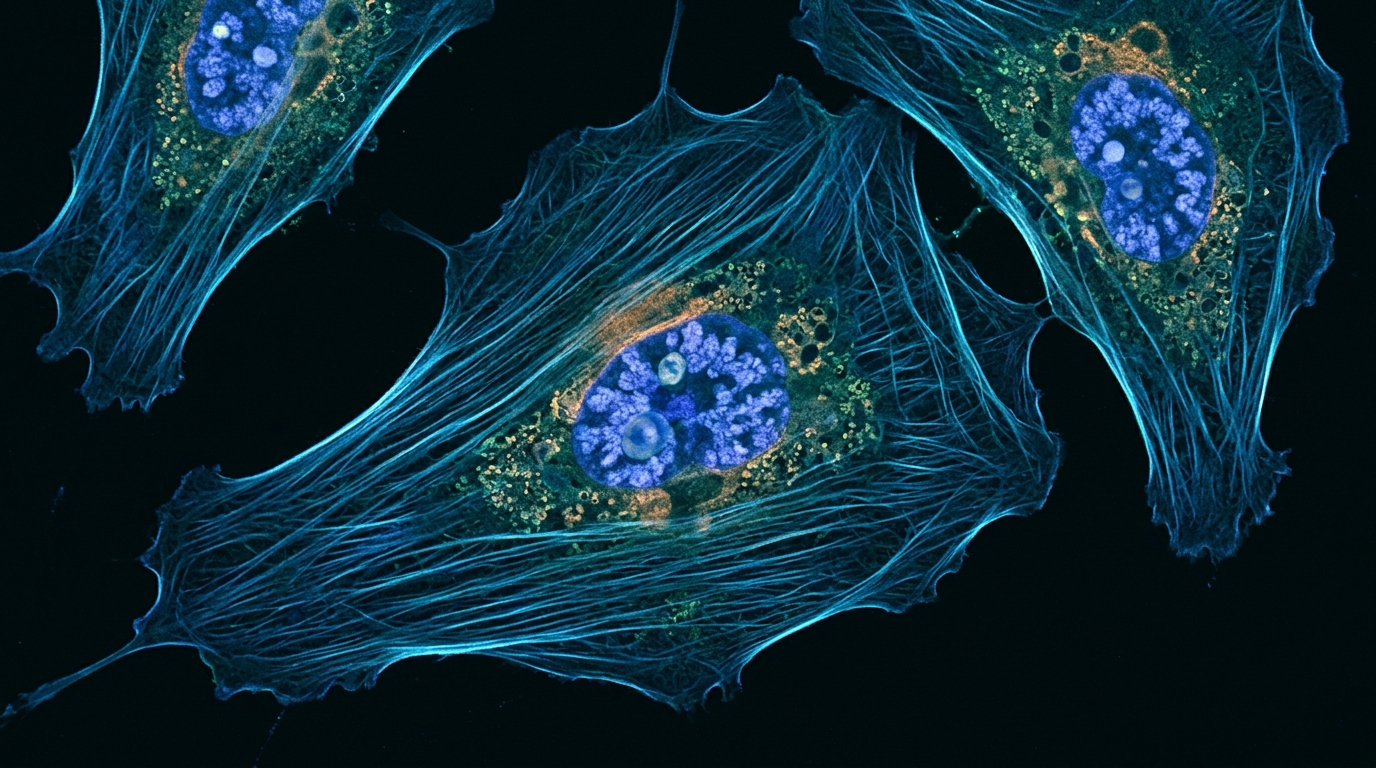
Human fibroblasts kept at confluency in a non-dividing state for six months show accelerated molecular aging that mirrors and speeds up features of in vivo aging, according to a study published in Aging Cell. Researchers led by a team at the Medical University of Innsbruck report that this long-term post-mitotic culture system recapitulates key epigenetic and transcriptomic aging signatures without triggering replicative senescence, and can be used to dynamically test candidate anti-aging compounds such as Metformin and Rapamycin.
The study, which appears in the journal Aging Cell under DOI 10.1111/acel.70796, addresses a long-standing gap in aging research. While animal models have limited predictive value for human aging due to species-specific genetics, physiology, and lifespan, existing human cell models rely on cross-sectional comparisons of donors of different ages. These age-equivalent models capture authentic aging signatures of a donor but do not allow researchers to observe the dynamic aging process over time or to test interventions against it. Stressor-based approaches, such as oxidative agents or senescence induction, trigger specific aging pathways but cannot recapitulate the full range and complexity of cellular aging.
To build a complementary model, the team obtained primary human fibroblasts from skin punch biopsies of 33 individuals aged 0 to 92 years to establish in vivo aging baselines. For the in vitro aging experiments, fibroblasts from four independent female donors aged 53, 55, 67, and 68 years were cultured at confluency without passaging for six months. This age range corresponds to the period during which age-related diseases most commonly begin to manifest in humans and is virtually inaccessible with conventional aging models. The researchers harvested cells at five to seven time points, each 30 days apart, and performed genome-wide DNA methylation and RNA sequencing analyses.
Long-term cultures of confluent contact-inhibited non-dividing fibroblasts remained stable without apparent morphological changes and did not show signs of overgrowth or cell death. In contrast to sequential passaging experiments, fibroblasts maintained in long-term culture did not enter a senescence-associated state, confirmed by the absence of p21 and p16 immunoreactivity, maintenance of small nuclear sizes, and no upregulation of genes associated with senescence and the senescence-associated secretory phenotype. The cells also retained proliferative capacity and remained passagable after six months, demonstrating that the long-term culture did not induce permanent cell cycle arrest.
To quantify biological aging signatures, the researchers employed DNA methylation and transcriptomic clock analyses. The DNAm Blood&Skin clock outperformed other established clocks in cultured human fibroblasts, showing a near-perfect correlation of DNAm age to the chronological age of the 22 in vivo-aged donor samples (R² = 0.98, p = 7.2e−15). During extended post-mitotic in vitro culture, the DNAm clock continued to tick but at an accelerated pace for all donors. Linear mixed effect models with donor as a random effect revealed that DNAm age increases significantly with time in vitro, showing an average aging velocity of 8.2×. The transcriptomic clock showed an even greater increase, with an aging velocity of 22.5× using tAge and 48.3× based on the RNAAgeCalc, though with substantially higher variability across donors. Aging velocities significantly differed between DNAm and transcriptomic clocks, indicating that the transcriptomic clock progresses roughly three to five times faster than the DNAm clock.
The researchers next asked to what extent in vitro aging reflects in vivo signatures of cellular aging at the transcriptional pathway level. They performed linear regression analyses on RNA-seq data from in vitro aging, in vivo aging (n = 20, ages 22–92 years, adjusted for sex), and a larger in vivo cohort by Fleischer et al. (n = 143 donors, ages 1–96 years, adjusted for sex). Using ClueGO pathway enrichment analysis, they identified 17 overlapping downregulated aging pathways and seven overlapping upregulated aging pathways shared across all three datasets. Of the pathways significantly associated with in vitro aging, 60 of the 66 significant downregulated aging pathways and 20 of the 31 significant upregulated pathways were also significantly associated with in vivo aging. The remaining pathways likely reflect culture-specific and donor-specific transcriptional responses, thereby defining the scope and limitations of this reductionist model. The majority of the overlapping pathways were accelerated several-fold in vitro, and all pathways were significantly accelerated compared to in vivo aging, without distorting the direction of concordant aging pathways.
Integrating promoter methylation changes with mRNA expression, the team found a strong inverse relationship between RNA expression and DNA methylation for genes contributing to the downregulated (ρ = −0.86, p = 0.01) and upregulated pathways (ρ = −0.75, p = 0.03). This suggests that while in vitro transcriptomic aging velocities seem to uncouple from DNAm in terms of velocity, they remain functionally coupled at the level of gene regulation.
Because fibroblasts are commonly the source of many direct trans-differentiation protocols that retain age-related signatures of the original cells, the researchers tested whether pre-aged fibroblasts could generate induced neurons (iNs) that preserve their biological age. They cultured fibroblasts from three donors for six months before converting them into iNs using an established protocol. DNAm and transcriptomic clock analyses revealed a clear increase in biological age in iNs generated from six-month pre-aged fibroblasts compared to iNs generated from baseline fibroblasts. DNAm age increased by an average of 4.2 ± 1.7 years, while the tAge and RNAAgeCalc increased by 6.6 ± 1.5 and 10.7 ± 4.4 years, respectively. The accelerated aging signature was preserved to a similar extent following replating, indicating that the age-related molecular changes acquired during pre-aging were robustly retained. This approach provides a viable strategy to generate pseudo-longitudinal iN samples to model progressive neuronal aging in vitro, particularly in scenarios where longitudinal biopsies are not feasible.
Single-cell RNA sequencing of fibroblasts from two donors at Month 0 and Month 5 revealed increasing cellular heterogeneity with age. At baseline, most cells from both donors contributed to the youngest quartile of the aging score, and only 15% and 9% of cells contributed to the upper quartile of old cells. Following five months of in vitro aging, the ratios shifted toward smaller proportions of younger cells and higher proportions of older cells, resulting in 28% and 41% of cells contributing to the oldest quartile. The researchers also observed that negative binomial deviance of longitudinal aging genes was significantly elevated at Month 5, indicating a progressive loss of transcriptional control and accumulation of transcriptional noise. This increase exceeded what would be expected based on the global transcriptome, suggesting that aging-associated genes are particularly prone to increased heterogeneity. These findings were cross-validated using independent aging gene sets, indicating that the phenotype is a general feature of aging genes and not driven by circularity in gene selection.
To assess the predictive power of this accelerated in vitro aging model, the researchers treated cultures of four donors with 25 nM Rapamycin or 1 mM Metformin over six months and performed RNA-seq and DNAm analysis each month. Metformin treatment had a slowing effect on the DNAm and transcriptomic aging velocity, significantly reducing the average DNAm aging velocity from 8.23× to −2.8×, and the velocity based on RNAAgeCalc from 48.3× to 11.0×. A linear mixed-effects model confirmed a significant interaction effect of Metformin, confirming that Metformin slows down the rate of DNAm aging. Metformin significantly attenuated the decline of all downregulated aging pathways and almost completely reversed them, reducing the slope of one-third of upregulated pathways by more than 50%. In contrast, Rapamycin showed a slowing trend on both DNAm and transcriptomic clocks but not at statistical significance, and had minimal effects on either downregulated or upregulated aging pathways. The researchers note that these in vitro results align with pre-clinical evidence, including findings in cynomolgus monkeys showing Metformin’s beneficial effects on aging-related readouts such as epigenetic clocks, although corresponding human trial data remain limited. They caution that only one concentration of each compound was tested as a proof of concept, and dedicated studies are required to assess optimal dosage. The model does not fully replicate the complexities of real longitudinal studies, as it cannot account for environmental factors such as diet, exercise, and exposure to various stressors, or patient-specific events including illnesses or lifestyle changes that may significantly impact individual aging trajectories.
Subject of Research: Long-term post-mitotic culture of human fibroblasts as a model for accelerated cellular aging and anti-aging compound testing
Article Title: Long‐Term Post‐Mitotic Culture of Human Fibroblasts Recapitulates and Accelerates Features of In Vivo Aging and Enables Dynamic Testing of Anti‐Aging Compounds
Article References: Traxler, L., Karbacher, L., Borgogno, O., Ozbun, T., Champion, K., Smaling, A., Zhou‐Yang, L., Herdy, J. R., Böhnke, L., Böckle, B. C., Gage, F. H., Mack, H. I. D., Defrancesco, M., & Mertens, J. (2026). Long‐Term Post‐Mitotic Culture of Human Fibroblasts Recapitulates and Accelerates Features of In Vivo Aging and Enables Dynamic Testing of Anti‐Aging Compounds. Aging Cell, 25(11), Article e70796. https://doi.org/10.1111/acel.70796
Image Credits: AI Generated
DOI: 10.1111/acel.70796
Keywords: human fibroblasts, in vitro aging, DNA methylation clock, transcriptomic aging, epigenetic aging, induced neurons, single-cell RNA sequencing, Metformin, Rapamycin, cellular senescence, aging pathways, pseudo-longitudinal model
News Source: Beatrice Stafford. (November 7, 2026). Six Months in a Dish Speed Up Human Cellular Aging, New Study Finds. Scienmag.