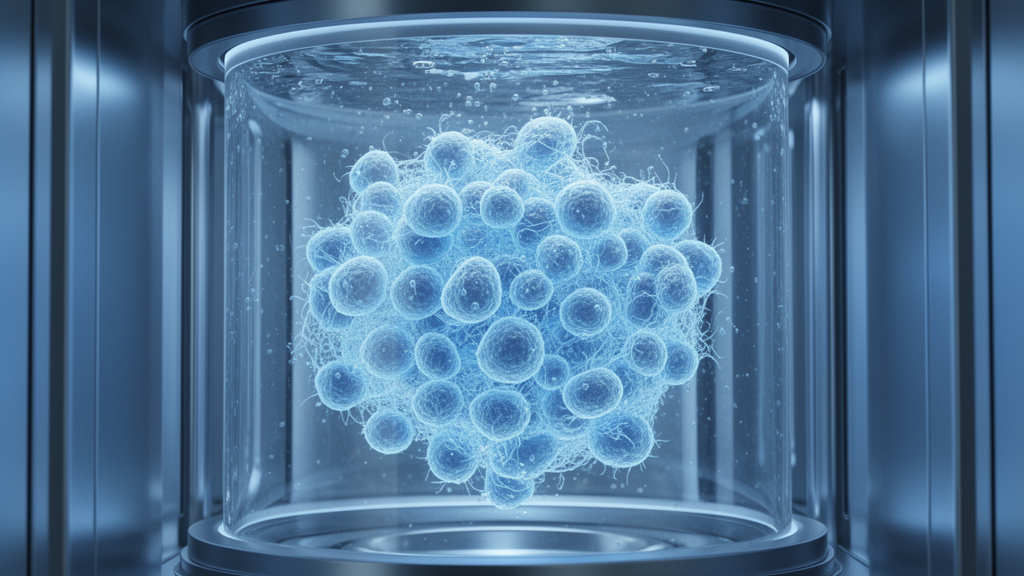
Biomedical researchers have established a sequential three-dimensional culture method that leverages simulated microgravity inside a rotating bioreactor to produce human induced pluripotent stem cell-derived mesenchymal stem cells displaying accelerated proliferation and enhanced cutaneous wound-healing properties. The experimental platform, detailed in Molecular Biomedicine by a research team led by Ahmed Abdal Dayem, Soo Bin Lee, Yeonjoo Kwak, and colleagues, addresses persistent manufacturing bottlenecks that have long constrained cell therapies derived from living adult tissues. By combining initial microwell-assisted aggregate formation with continuous dynamic suspension culture, the investigators guided pluripotent cells through a structured three-dimensional maturation phase before initiating adherent differentiation. The resulting stem cell population, designated as microgravity-assisted large spheroid-derived stem cells, fulfilled international standard identity criteria while demonstrating delayed replicative senescence, reduced intracellular oxidative stress, and notable wound-repair capabilities across both cell-culture assays and an exploratory murine wound model.
Mesenchymal stem and stromal cells have garnered extensive clinical interest across regenerative medicine because of their pronounced immunomodulatory capacities, secretome-mediated trophic signaling, and multilineage differentiation potential. Despite these therapeutic attributes, conventional cell products sourced from adult or perinatal tissues such as adipose tissue, bone marrow, and Wharton’s jelly face severe limitations, including extensive donor-to-donor variability, limited cellular expansion lifetimes before entering replicative arrest, and marked phenotypic heterogeneity across tissue origins. Mesenchymal cells harvested from different anatomical locations within a single donor can present divergent baseline gene expression patterns, while post- and perinatal tissue comparisons remain difficult to standardize. Reprogrammed human induced pluripotent stem cells offer an essentially unlimited, renewable starting material capable of establishing uniform cell banks. However, existing differentiation strategies that rely on flat two-dimensional tissue culture plastic or unguided spontaneous embryoid body formation frequently produce heterogeneous cell yields, exhibit prolonged induction timelines, or fail to impart robust functional regenerative potency to the derived cell progeny.
To overcome these physical and biological constraints, the investigators engineered a sequential differentiation workflow that fundamentally alters the biophysical microenvironment through controlled three-dimensional aggregation and rotary mechanics. Pluripotent stem cells from the human 409B2 line were initially seeded into specialized microwell culture plates containing thousands of micro-cavities to induce uniform, statically assisted small spheroids over an initial twenty-four-hour incubation window. Rather than allowing these fragile cell clusters to expand statically, the team transferred the nascent aggregates into a ClinoStar rotating bioreactor. Operating on clinostat principles, this bioreactor counteracts unidirectional gravitational sedimentation by maintaining the cell aggregates in a continuous, gentle suspension loop at controlled rotational velocities ranging from eleven to fifteen revolutions per minute.
The physical differences between static and microgravity-assisted spheroid culture produced marked divergence in structural and molecular characteristics. Spheroids maintained under static conditions developed into small, irregular cellular aggregates with mean diameters clustered tightly between sixty and eighty micrometers. In sharp contrast, spheroids cultivated within the rotating bioreactor developed into large, spherical, and cohesive three-dimensional bodies primarily spanning two hundred to two hundred and fifty micrometers in diameter. Despite their substantially larger volume, these microgravity-assisted spheroids retained a highly uniform size distribution, displaying a coefficient of variation of 21.2 percent compared with 22.4 percent observed in the static control aggregates. Morphological growth was accompanied by prominent upregulation of cellular proliferation markers, including proliferating cell nuclear antigen and Ki67, alongside elevated stemness factors such as NANOG, OCT4, and stage-specific embryonic antigen 4. Furthermore, transcriptional profiling identified increased expression of endogenous antioxidant enzymes, including glutathione peroxidase 4 and catalase, coupled with a balanced expression of hypoxia-inducible factor 1-alpha relative to conventional two-dimensional monolayers.
Following five days of dynamic maturation within the bioreactor, the large spheroids were plated onto gelatin-coated tissue culture surfaces to facilitate spontaneous adherent outgrowth over a three-week interval in specialized expansion medium. Cells sprouting from statically maintained spheroids exhibited morphological irregularities, inconsistent adherence, and early proliferative arrest during serial passaging. Conversely, the microgravity-derived cells established uniform, spindle-shaped fibroblastic monolayers that expanded continuously. Extensive flow cytometric analysis confirmed that these cells met the foundational surface marker criteria defined by the International Society for Cellular Therapy, demonstrating greater than ninety percent expression of CD73, CD90, and CD105, alongside an absence of hematopoietic lineage markers CD34 and CD45. When exposed to chemical induction media, the derived cells demonstrated unequivocal trilineage differentiation into adipocytes, osteoblasts, and chondrocytes, validated through specific histochemical staining of intracellular lipid vacuoles, mineralized calcium matrices, and acidic proteoglycan deposition, as well as quantitative expression of lineage-specific master transcription factors.
Given that clinical translation of pluripotent cell derivatives requires strict safeguards against uncontrolled cell proliferation, the investigators conducted multi-layered cytogenetic and oncogenic evaluations. Western blot analyses demonstrated that core pluripotency proteins, including OCT4, SOX2, NANOG, and the oncogenic regulator c-MYC, were silenced to near-background levels comparable to primary adult mesenchymal stromal controls. Chromosomal integrity was evaluated across early, intermediate, and late culture stages at passages five, ten, and eighteen using standard G-banding karyotyping. Across all examined intervals, the derived cells maintained a stable female diploid 46,XX karyotype without detectable structural rearrangements, translocations, or aneuploidies across multiple analyzed metaphase spreads. In parallel soft-agar colony formation assays, the derived cells formed no anchorage-independent colonies over three weeks of culture, whereas malignant positive-control cells demonstrated robust colony-forming efficiencies of approximately 0.63 percent, confirming the absence of autonomous transformation under standard in vitro screening parameters.
Growth kinetics demonstrated that the microgravity-assisted platform imparted substantial proliferative advantages over traditional adult tissue-derived populations. The derived cells exhibited a mean population doubling time of 1.6 days, which was significantly shorter than the 2.3 days recorded for Wharton’s jelly-derived stem cells, while demonstrating comparable kinetics to adipose-derived stem cells at 1.8 days. Continuous passage monitoring over a forty-day culture window showed sustained logarithmic expansion, yielding cumulative cell quantities exceeding one trillion cells from a single initial production run. Importantly, prolonged expansion did not induce premature cellular senescence. Cytochemical staining for senescence-associated beta-galactosidase revealed that while adipose-derived stem cells accumulated more than thirty percent senescent cells by passage eighteen, the microgravity-derived cells maintained low positivity rates of approximately 15.3 percent, closely matching perinatal Wharton’s jelly cells. Western blot profiling corroborated these findings by revealing reduced levels of DNA double-strand break markers and senescent checkpoint regulators, specifically phosphorylated gamma-H2AX, P53, and P21.
The derived cells also exhibited enhanced cellular resilience when exposed to acute oxidative stress in vitro. Challenge with exogenous hydrogen peroxide induced a substantially smaller surge in intracellular reactive oxygen species within the microgravity-derived cells compared with both adipose and umbilical cord tissue controls, as measured by fluorogenic sensor accumulation. Although total intracellular glutathione regeneration capacities hovered between 58 and 70 percent without statistically significant variance among cell types, the reduced generation of oxidative radicals aligned with elevated basal antioxidant transcription. Lineage-directed transcriptional profiling revealed a unique mesodermal signature in the microgravity-derived population. Early- and mid-passage cells displayed marked upregulation of vascular and developmental mesodermal markers, specifically kinase insert domain receptor and platelet-derived growth factor receptor alpha, together with elevated expression of the transcription factor HAND2.
Functional wound-healing proficiencies were evaluated using complementary in vitro migration and co-culture model systems. In direct scratch assays, confluent monolayers of the microgravity-derived stem cells demonstrated accelerated wound closure, achieving approximately 63 percent closure within twelve hours, compared with 57 percent for Wharton’s jelly cells and 51 percent for adipose-derived cells, before reaching complete confluent closure across all cohorts by forty-eight hours. To assess whether this regenerative effect operates via paracrine signaling independent of physical cell-to-cell contact, researchers deployed a Transwell co-culture system where the stem cells were suspended above mechanically scratched human HaCaT keratinocyte monolayers. Keratinocytes exposed to the microgravity-derived cells showed accelerated early gap closure, achieving approximately 60 percent area reduction at twelve hours compared to 49 percent in unconditioned control wells.
Translational utility was subsequently explored in an in vivo full-thickness excisional skin wound model established in immunocompromised BALB/c nude mice. Standardized eight-millimeter cutaneous wounds received perilesional injections containing five hundred thousand cells from each respective stem cell cohort or vehicle controls. Macroscopic wound-area tracking demonstrated progressive re-epithelialization across all groups, with animals treated with the microgravity-derived cells achieving near-complete wound closure by day twenty-one. Histological examination using hematoxylin and eosin staining revealed accelerated epithelial resurfacing, structured granulation tissue formation, and reduced local inflammatory cell infiltration by day seven. By day twenty-one, epidermal thickness in treated animals had normalized toward the architecture of unwounded healthy skin, contrasting with persistent hyperplastic thickening seen in control wounds. Concurrently, Masson’s trichrome staining demonstrated organized, parallel bundles of mature dermal collagen fibers that reached approximately 55 percent area density by day twenty-one, the highest collagen restoration level recorded among all experimental groups.
While these experimental findings illustrate the practical feasibility of dynamic three-dimensional stem cell engineering, the study authors emphasize several critical methodological and biological limitations. The in vivo wound-healing assessments were based on an exploratory animal cohort that experienced scheduled interim sacrifices on day seven alongside subsequent animal attrition, reducing the final sample size to between one and four mice per group by day twenty-one. Consequently, time-course closure rates and histological measurements represent descriptive observational trends rather than statistically verified comparative superiorities. Similarly, in vitro scratch closure rates reflect combined cellular migration and proliferation without separate pharmacological inhibition, and the quantitative measurements were derived from technical regions of interest within single wells. Furthermore, the platform was characterized utilizing a single established human induced pluripotent stem cell line, highlighting the necessity of validating the protocol across genetically diverse donor lines to ensure broad reproducibility.
The study also notes that the mechanical complexity of rotating bioreactors introduces multiple simultaneous physical cues, including continuous fluid dynamic shear, three-dimensional spatial signaling gradients, and altered mass transport, making it impossible to isolate the exact biological contributions of simulated microgravity alone without extensive mechanotransduction dissection. Routine quantitative polymerase chain reaction normalizations relied on a single internal reference gene, indicating that broader multi-gene normalization will be required in subsequent genomic evaluations. Looking forward, comprehensive multi-omic characterization of the cellular secretome, high-resolution genomic copy-number variation arrays, and rigorous long-term biodistribution and tumorigenicity profiling will be essential to establish formal preclinical safety profiles. Nonetheless, the integration of controlled microwell aggregation, rotating microgravity bioreactor conditioning, and directed adherent expansion represents a robust, standardized engineering paradigm for producing high-yield, functional mesenchymal therapeutics tailored for complex tissue repair and regenerative medicine applications.
Subject of Research: Microgravity-assisted generation and characterization of mesenchymal stem cells from induced pluripotent stem cells for wound repair
Article Title: Microgravity-assisted large spheroid culture generates mesenchymal stem cells with enhanced wound-healing activity
Article References: Abdal Dayem, A., Lee, S. B., Kwak, Y., Jeun, H., Yeo, H. C., & Cho, S.-G. (2026). Microgravity-assisted large spheroid culture generates mesenchymal stem cells with enhanced wound-healing activity. Molecular Biomedicine, 7(1), Article 262. https://doi.org/10.1186/s43556-026-00671-6
Image Credits: AI Generated
DOI: 10.1186/s43556-026-00671-6
Keywords: mesenchymal stem cells, induced pluripotent stem cells, simulated microgravity, ClinoStar bioreactor, 3D spheroid culture, wound healing, tissue regeneration, cell proliferation, cellular senescence, trilineage differentiation, karyotype stability, reactive oxygen species, AggreWell, HaCaT keratinocytes, excisional wound model, regenerative medicine, extracellular matrix, paracrine signaling
News Source: Drew Townsend. (November 23, 2026). Simulated Microgravity Bioreactor Yields Stem Cells With Enhanced Wound Repair Traits. Scienmag.