Researchers from ITQB NOVA have characterized a therapeutic target with great potential and built its first three-dimensional model
Credit: ITQB NOVA
When invaded by a virus, our body cells launch an alert to neighboring cells to increase their antiviral defenses to prevent the infection from spreading. Some viruses, however, manage to bypass this system by mimicking the host’s RNA, preventing them from being detected by the infected cell and avoiding this alert. In the case of SARS-CoV-2, this mimicking uses a protein known as nsp14. This protein is also very important for virus multiplication, a task which is facilitated by its binding to the nsp10 protein, resulting in a protein complex. Interfering with nsp14 binding and with the nsp10-nsp14 protein complex is the aim of the most recent ITQB NOVA research in COVID-19, led by researchers Margarida Saramago, Rute Matos and Cecília Arraiano.
The researchers began by performing the biochemical characterization of the nsp10-nsp14 protein complex, a known therapeutic target. “For the first time, it was possible to identify the amino acids which must be targeted in order to silence this complex”, explains Rute Matos. The silencing of nsp14 also “makes it easier for the organism to identify the virus’ messenger RNA and to activate the immune system before it replicates”, adds fellow researcher Margarida Saramago.
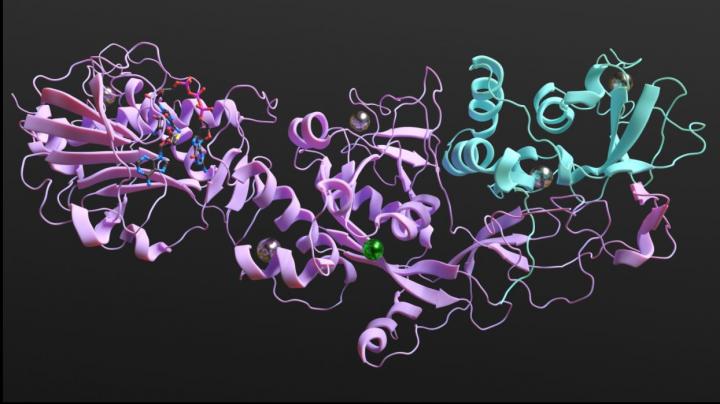
The discovery was only possible due to the collaboration between researchers from an experimental RNA laboratory and scientists from the bioinformatics area, who worked together to characterize the proteins. The construction of the three-dimensional model of the nsp14-nsp10 complex was based on the equivalent SARS-Cov-1 proteins. “It’s like doing a facial composite”, says bioinformatician Caio Souza, who built the model. With a very clear notion of the shape of the protein, it was possible to predict the most important amino acids. “We have a very detailed map of the target we must attack with future therapies,” points out Diana Lousa, fellow bioinformatician and co-author of the study. “By silencing this protein, we will be able to “domesticate” a severe disease and turn it into a cold,” explains Cecilia Arraiano, leader of one of the two laboratories involved. “It’s as if we turned a wolf into a dog.”
This knowledge can now be used to develop antivirals, research which is now being carried out by the team. “Even with the hope of vaccines, it is essential to identify therapies capable of treating the infections that will continue to occur,” explains Cláudio M. Soares, Director of ITQB NOVA and co-author of the work. “This type of research must be funded by public institutions,” he adds. The scientific paper has been accepted for publication by the Federation of European Biological Societies (FEBS) in “The FEBS Journal“.
###
ITQB NOVA has 11 ongoing research projects dedicated to SARS-CoV-2. In December, another team conducted a pilot screening of a saliva test developed at the institute using LAMP (Loop-Mediated Isothermal Amplification) technology, with results that can be interpreted with the naked eye. The institute has also been on the frontline of the fight against the pandemic: thousands of RT-PCR COVID-19 diagnostic tests on frontline workers, such as firefighters, police officers, and educational assistants, have been performed at the institute in a partnership with the Municipality of Oeiras. The institution also participates in the SEROLOGY4COVID consortium, which brings together five institutions.
Media Contact
Renata Ramalho
[email protected]
Original Source
https:/
Related Journal Article
http://dx.