A polyphasic taxonomic study of 24 fungal specimens collected in Sichuan Province, China, identified nine scale insect-associated species of Clavicipitaceae, including five new species, four new provincial records and one proposed taxonomic synonym. The investigation covered fungi in the genera Conoideocrella, Hypocrella, Helicocollum and Regiocrella, which the authors characterized as obligate or specialized pathogens associated with scale insects in the sampled material.
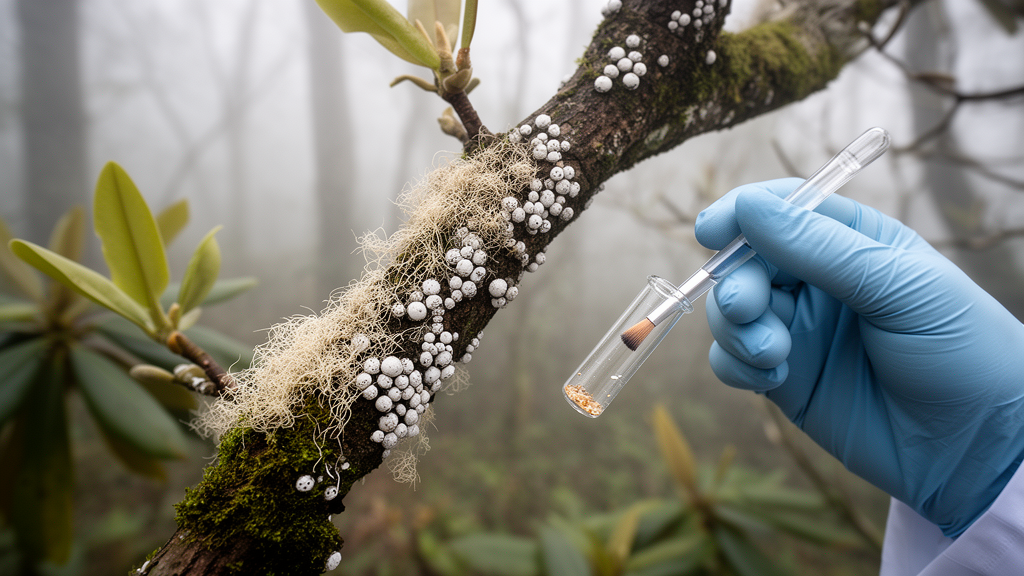
The specimens were gathered from several parts of Sichuan between 2022 and 2025, primarily from forest floors, leaf litter, decayed wood, tree trunks and living leaves. Axenic cultures were established from germinating ascospores, conidia or stromal tissue. Researchers documented host associations and macroscopic fungal features, including stromatal color and shape, before examining perithecia, asci, ascospores, phialides and conidia microscopically. Pure cultures were maintained on potato dextrose agar, quarter-strength Sabouraud dextrose agar with yeast extract and oatmeal agar at 25 °C under alternating 14-hour light and 10-hour dark cycles.
For the molecular analysis, DNA was extracted from fresh specimens or cultures. The researchers amplified and sequenced three nuclear regions: the large subunit ribosomal RNA gene, translation elongation factor 1-alpha and the RNA polymerase II largest subunit gene. The concatenated alignment represented 69 taxa and contained 2,793 base pairs, including gaps, with 1,167 distinct patterns. Maximum-likelihood and Bayesian analyses produced congruent trees, while two isolates of Purpureocillium lilacinum served as outgroups.
The five species formally described as new were Conoideocrella jiufengensis, C. violaceomarginata, Helicocollum bambusae, Hypocrella cinnamomum and Regiocrella sichuanensis. C. jiufengensis was collected from scale insects on bamboo at Jiufeng Mountain and recovered as a well-supported sister lineage to C. krungchingensis. It differs from that species in its larger stromata, longer phialides and conidia with one transverse septum rather than three to four. Sequence comparisons with the ex-type strain of C. krungchingensis showed differences of 32.38% in LSU and 7.37% in tef1-alpha.
C. violaceomarginata was found on scale insects infesting Camellia sinensis in Tianquan County, and its stromata develop a conspicuous violet-pigmented margin. It formed a sister clade to C. fenshuilingensis with 99% maximum-likelihood bootstrap support and a Bayesian posterior probability of 1.00. The new species differed in its smaller stromata, shorter phialides and larger conidia. Nucleotide differences from C. fenshuilingensis were 6.57% in rpb1 and 4.82% in tef1-alpha.
H. cinnamomum was collected from scale insects on Cinnamomum japonicum in Baoxing County and placed in the Pulvinate clade A of Hypocrella with 85% maximum-likelihood bootstrap support and a Bayesian posterior probability of 0.97. H. bambusae was found on scale insects on Bambusa emeiensis leaves in Pingshan County and formed a sister clade to H. krabiensis with 100% maximum-likelihood bootstrap support and a Bayesian posterior probability of 1.00. It differs from H. krabiensis in its slimmer phialides, longer helical necks and nucleotide differences across all three analyzed genes.
R. sichuanensis was identified from scale insects on C. sinensis in Yingjing County. It was most closely related to R. camerunensis with 100% maximum-likelihood bootstrap support and a Bayesian posterior probability of 1.00. The new species has pulvinate to hemiglobose stromata, narrower phialides and smaller conidia than R. camerunensis. Comparisons with the ex-type strain of R. camerunensis showed differences of 0.91% in LSU, 2.46% in rpb1 and 1.15% in tef1-alpha.
The study also documented C. luteorostrata, C. tenuis, C. fenshuilingensis and C. gongyashanensis as new provincial records for Sichuan. It proposed C. tiankengensis as a synonym of C. luteorostrata because their phylogenetic placements were indistinguishable and their morphology was similar; the compared sequences differed by one base in LSU and three bases in tef1-alpha. Both anamorphic and teleomorphic states of C. fenshuilingensis and C. gongyashanensis were observed simultaneously for the first time. The Sichuan collections of C. gongyashanensis were also recovered from scale insects on bamboo and tea plants, adding a host and provincial record for that species.
Among the sampled fungi, the authors noted that Helicocollum occurred on scale insects on bamboo leaves. They also identified a distinction between basal Conoideocrella lineages, which produce one or two conidia at each phialide apex, and other congeners that produce multiple conidia grouped in slimy heads. The findings expand the documented diversity and geographic distribution of Clavicipitaceae in Sichuan, but the evidence remains limited to the sampled habitats, hosts and collection period. Teleomorphic characters could not be observed in every taxon because some specimens were immature, and the study did not experimentally test host specificity or agricultural performance.
Subject of Research: Polyphasic taxonomy of scale insect-associated Clavicipitaceae fungi collected in Sichuan Province, China
Article Title: Polyphasic taxonomy of entomopathogenic fungi infecting scale insects in Clavicipitaceae ( Hypocreales ) from China
Article References: Liu, F., Wang, F., Xu, X., Xiang, S., Li, X., Jiang, X., Yang, H., Liu, L., Liu, Y., Li, S., & Yang, C. (2026). Polyphasic taxonomy of entomopathogenic fungi infecting scale insects in Clavicipitaceae (Hypocreales) from China. IMA Fungus, 17, Article e195753. https://doi.org/10.3897/imafungus.17.195753
Image Credits: AI Generated
DOI: 10.3897/imafungus.17.195753
Keywords: Clavicipitaceae, entomopathogenic fungi, scale insects, fungal taxonomy, phylogenetics, Sichuan Province, Conoideocrella, Hypocrella, Helicocollum, Regiocrella, Polyphasic, taxonomy
News Source: Roger Howard. (October 20, 2026). Sichuan survey identifies five new scale-insect-associated Clavicipitaceae fungi. Scienmag.