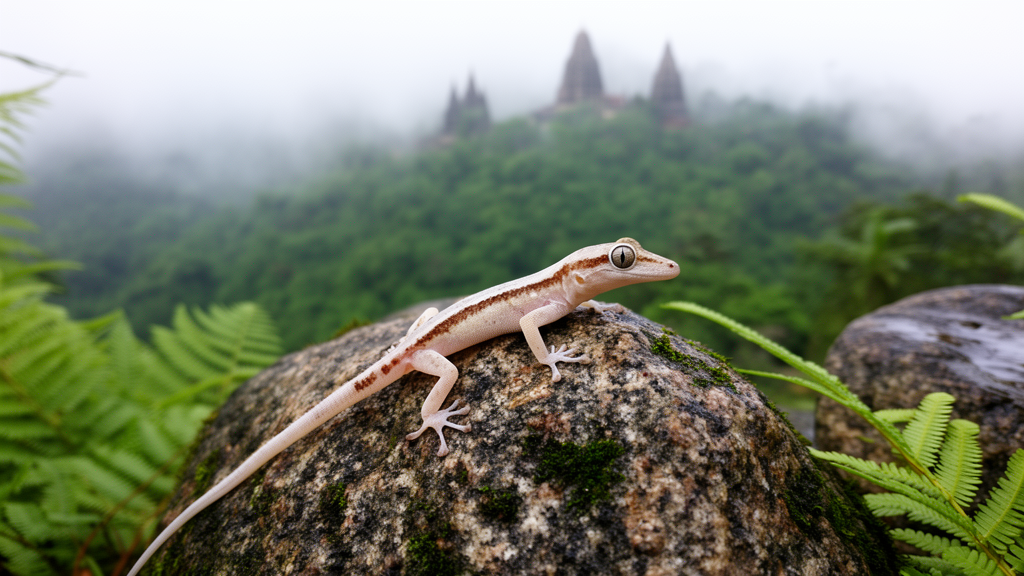
A taxonomic study has described Hemiphyllodactylus venkatadri sp. nov., a new species of gecko collected from Venkatadri Hill in the Tirumala Hill ranges of Andhra Pradesh, India. The study used five adults for morphological analysis, one unsexed juvenile as a referred specimen and mitochondrial DNA analysis to distinguish the species from other peninsular Indian members of the genus.
The six specimens were hand-collected at Venkatadri Hill, 13.7066°N, 79.3644°E and 881 m above sea level, in the Seshachalam Biosphere Reserve, Tirupati District. The series comprised four males, one female and one unsexed juvenile. Liver tissue from three individuals was preserved in molecular-grade ethanol at −20 °C for molecular analysis.
Adult snout–vent lengths in the type series ranged from 22.3 to 33.7 mm. Measurements were taken with digital calipers to the nearest 0.1 mm, while scale counts were recorded under a microscope. The examination covered body and head dimensions, scale counts, precloacal and femoral pores, subdigital lamellae and coloration recorded from photographs of living animals.
Diagnostic features included 12–16 chin scales, 9–12 supralabials, 9–12 infralabials, 16–18 dorsal scales and 9–16 ventral scales at mid-body. Males had six to eight precloacal pores separated by seven to ten poreless scales from series of five to seven femoral pores on each thigh. Both the manus and pes had a lamellar formula of 2-2-2-2, and the species lacked plate-like enlarged subcaudals. Its dorsal coloration was variable, with longitudinal paravertebral markings, irregular dark lines, light spots and dark-edged tail blotches; the belly was light and mottled with black.
For the genetic analysis, the researchers extracted genomic DNA from preserved liver tissue, amplified the complete mitochondrial NADH dehydrogenase subunit 2 gene and sequenced a 1,041-base-pair fragment. Bidirectional sequences were manually checked and aligned before being added to an existing dataset of named and unnamed Indian Hemiphyllodactylus species from the Eastern and Western Ghats. Maximum-likelihood analysis in IQ-TREE used codon-partitioned data and 10,000 bootstrap replicates, and uncorrected pairwise differences were calculated as p-distances.
The analysis recovered a well-supported monophyletic South Indian clade. Within that clade, H. venkatadri was strongly supported as a distinct lineage with a bootstrap value of 97. Its sister relationship to a group containing H. jnana, H. nilgiriensis, H. peninsularis and the undescribed H. sp. IN 5 from the Mysore Plateau had a bootstrap value of 88. The authors reported 9.9–11.7% uncorrected ND2 divergence from these closest peninsular Indian congeners.
Adult male FBRC-ZSI-17, collected on 16 December 2024, was designated as the holotype. Three additional males and one female were designated as paratypes: FBRC-ZSI-18, FBRC-ZSI-19, FBRC-ZSI-20 and ZSI-R-28870. The unsexed juvenile ZSI-R-28871 was listed as a referred specimen. Voucher material was deposited at the Freshwater Biology Regional Centre of the Zoological Survey of India in Hyderabad and the Reptilia section of the Zoological Survey of India in Kolkata. The proposed common English name is the Venkatadri slender gecko.
The holotype and paratypes were collected beneath the bark of Diospyros melanoxylon trees within a 30-meter radius, at heights of 1.5–3 m above the ground and during daytime hours from 1200 to 1620. The holotype came from a sandalwood plantation containing grassland surrounded by tropical dry deciduous forest, moist deciduous patches and scrubland. Other arboreal geckos recorded in the area included Hemidactylus cf. parvimaculatus, Hemidactylus rishivalleyensis and Cnemaspis avasabinae.
Hemiphyllodactylus venkatadri is currently known only from the high-elevation forests of Venkatadri Hill. Rapid surveys across other hill ranges within the Seshachalam Biosphere Reserve did not yield records of Hemiphyllodactylus during the study period, leaving the species’ wider distribution unresolved. The description is based on six collected individuals, including five adults assessed morphologically and a single known locality, so the present evidence cannot establish the species’ broader range or population size. The authors noted that further sampling is needed to resolve diversity within the H. aurantiacus species complex and to assess biodiversity in the Seshachalam Hills, which span elevations from 150 to 1,130 m and include tropical dry and mixed deciduous forests.
Subject of Research: Taxonomic description of a new Hemiphyllodactylus gecko from Venkatadri Hill, Andhra Pradesh
Article Title: A new species of Hemiphyllodactylus Bleeker, 1860 ( Squamata , Gekkonidae ) from Eastern Ghats, Andhra Pradesh, India
Article References: Bhupathi, B., Ray, S., Narayana, B. L., Karuthapandi, M., Jaiswal, D., Kar, N. B., & Mohapatra, P. P. (2025). A new species of Hemiphyllodactylus Bleeker, 1860 (Squamata, Gekkonidae) from Eastern Ghats, Andhra Pradesh, India. Herpetozoa, 38, 333-343. https://doi.org/10.3897/herpetozoa.38.e167113
Image Credits: AI Generated
DOI: 10.3897/herpetozoa.38.e167113
Keywords: Hemiphyllodactylus venkatadri, new gecko species, taxonomic description, Andhra Pradesh, Venkatadri Hill, Eastern Ghats, Seshachalam Biosphere Reserve, morphological analysis, mitochondrial ND2, phylogenetics, species, Hemiphyllodactylus
News Source: Drew Townsend. (October 20, 2026). Taxonomic study describes new gecko from a single Andhra Pradesh hill locality. Scienmag.