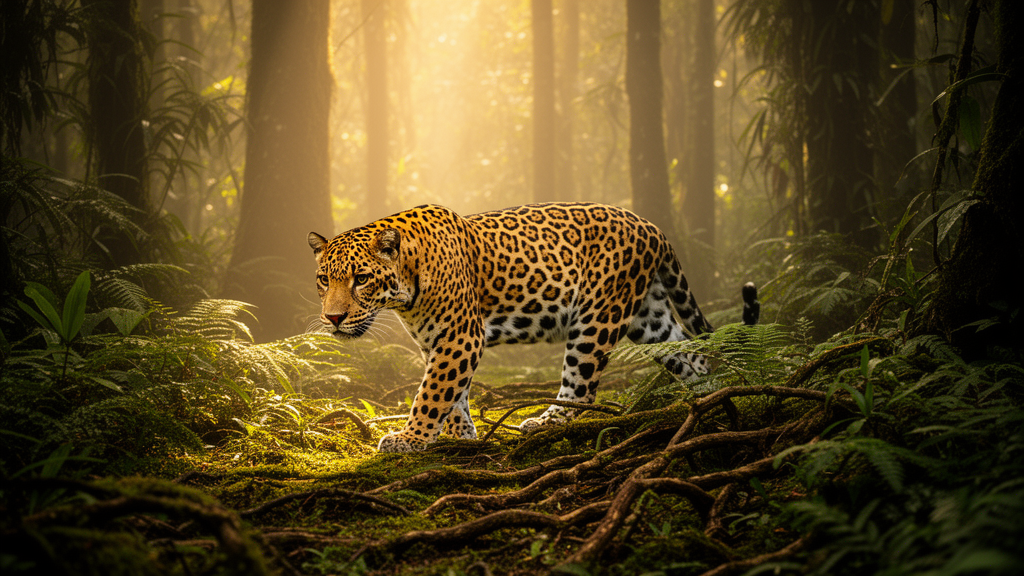
Camera traps documented a jaguar in two forests in northwestern Ecuador, with fur-pattern analysis indicating that the records came from the same individual. The animal was photographed in the Río Manduriacu Reserve on November 30, 2023, and in the Junín Community Forest on January 24 and February 11, 2024. The observations were reported as the first camera-trap records in those areas after periods of seven years in Manduriacu and at least 15 years in Junín, although limited monitoring means the earlier absence of jaguars cannot be established conclusively.
The records came from an observational camera-trap monitoring effort in the Tropical Andes Bioregion, about three hours from Quito. Universidad Central del Ecuador, Fundación Cóndor Andino and Fundación Ecominga conducted monitoring in Río Manduriacu, where 20 cameras were deployed for three months between October and December 2023 at elevations of 1,200 to 1,800 metres above sea level. The camera that captured the jaguar was positioned at 0°18′27.4″N, 78°51′49.0″W and recorded it at about 17:00 on November 30.
A parallel, smaller survey was supported by DECOIN, Ecoforensics and a local paraecologist monitoring group. Two cameras operated in the Junín Community Forest, within the Llurimagua mining concession at 1,200 to 1,500 metres, from January 4 to February 24, 2024. One camera recorded the jaguar at 0°18′43.5″N, 78°38′43.3″W at approximately 14:50 on January 24 and again at 21:30 on February 11. The researchers described these as Junín’s first camera-trap records in at least 15 years, while noting that the survey’s limited scope precluded determining the presence or absence of jaguars and other large mammals before February 2023. No jaguar sightings had been reported locally or by other sources for many years.
Comparison of the distinctive fur patterns in the Manduriacu and Junín images showed that the photographs depicted the same individual. The two sites are about 25 kilometres apart, and the dates span nearly two months, leading the researchers to infer that the jaguar travelled between them through forested and human-altered areas of the Cordillera del Toisán. Its origin, destination, reason for movement and exact route remain uncertain. A previous record in Manduriacu had been captured on August 5, 2016, while a jaguar was killed nearby in 2017; the authors cautioned that gaps in records may reflect insufficient or inconsistent monitoring rather than complete absence.
Evidence supplied by Fundación Ecominga and members of the Cielo Verde community indicated that a jaguar attacked livestock during the week before January 1, 2024. Investigators documented fur, a pawprint and patterns consistent with jaguar predation at the site. The attack occurred about eight kilometres from the later Manduriacu record, suggesting that the photographed individual may have been responsible. The researchers also identified another, less likely possibility: an undocumented jaguar could have made the attack, given the extensive territories jaguars may occupy. Near the Junín record, livestock were present close to the forest, but no cattle attacks were reported during the survey period.
Local authorities inspected the attack site, collected information and held two workshops in the Cielo Verde community. The Imbabura Prefecture’s Research Component for Conservation, supported by Cotacachi-Cayapas National Park, introduced deterrent measures based on olfactory signals for testing. The authorities also presented a project intended to develop field training schools, design farm models, install solar-powered electric fencing to exclude livestock from forests and provide livestock water troughs that could reduce encounters with jaguars. Community members expressed interest in applying the measures and participating in the project; no effectiveness results were reported.
The landscape around the records retained substantial forest, with vegetation cover estimated at about 90% within five kilometres of the Manduriacu record and nearly 100% within one kilometre of the Junín camera. Forest loss increased to the southeast and southwest at lower elevations, roughly three to five kilometres away. Continuous forest north of the Junín cameras potentially connects the survey area with Manduriacu and Cotacachi-Cayapas National Park, but further analysis is needed to establish biological corridors in this highly fragmented coastal Ecuadorian ecosystem. Mining, deforestation and land-use change remain major pressures.
Protected and community-managed forests form part of the regional conservation network. These include the Los Cedros and El Cebú registered protected forests, private and community reserves, the Socio Bosque program and the 1,269.68-square-kilometre Intag-Toisán Municipal Conservation and Sustainable Use Area. The latter directly connects with Cotacachi-Cayapas National Park, which covers 2,436.38 square kilometres. A court-ordered withdrawal of mining activity in Llurimagua in March 2023 preceded the Junín camera detections. The authors suggest that reduced mining pressure may have improved the chances of jaguars returning, but they also identify retaliatory killing as a potential risk associated with human-wildlife conflict.
Andean bears were also documented in both survey areas. Manduriacu cameras recorded one on October 23, 2023, at 1,791 metres, while Junín cameras photographed two individuals on June 24, 2023, and a third on July 3 and August 2, 2024. The region also supports pumas, margays, oncillas and ocelots. More than 100 endangered species occur in the Junín Community Forest, and more than 21 endangered amphibian and reptile species have been documented over the years at Río Manduriacu. Together, the observations show that these fragmented forests retain habitat for threatened large mammals, while the limited camera coverage, uncertain movement pathway and possible livestock predation constrain conclusions about population recovery and the jaguar’s precise movements.
Subject of Research: Camera-trap documentation of a jaguar crossing two forests in northwestern Ecuador
Article Title: Remarkable records of jaguars and Andean bears in northwestern Ecuador: Implications for human-wildlife conflicts
Article References: Torres-Jiménez, J., Seger, S. M., Acosta-López, C., Gavilánez, M. M., Kohn, S., Narváez, F., Laguna, A., Monteros, M., Ramírez-Piedra, H., Lucero-Toapanta, D., & Armas, C. (2024). Remarkable records of jaguars and Andean bears in northwestern Ecuador: Implications for human-wildlife conflicts. Neotropical Biology and Conservation, 19(4), 495-503. https://doi.org/10.3897/neotropical.19.e129163
Image Credits: AI Generated
DOI: 10.3897/neotropical.19.e129163
Keywords: jaguar, Andean bear, camera trapping, northwestern Ecuador, Tropical Andes, human-wildlife conflict, livestock predation, habitat fragmentation, mining pressure, wildlife monitoring, Remarkable, records
News Source: Margaret Porter. (October 20, 2026). Camera-trap report documents a critically endangered jaguar moving across northwestern Ecuador. Scienmag.