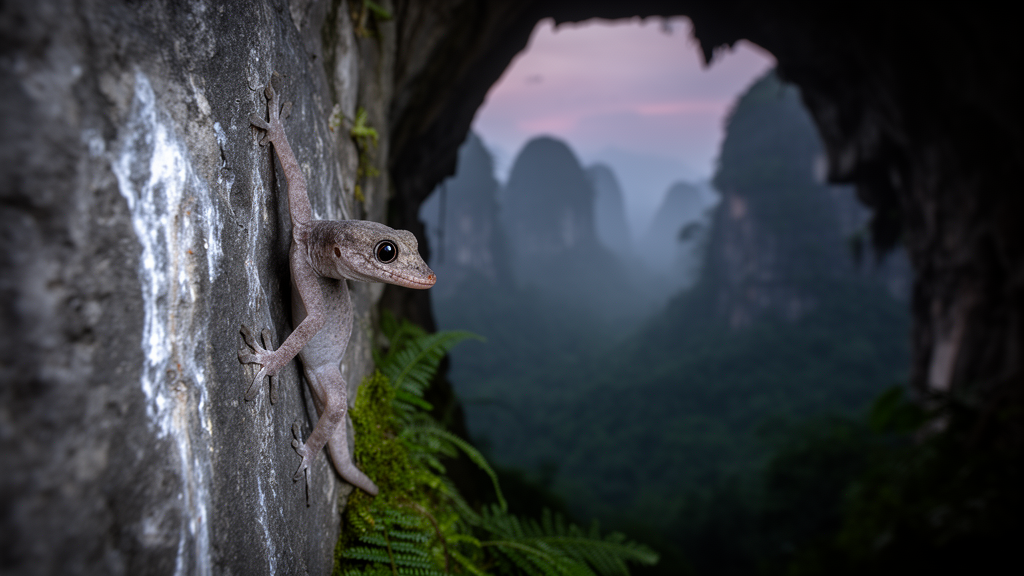
Researchers described a new species of karst-associated gecko, Gekko wuzhengjuni, after collecting three specimens in Yongfu County, Guilin City, Guangxi Zhuang Autonomous Region, China. The species was identified through a combination of mitochondrial DNA analysis, phylogenetic comparisons and examination of its external morphology, according to the study report.
The new gecko increases the recognized number of species in the subgenus Japonigekko in China to 23. Gekko is a widely distributed genus of nocturnal lizards with 94 currently recognized species, and Japonigekko is its most diverse subgenus within China. Guangxi is identified as the center of diversity for the subgenus, with eight species recognized before the description of G. wuzhengjuni.
The three specimens were collected in 2023 and 2025 at the type locality in Yongfu County. All were recorded at an elevation of 321 metres in areas with dense arboreal vegetation. The nocturnal geckos were frequently observed on limestone surfaces near roadside slopes and around limestone accumulations at cave entrances. The voucher specimens are held in the Herpetological Collection of Guangxi Normal University in Guilin.
For the molecular analysis, the researchers extracted genomic DNA from muscle tissue and sequenced fragments of the mitochondrial 16S rRNA and NADH dehydrogenase subunit 2, or ND2, genes. The resulting sequences were combined with 67 Gekko sequences retrieved from GenBank. Maximum-likelihood and Bayesian-inference trees based on a combined alignment of 1,023 base pairs produced similar topologies, with the GTR+I+G substitution model selected for both analyses.
All three Yongfu specimens formed a well-supported clade within Japonigekko, with a Bayesian posterior probability of 1.00 and maximum-likelihood bootstrap support of 100. The clade was sister to Gekko fengshanensis, with moderate support of 0.98 posterior probability and 77% bootstrap support. These two species together formed a strongly supported lineage that was sister to G. kwangsiensis.
Uncorrected sequence distances between the new species and other congeners ranged from 9.85% to 19.11% for 16S rRNA and from 14.62% to 32.84% for ND2. These distances were larger than the reported uncorrected distances between two recognized species, G. adleri and G. palmatus, which were 2.72% for 16S and 6.84% for ND2. The comparison provides molecular context for the observed divergence but does not establish a universal genetic threshold for delimiting species across the genus.
Morphological analysis showed that most measurements did not differ significantly between the new species and G. fengshanensis in a one-way analysis of variance, although axilla-groin length, head length, head width and snout length had marginal differences with p-values between 0.05 and 0.10. In principal component analysis, the first two components accounted for 60.4% of total variance, and the Yongfu samples partly overlapped with G. kwangsiensis while retaining a distinct clustering pattern. Multiple factor analysis placed the Yongfu specimens in a separate cluster without overlap with the two comparison species.
The species is distinguishable by a combination of traits, including nares contacting the rostral scale, an absent internasal scale, two enlarged postmental scales, and enlarged tubercles extending from behind the eyes to the base of the tail in eight or nine rows at midbody. It has 140–143 midbody scale rows, 10 continuous precloacal pores in males and none in females, and one postcloacal tubercle on each side. The adult male holotype has a snout–vent length of 72.7 mm. In life, the gecko is light reddish-brown with white markings, dark transverse bars and a yellow-green iris.
The description is based on only three specimens, including two adults and one juvenile from a single locality, and the morphological statistical comparisons involved small samples. The new species is currently known only from Yongfu County, so the study does not establish its broader distribution, abundance or population trends. Adding G. wuzhengjuni brings the number of Chinese Japonigekko species associated with karst environments to six, including five previously identified species. Molecular analyses placed the new species with G. fengshanensis, G. kwangsiensis, G. liboensis and G. paucituberculatus in a monophyletic group, except that G. adleri was not included in that grouping.
Subject of Research: Description and delimitation of a new karst-associated Gekko species from Guangxi, China
Article Title: A new species of karst-adapted gecko ( Squamata , Gekkonidae , Gekko ) from Guangxi, China
Article References: Yu, J.-Y., Chen, H.-L., Li, Y.-B., Li, Y.-H., & Chen, Z.-N. (2026). A new species of karst-adapted gecko (Squamata, Gekkonidae, Gekko) from Guangxi, China. Zoosystematics and Evolution, 102(2), 719-729. https://doi.org/10.3897/zse.102.185568
Image Credits: AI Generated
Keywords: Gekko wuzhengjuni, new gecko species, karst biodiversity, Guangxi China, mitochondrial phylogeny, species delimitation, morphological analysis, South China Karst, species, karst-adapted, gecko, Squamata
News Source: Gavin Prescott. (October 20, 2026). Mitochondrial and morphological evidence distinguishes new karst gecko species in Guangxi. Scienmag.