Researchers have formally described a new blind snake, Indotyphlops gyirongensis, from a single specimen collected in Gyirong County, Xizang, China, on the Qinghai-Xizang Plateau. The study combined molecular phylogenetic analysis with detailed morphological comparisons to distinguish the animal from known members of the genus.
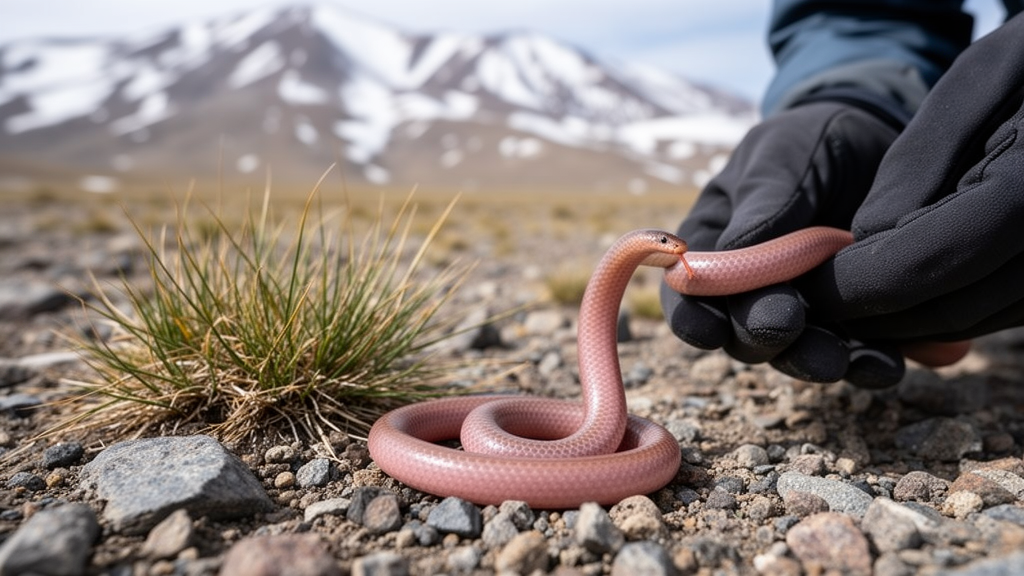
The adult female holotype, catalogued as YBU 251031, was collected in Gyirong Town near the China-Nepal border in August 2025 at an elevation of 2,262 m. The specimen was found beneath a stone at the edge of a roadside forest. It measured 265 mm in total length, with a tail length of 7.5 mm and a midbody diameter of 3.5 mm.
For the molecular analysis, the researchers extracted genomic DNA from liver tissue preserved in 90% ethanol. Partial fragments of the mitochondrial cytochrome b and cytochrome c oxidase subunit 1 genes were amplified and sequenced. The resulting sequences were aligned with ClustalW, visually inspected, and checked for unexpected stop codons before being incorporated into a dataset covering 97 species and 10 genes, including four mitochondrial and six nuclear genes.
Bayesian inference produced a tree nearly identical to the earlier phylogeny of Pyron and Wallach. The Gyirong specimen was placed within the Indotyphlops clade and formed a well-supported monophyletic lineage with its congeners, with a posterior probability of 0.97. Within the genus, it was recovered as the sister taxon to I. albiceps with strong support, measured by a posterior probability of 0.95.
The genetic separation was substantial. The uncorrected mitochondrial p-distance between the new specimen and the closest congener with publicly available cytochrome b sequences exceeded 24%. For the cytochrome c oxidase subunit 1 gene, the distance reached 18.3% relative to I. braminus. The two newly generated sequences were submitted to GenBank as PZ862014 and PZ339874.
Morphological examination placed the specimen in Indotyphlops on the basis of its total length, body scales, and middorsal scale counts. It had 18 rows of smooth, glossy dorsal scales, 432 middorsal scales, 17 subcaudals, two infralabials and no terminal tail spine. Its most distinctive feature was a light cream-colored head cap, together with a T-V supralabial imbrication pattern in which the second and third supralabials overlap the shields above them. The T-III pattern is the dominant state within Typhlopoidea, making the T-V arrangement an uncommon diagnostic character among Indotyphlops.
The description compared the specimen with a set of related congeners using scale counts, body measurements, sutures, coloration and the arrangement of head shields. It differed from I. albiceps in its supralabial pattern and number of scale rows; from I. braminus in the same characters, nasal sutures, inferior nasal suture contact and head-cap coloration; and from I. combank in scale rows, body size, body proportions, postocular count, nasal sutures and coloration. The authors also provided distinctions from I. exiguus, I. jerdoni, I. laca, I. lankaensis, I. lazelli, I. leucomelas, I. longissimus, I. loveridgei, I. malcolmi, I. meszoelyi, I. pammeces, I. porrectus, I. schmutzi, I. tenebrarum, I. tenuicollis, I. veddae and I. violaceus. The detailed comparison did not cover every species recognized in the genus.
Taxonomically, the study named the species Indotyphlops gyirongensis, with the epithet referring to the type locality of Gyirong Town. The authors proposed the English common name “Gyirong blind snake” and the Chinese name “吉隆盲蛇” (Jílóng Mángshé). The holotype and tissue sample were deposited at Yibin University in China. The description identifies the animal as the third blind snake species reported from the Qinghai-Xizang Plateau and the first blind snake record from the Xizang Autonomous Region, while adding a new species to the Chinese herpetofauna.
Because the description is based on one specimen, the species’ geographic range and population size remain uncertain. The collection site lies in evergreen broad-leaved forest with deep humus and a thick leaf-litter layer, where sympatric herpetofauna included Protobothrops himalayanus, Orthriophis hodgsoni, Ablepharus mahabharatus and Bufo himalayanus. Its occurrence near the China-Nepal border suggests that it may also occur in Nepal, but the authors state that this remains to be confirmed by field investigation. The broader limitation is the sparse genetic and specimen data available for blind snakes, which the researchers say constrain understanding of their systematics and evolutionary relationships.
Subject of Research: Description and molecular identification of a new blind snake species from China’s Qinghai-Xizang Plateau
Article Title: A new species of blind snake, Indotyphlops ( Serpentes , Typhlopidae ), from the Qinghai-Xizang Plateau, China
Article References: Lyu, B., Tan, S., Zhao, Z., Wallach, V., Liu, Q., & Guo, P. (2026). A new species of blind snake, Indotyphlops (Serpentes, Typhlopidae), from the Qinghai-Xizang Plateau, China. ZooKeys, 1292, 261-273. https://doi.org/10.3897/zookeys.1292.197322
Image Credits: AI Generated
DOI: 10.3897/zookeys.1292.197322
Keywords: Indotyphlops gyirongensis, blind snake, Qinghai-Xizang Plateau, Xizang, China-Nepal border, molecular phylogeny, morphology, taxonomy, Typhlopidae, biodiversity, species, blind
News Source: Margaret Porter. (October 20, 2026). New blind snake species identified from the Qinghai-Xizang Plateau. Scienmag.