Where tectonic plates meet, a change in angle
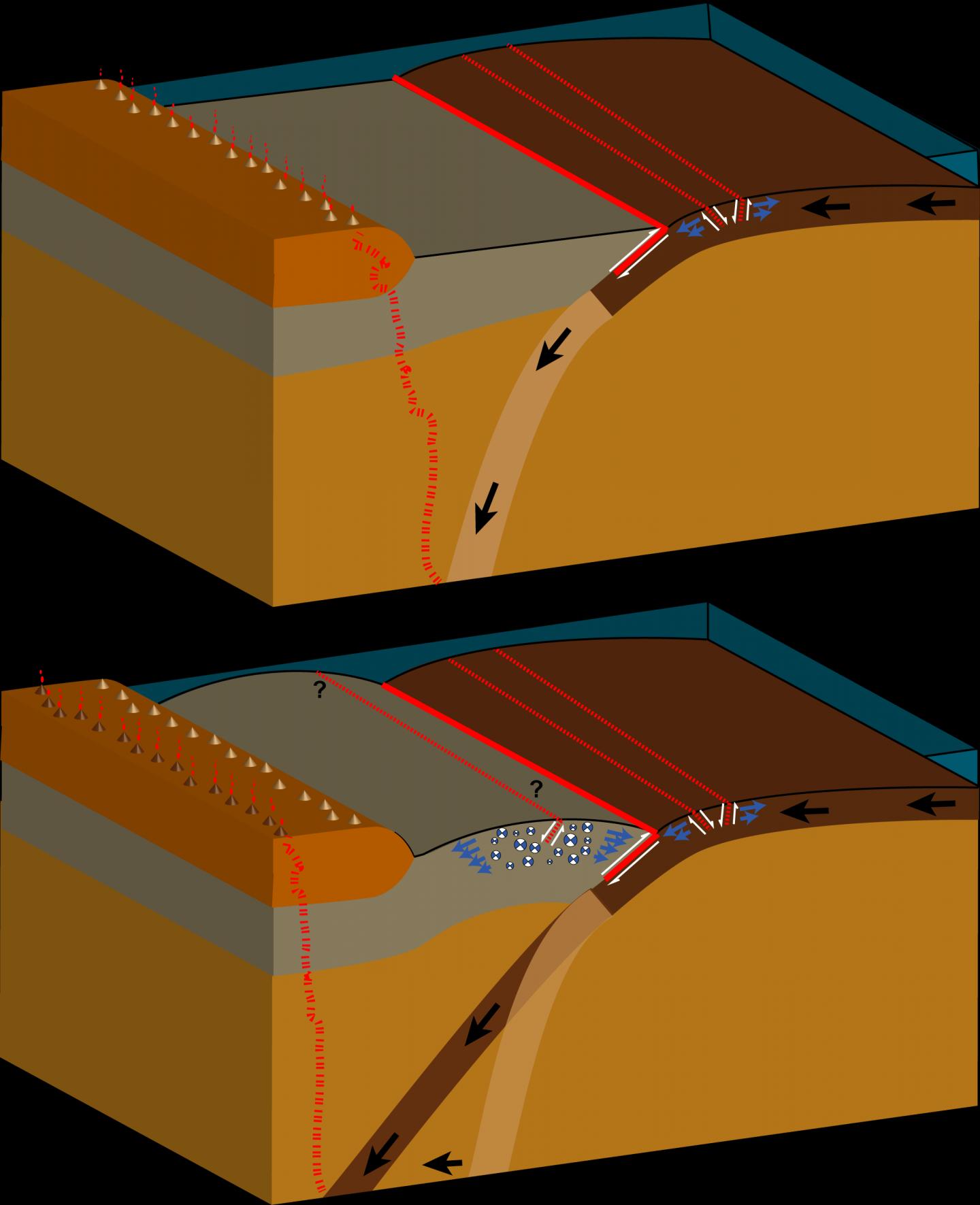
Credit: Adapted from Oryan and Buck, Nature Geoscience 2020
On March 11, 2011, a magnitude 9 earthquake struck under the seabed off Japan–the most powerful quake to hit the country in modern times, and the fourth most powerful in the world since modern record keeping began. It generated a series of tsunami waves that reached an extraordinary 125 to 130 feet high in places. The waves devastated much of Japan’s populous coastline, caused three nuclear reactors to melt down, and killed close to 20,000 people.
The tsunami’s obvious cause: the quake occurred in a subduction zone, where the tectonic plate underlying the Pacific Ocean was trying to slide under the adjoining continental plate holding up Japan and other landmasses. The plates had been largely stuck against each other for centuries, and pressure built up. Finally, something gave. Hundreds of square miles of seafloor suddenly lurched horizontally some 160 feet, and thrust upward by up to 33 feet. Scientists call this a megathrust. Like a hand waved vigorously underwater in a bathtub, the lurch propagated to the sea surface and translated into waves. As they approached shallow coastal waters, their energy concentrated, and they grew in height. The rest is history.
But scientists soon realized that something did not add up. Tsunami sizes tend to mirror earthquake magnitudes on a predictable scale; This one produced waves three or four times bigger than expected. Just months later, Japanese scientists identified another, highly unusual fault some 30 miles closer to shore that seemed to have moved in tandem with the megathrust. This fault, they reasoned, could have magnified the tsunami. But exactly how it came to develop there, they could not say. Now, a new study in the journal Nature Geoscience gives an answer, and possible insight into other areas at risk of outsize tsunamis.
The study’s authors, based at Columbia University’s Lamont-Doherty Earth Observatory, examined a wide variety of data collected by other researchers before the quake and after. This included seafloor topographic maps, sediments from underwater boreholes, and records of seismic shocks apart from the megathrust.
The unusual fault in question is a so-called extensional fault–one in which the earth’s crust is pulled apart rather than being pushed together. Following the megathrust, the area around the extensional fault moved some 200 feet seaward, and a series of scarps 10 to 15 feet high could be seen there, indicating a sudden, powerful break. The area around the extensional fault was also warmer than the surrounding seabed, indicating friction from a very recent movement; that suggested the extensional fault had been jolted loose when the megathrust struck. This in turn would have added to the tsunami’s power.
Extensional faults are in fact common around subduction zones–but only in oceanic plates, not the overriding continental ones, where this one was found. How did it get there? And, might such dangerous features lurk in other parts of the world?
The authors of the new paper believe the answer is the angle at which the ocean plate dives under the continental; they say it has been gradually shallowing out over millions of years. “Most people would say it was the megathrust that caused the tsunami, but we and some others are saying there may have been something else at work on top of that,” said Lamont PhD. student Bar Oryan, the paper’s lead author. “What’s new here is we explain the mechanism of how the fault developed.”
The researchers say that long ago, the oceanic plate was moving down at a steeper angle, and could drop fairly easily, without disturbing the seafloor on the overriding continental plate. Any extensional faulting was probably confined to the oceanic plate behind the trench–the zone where the two plates meet. Then, starting maybe 4 million or 5 million years ago, it appears that angle of subduction began declining. As a result, the oceanic plate began exerting pressure on sediments atop the continental plate. This pushed the sediments into a huge, subtle hump between the trench and Japan’s shoreline. Once the hump got big and compressed enough, it was bound to break, and that was probably what happened when the megathrust quake shook things loose. The researchers used computer models to show how long-term changes in the dip of the plate could produce major changes in the short-term deformation during an earthquake.
There are multiple lines of evidence. For one, material taken from boreholes before the quake show that sediments had been squeezed upward about midway between the land and the trench, while those closer to both the land and the trench had been subsiding–similar to what might happen if one laid a piece of paper flat on a table and then slowly pushed in on it from opposite sides. Also, recordings of aftershocks in the six months after the big quake showed scores of extensional-fault-type earthquakes carpeting the seabed over the continental plate. This suggests that the big extensional fault is only the most obvious one; strain was being released everywhere in smaller, similar quakes in surrounding areas, as the hump relaxed.
Furthermore, on land, Japan hosts numerous volcanoes arranged in a neat north-south arc. These are fueled by magma generated 50 or 60 miles down, at the interface between the subducting slab and the continental plate. Over the same 4 million to 5 million years, this arc has been migrating westward, away from the trench. Since magma generation tends to take place at a fairly constant depth, this adds to the evidence that the angle of subduction has gradually been growing shallower, pushing the magma-generating zone further inland.
Lamont geophysicist and coauthor Roger Buck said that the study and the earlier ones it builds on have global implications. “If we can go and find out if the subduction angle is moving up or down, and see if sediments are undergoing this same kind of deformation, we might be better able to say where this kind of risk exists,” he said. Candidates for such investigation would include areas off Nicaragua, Alaska, Java and others in the earthquake zones of the Pacific Ring of Fire. “These are areas that matter to millions of people,” he said.
###
Scientist contacts:
Bar Oryan [email protected]
Roger Buck [email protected]
More information: Kevin Krajick, Senior editor, science news, The Earth Institute
[email protected] 212-854-9729
Lamont-Doherty Earth Observatory is Columbia University’s home for Earth science research. Its scientists develop fundamental knowledge about the origin, evolution and future of the natural world, from the planet’s deepest interior to the outer reaches of its atmosphere, on every continent and in every ocean, providing a rational basis for the difficult choices facing humanity. http://www.
The Earth Institute, Columbia University mobilizes the sciences, education and public policy to achieve a sustainable earth. http://www.
Media Contact
Kevin Krajick
[email protected]
212-854-9729