• HOME
  • NEWS
  • EXPLORE
    • CAREER
      • Companies
      • Jobs
    • EVENTS
    • iGEM
      • News
      • Team
    • PHOTOS
    • VIDEO
    • WIKI
  • BLOG
  • COMMUNITY
    • FACEBOOK
    • INSTAGRAM
    • TWITTER
Monday, May 11, 2026
BIOENGINEER.ORG
No Result
View All Result
  • Login
  • HOME
  • NEWS
  • EXPLORE
    • CAREER
      • Companies
      • Jobs
        • Lecturer
        • PhD Studentship
        • Postdoc
        • Research Assistant
    • EVENTS
    • iGEM
      • News
      • Team
    • PHOTOS
    • VIDEO
    • WIKI
  • BLOG
  • COMMUNITY
    • FACEBOOK
    • INSTAGRAM
    • TWITTER
  • HOME
  • NEWS
  • EXPLORE
    • CAREER
      • Companies
      • Jobs
        • Lecturer
        • PhD Studentship
        • Postdoc
        • Research Assistant
    • EVENTS
    • iGEM
      • News
      • Team
    • PHOTOS
    • VIDEO
    • WIKI
  • BLOG
  • COMMUNITY
    • FACEBOOK
    • INSTAGRAM
    • TWITTER
No Result
View All Result
Bioengineer.org
No Result
View All Result
Home NEWS Science News

Shaping waveforms

Bioengineer by Bioengineer
February 13, 2020
in Science News
Reading Time: 2 mins read
0
IMAGE
Share on FacebookShare on TwitterShare on LinkedinShare on RedditShare on Telegram

IMAGE

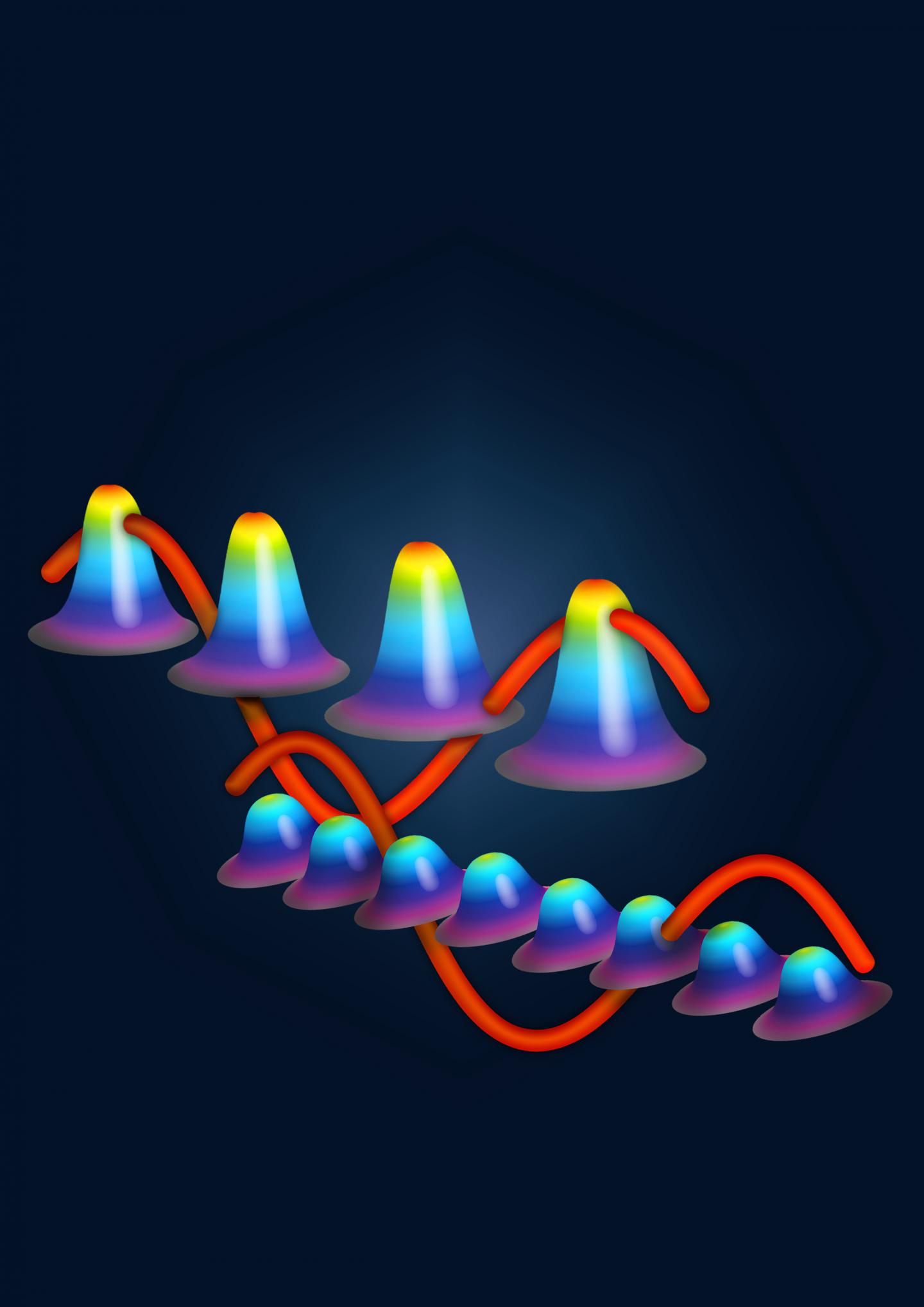
Credit: Illustration: Jürgen Oschwald and Carlo Callegari


Chemical reactions are determined at their most fundamental level by their respective electronic structure and dynamics. Steered by a stimulus such as light irradiation, electrons rearrange themselves in liquids or solids. This process takes only a few hundred attoseconds, whereby one attosecond is the billionth part of a billionth of a second. Electrons are sensitive to external fields, so researchers can easily control them by irradiating the electrons with light pulses. As soon as they thus temporally shape the electric field of an attosecond pulse, researchers can control the electronic dynamics in real time. A team led by Prof. Dr. Giuseppe Sansone from the Institute of Physics at the University of Freiburg shows in the scientific journal Nature how they were able to completely shape the waveform of an attosecond pulse.

“These pulses enable us to study the first moment of the electronic response in a molecule or crystal,” explains Sansone. “With the ability to shape the electric field enables us to control electronic movements – with the long-term goal of optimising basic processes such as photosynthesis or charge separation in materials.” The team, consisting of theoreticians and experimental physicists from research institutes in the USA, Russia, Germany, Italy, Austria, Slovenia, Hungary, Japan and Sweden, carried out their experiment at the Free-Electron Laser (FEL) FERMI in Trieste/Italy. This laser is the only one which offers the unique capability to synthesize radiation with different wavelengths in the extreme ultraviolet spectral range with fully controllable relative phases.

The attosecond pulse results from the temporal overlap of laser harmonics. The scientists generated groups of four laser harmonics of a fundamental wavelength using the undulators available at FERMI. These are technical devices, which steer the motion of a relativistic electron bunch, thus leading to the production of ultraviolet radiation. One of the main challenges of the experiment was the measurement of these relative phases, which were characterized by acquiring the photoelectrons released from neon atoms by the combination of the attosecond pulses and an infrared field. This leads to additional structures in the electron spectra, usually referred to as sidebands. The scientists measured the correlation between the different sidebands generated for each laser shot. This finally enabled them to fully characterize the attosecond pulse train.

“Our results indicate not only that FELs can produce attosecond pulses”, says Sansone, “but, due to the approach implemented for the waveform generation, such pulses are fully controllable and attain high peak intensities. These two aspects represent key advantages of our approach. The results will also influence the planning and design of new Free-Electron Lasers worldwide.”

###

Original publication:

Maroju, P.K. et al., Sansone, G. (2020): Attosecond pulse shaping using a seeded free-electron Laser. In: Nature. DOI: 10.1038/s41586-020-2005-6

Contact:

Institute of Physics

University of Freiburg

Media Contact
Dr. Giuseppe Sansone
[email protected]
49-761-203-5738

Related Journal Article

http://dx.doi.org/10.1038/s41586-020-2005-6

Tags: Chemistry/Physics/Materials SciencesElectromagneticsIndustrial Engineering/Chemistry
Share13Tweet8Share2ShareShareShare2

Related Posts

Humans and Zebra Finches Share Similar Speech Learning Techniques #ASA190 — Chemistry

Humans and Zebra Finches Share Similar Speech Learning Techniques #ASA190

May 11, 2026
New Study Uncovers How Fungal Parasites Attack Strawberries and Raspberries — Agriculture

New Study Uncovers How Fungal Parasites Attack Strawberries and Raspberries

May 11, 2026

City of Hope Researchers to Present Groundbreaking Immunotherapy and Precision Medicine Advances Across Multiple Cancer Types at ASCO 2026

May 11, 2026

Medicaid Expansion Reduces Mortality in Young Adults with Kidney Failure

May 11, 2026
Please login to join discussion

POPULAR NEWS

  • Research Indicates Potential Connection Between Prenatal Medication Exposure and Elevated Autism Risk

    841 shares
    Share 336 Tweet 210
  • New Study Reveals Plants Can Detect the Sound of Rain

    728 shares
    Share 290 Tweet 182
  • Salmonella Haem Blocks Macrophages, Boosts Infection

    62 shares
    Share 25 Tweet 16
  • Breastmilk Balances E. coli and Beneficial Bacteria in Infant Gut Microbiomes

    57 shares
    Share 23 Tweet 14

About

We bring you the latest biotechnology news from best research centers and universities around the world. Check our website.

Follow us

Recent News

Humans and Zebra Finches Share Similar Speech Learning Techniques #ASA190

New Study Uncovers How Fungal Parasites Attack Strawberries and Raspberries

City of Hope Researchers to Present Groundbreaking Immunotherapy and Precision Medicine Advances Across Multiple Cancer Types at ASCO 2026

Subscribe to Blog via Email

Enter your email address to subscribe to this blog and receive notifications of new posts by email.

Join 82 other subscribers
  • Contact Us

Bioengineer.org © Copyright 2023 All Rights Reserved.

Welcome Back!

Login to your account below

Forgotten Password?

Retrieve your password

Please enter your username or email address to reset your password.

Log In
No Result
View All Result
  • Homepages
    • Home Page 1
    • Home Page 2
  • News
  • National
  • Business
  • Health
  • Lifestyle
  • Science

Bioengineer.org © Copyright 2023 All Rights Reserved.