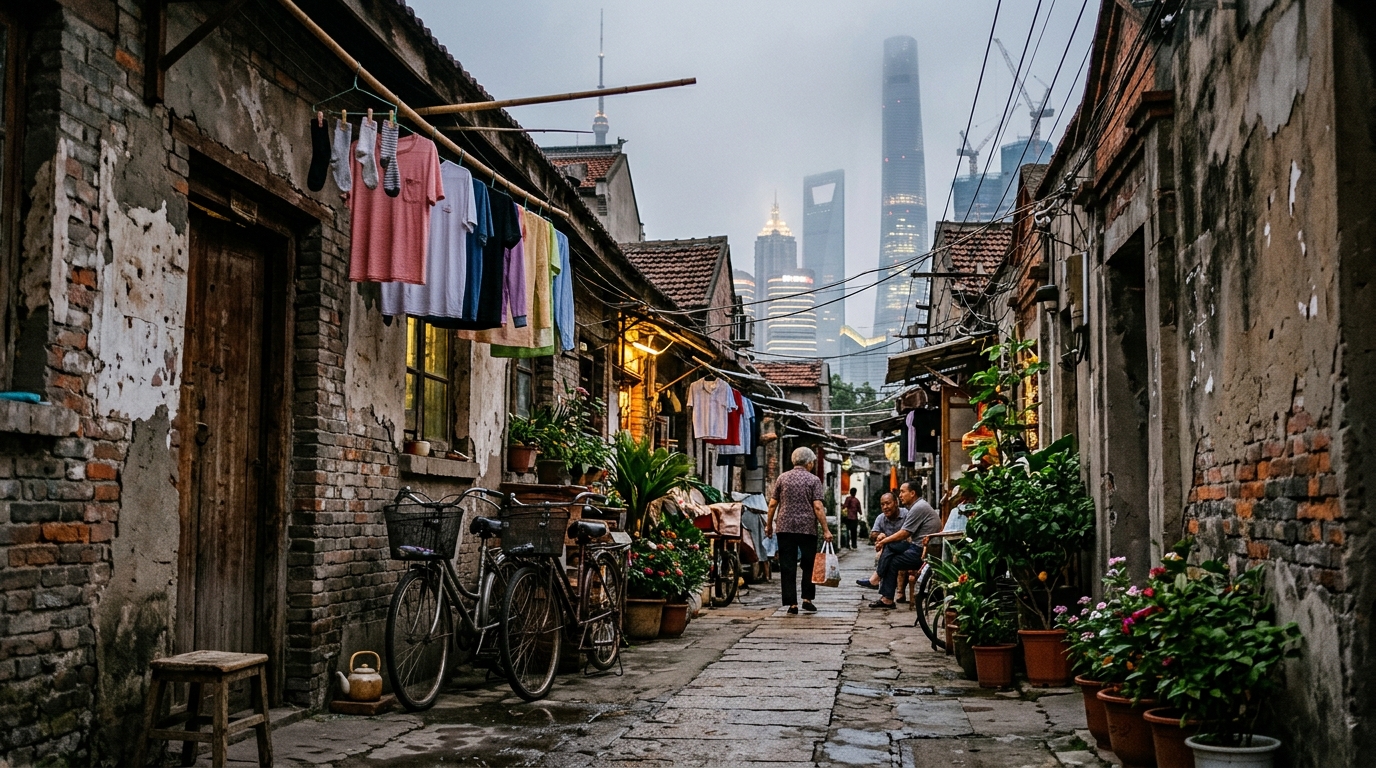
In the narrow lanes and courtyards of two Shanghai urban villages, the spaces where migrant workers once gathered are quietly disappearing. A three-year qualitative study of Hualong Xinyuan Xiaoqu in the Xuhui district and Guquanlu in Pudong documents how government-led community upgrades, framed as improvements to communal life, have instead accelerated the collapse of socialisation among migrant residents. The research, published in the journal City, Territory and Architecture, argues that this paradox—residents clinging to the promise of better communities even as the conditions for community life are dismantled—fits Lauren Berlant’s theory of cruel optimism.
Urban villages, known in China as Chengzhongcun, are semi-informal settlements that emerged when villages were engulfed by expanding urban tissue. Housing construction and communal spatial organisation in these areas occurred largely outside governmental planning frameworks, yet the settlements provide residents with essential social services and economic opportunities. They have become critical housing for low-income migrants: in 2021, Shanghai’s population reached 24.87 million, of whom 10.47 million were migrants constituting 42.1 percent of the total, with half belonging to the low-income demographic. Nationwide, China’s internal migration comprised 281 million people as of 2020. These low-income inhabitants live in urban villages, shanty towns, factory dormitories and migrant apartments because of affordable accommodation and economic opportunity, despite inadequate infrastructure, social segregation and environmental degradation.
The study’s author, Goran Ivo Marinovic, employed critical participatory action research, combining systematic field observation, semi-structured interviews, questionnaires and informal conversations with community leaders. Fieldwork spanned more than three years, from initial interviews in June 2021 to final questionnaires in March 2024, conducted weekly with four research assistants who provided English translations of Chinese responses. Observation sessions ranged from 45 minutes to 4 hours, using a semi-open observation grid to record spatial characteristics and communal practices. The team interviewed 29 migrant families: 16 from central China residing in Hualong Xinyuan Xiaoqu and 13 from western Chinese provinces living in Guquanlu. All respondents had lived in their communities for more than 10 years, and all participants were over 40 years old. Seventy-four percent of interviewed participants were married and 22 percent separated.
The two neighbourhoods were selected because they represent different stages of redevelopment. Hualong Xinyuan Xiaoqu, constructed in 1994 on a 10,200-square-metre site in Xuhui, is in a post-demolition phase: rapid urban development demolished most of the original village, preserving only a small territory for low-income villagers and their migrant tenants. It contains 84 households in row houses ranging from 19.5 to 58.5 square metres, with 41 percent of the surface area dedicated to public space. Guquanlu, known locally as Nanxin Village, sits on Guquan Road in Pudong and represents a pre-demolition stage; residents had been notified of scheduled demolition in March 2024, a notification received after data collection and during discussion of findings with respondents. The site spans 18,210 square metres with 100 housing units, and 30 percent of its ground area is allocated to third places around the Chuanyang River and between buildings.
The analytical focus falls on what sociologist Ray Oldenburg called third places—public spaces for informal social interaction outside home and workplace. The study concentrated on community clubs, volunteer associations, places of worship, outdoor gyms, and spaces for calligraphy, music and dance operating in public areas of the villages. Both case studies are physically separated from the surrounding city by water, boulevards, buffer zones and brick walls, and both communities are gated and concealed from street view, so residents expressed feelings of isolation and marginalisation from the broader city. Respondents consistently emphasised the importance of these internal third places for socialisation and activities that remain inaccessible outside their community boundaries.
Mapping pedestrian traffic revealed a measurable restructuring of movement. The researchers categorised spatial flows as locomotion—unidirectional movements along frequent destinations—or punctuation, multidirectional movements linking streets, courtyards and cul-de-sacs that traditionally functioned as sites of informal encounter. In Hualong Xinyuan Xiaoqu, locomotion trajectories concentrate along unidirectional street axes connecting three community entrances, with six narrow courtyards between row houses facilitating diminished punctuation flows. Guquanlu features a multidirectional locomotion axis connecting seven courtyards with fragmented punctuation flows towards three to four destinations. The temporal data demonstrates how urban upgrading creates necessary corridors while systematically eliminating spaces for social activities, prioritising circulation over congregation.
The questionnaire results quantify the withdrawal. Eighty-one percent of Hualong Xinyuan Xiaoqu respondents and 76 percent of Guquanlu respondents prefer online purchasing instead of participating in activities at commercial places to which they remain emotionally attached. Three-quarters of Hualong Xinyuan Xiaoqu respondents and a significant majority of Guquanlu migrants demonstrated decreased third-place utilisation as upgrading processes undermine the spatial foundations of community life. Yet only 24 percent of Hualong Xinyuan Xiaoqu respondents and 11 percent of Guquanlu respondents openly expressed pessimism regarding resettlement. Clear generational differences emerged: residents over forty and children under ten actively use these spaces to forge social bonds, while residents under forty show decreased engagement due to dissatisfaction with governmental neglect and eventual demolition.
Interviews capture the defensive logic behind this retreat. One Guquanlu respondent described nearby shops as transitory: “I often visit two nearby shops for daily grocery shopping […] these places are transitory, and I do not socialise there.” A family head in Hualong Xinyuan Xiaoqu explained that improvised alterations of third places are tolerated by authorities only until demolition: “They only care about clean-cut and convince us to believe in the promise of a fresh start without continuation of current ways of living.” Another respondent stated: “I don’t like to participate in social gatherings since soon we will have a newly designed neighbourhood where we will be happy and free from communal bonds.” The study interprets this optimism as a defensive response to fraying social bonds under continuous development pressure—migrants pre-emptively disinvest from relationships they anticipate losing, creating a self-fulfilling prophecy that accelerates the social dissolution they seek to avoid.
The physical evidence of upgrading is concrete. Inhabitants reported that beautification of communal places sponsored by authorities increased social tension by pushing communal activities away from public view. Remnants of agricultural land between dwellings, previously used by households for food production, were transformed into grass fields or covered with concrete surfaces. Despite sixteen-hour workdays in factories or service institutions, migrant workers attempt to maintain connections through gambling gatherings, spiritual rituals and recreational activities, yet these practices increasingly occur in spaces marked for demolition. Efforts to preserve third places through gardening, placing furniture and maintaining public places function as individual coping strategies that cannot address the structural reduction of space available for collective social reproduction.
The study’s broader argument is that the observed decline in communal interaction inadvertently legitimises governmental urban renewal initiatives, perpetuating cycles of marginalisation. The tension between declining third-place utilisation and unrealistic housing aspirations produces what the author calls a cruel disintegration of migrants’ self-organisation, with most residents acquiescing to existing planning regulations through social withdrawal rather than collective resistance. The author notes limitations: the paper excludes migrant socialisation in other Chinese coastal metropolitan areas, does not explore the further fragmentation of public places into fourth and fifth spaces, and does not examine events before, during and following the destruction of urban villages. Future research, the paper suggests, should examine the impact of these processes on migrants’ temporal adjustments, mental health, self-care and self-esteem.
Subject of Research: Decline of third-place socialisation among migrant residents of two Shanghai urban villages undergoing government-led redevelopment.
Article Title: Cruel optimistic community upgrades: collapsing socialisation in two Shanghainese urban villages
Article References: Marinovic, G. I. (2026). Cruel optimistic community upgrades: collapsing socialisation in two Shanghainese urban villages. City, Territory and Architecture, 13(1), Article 25. https://doi.org/10.1186/s40410-026-00315-w
Image Credits: AI Generated
DOI: 10.1186/s40410-026-00315-w
Keywords: Shanghai, urban villages, third places, migrant workers, cruel optimism, urban redevelopment, socialisation, Berlant, qualitative study, China urbanisation, community upgrading, displacement
News Source: Denise Maddox. (November 5, 2026). Shanghai urban village upgrades promise community renewal while eroding migrant social life. Scienmag.