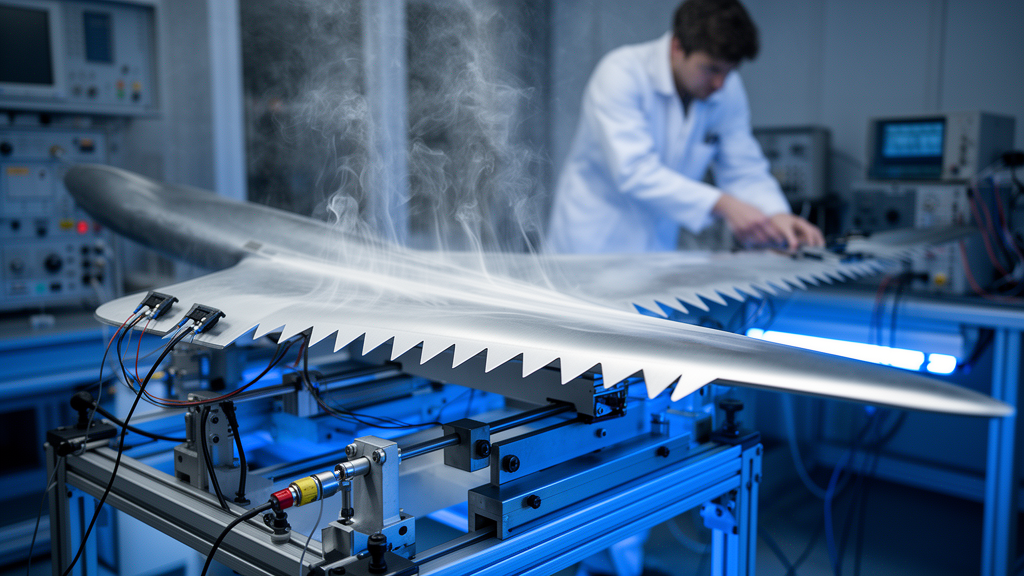
A new comparative analysis published in Aerospace Systems puts that idea to a rigorous test, combining wind tunnel experiments, computational fluid dynamics (CFD) simulations and an artificial neural network to evaluate serrated and non-serrated versions of two classic wing profiles, the NACA 0012 and NACA 0015 airfoils. The study measured three key quantities across different freestream velocities: the lift coefficient, the maximum lift coefficient and the stall angle at which lift collapses. The central finding is a trade-off.
Serrations consistently reduced the lift coefficient for both airfoil families, but the penalty was not uniform. The NACA 0015 airfoil, the thicker of the two profiles, suffered lift reductions of up to 20 percent, while the thinner NACA 0012 lost up to 14 percent. Stall behavior, however, told a more nuanced story.
On the NACA 0012 airfoil, serrations raised the stall angle by up to three degrees, suggesting the wing could keep generating useful lift at higher angles of attack before flow separation set in. The NACA 0015 responded in the opposite direction: serrations decreased its stall angle, meaning stall arrived earlier. The same airfoil modification therefore improved stall characteristics on one profile and worsened them on another.
The maximum lift coefficient showed a similarly split outcome. Serrations increased Clmax by up to 11 percent on the NACA 0012, a genuine gain in peak lifting capability. On the NACA 0015, Clmax dropped significantly, by as much as 20 percent.
The maximum lift-to-drag ratio decreased for both airfoils when serrations were incorporated, indicating that whatever lift benefits appeared came at the cost of aerodynamic efficiency. Taken together, the results suggest serrations did not significantly increase the overall lift coefficient, but they did contribute to a higher stall angle as airspeed increased, at least for the NACA 0012. The authors argue these findings carry significant implications for the design and utilization of serrated airfoils in various aviation applications, where engineers must weigh delayed stall against reduced lift and efficiency.
The machine learning component adds a practical dimension to the work. The team trained an artificial neural network on CFD-generated data covering the serrated and non-serrated configurations, then validated its predictions against both additional CFD results and the wind tunnel measurements. The ANN showed good agreement with the reference data, demonstrating that it could accurately predict the aerodynamic performance of serrated airfoils while reducing the need for extensive, computationally expensive CFD simulations.
The divergent responses of the NACA 0012 and NACA 0015 profiles also serve as a caution: serration benefits are not universal properties but depend strongly on the underlying airfoil thickness and shape. For aviation applications, the study frames serrations as a modification with measurable but conditional effects.
Subject of Research: Aerodynamic stall behavior of serrated NACA 0012 and NACA 0015 airfoils analyzed with CFD, wind tunnel testing and machine learning
Article Title: Comparative analysis of aerodynamic stall behavior of serrated airfoils using CFD, wind tunnel testing and ML techniques
Article References: Ashraf, H., Loya, A., Khan, S. A., Hussain, A., & Shahzad, A. (2026). Comparative analysis of aerodynamic stall behavior of serrated airfoils using CFD, wind tunnel testing and ML techniques. Aerospace Systems. https://doi.org/10.1007/s42401-026-00560-4
Image Credits: AI Generated
DOI: 10.1007/s42401-026-00560-4
Keywords: aerodynamics, airfoil serrations, aerodynamic stall, NACA 0012, NACA 0015, computational fluid dynamics, wind tunnel testing, artificial neural network, lift coefficient, aerospace engineering, Comparative, analysis
News Source: Blake Davidson. (October 26, 2026). Serrated Airfoils Reshape Stall Behavior in CFD, Wind Tunnel and Machine Learning Study. Scienmag.