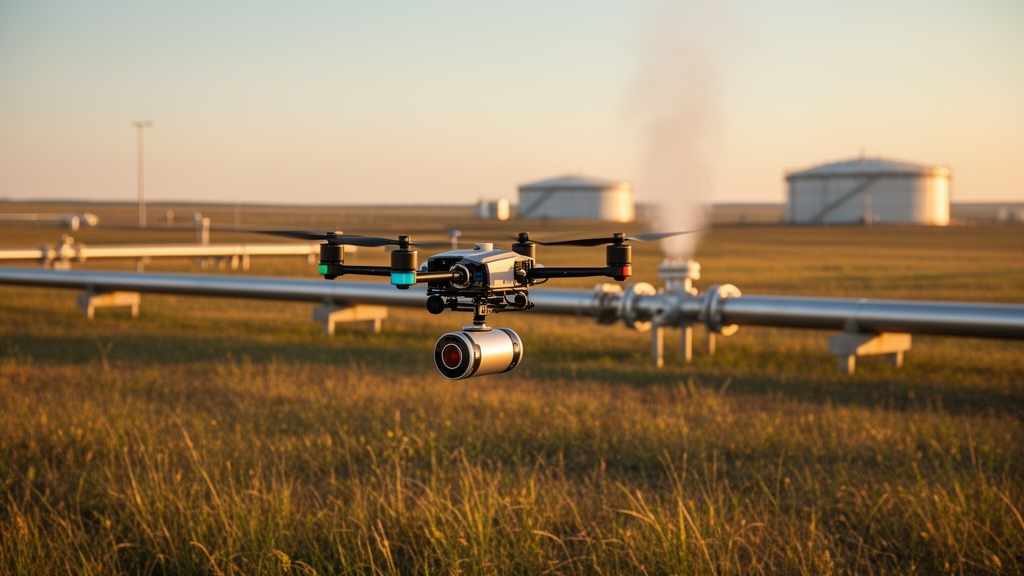
A team at Canada’s National Research Council, working with the Geological Survey of Canada, has built an open-path methane spectrometer weighing just 1.2 kilograms, including its dedicated battery, and flown it on a small drone to detect and quantify a controlled methane release of 0.48 kilograms per hour, a rate below the detection limit of most conventional aircraft surveys. Using a direct mass balance flux approach with onboard wind measurements, the estimated emission rates came within 9 percent of the true release rate. The design and demonstration are reported in the journal Atmospheric Measurement Techniques.
The new instrument is 75 percent lighter than the team’s previous design and roughly one quarter the mass of its five-kilogram predecessor, placing it among the lightest spectroscopic methane sensors reported to date. The package is also 84 percent smaller by volume, shrinking to dimensions of 23.5 by 12.5 by 9.5 centimeters, and it draws only about 11 watts of electrical power at room temperature, down from roughly 18 watts for the earlier version. Those numbers matter because small uncrewed aerial vehicles, those under 25 kilograms, are easy to transport and face fewer regulatory restrictions than larger drones, but they impose punishing payload limits. A sensor light enough to fly alongside a second instrument, such as an anemometer, on a widely available enterprise-grade drone transforms what a single flight mission can accomplish.
At the heart of the sensor is tunable diode laser absorption spectroscopy in the mid-infrared. A collimated GaSb-based distributed feedback diode laser, centered at 3270.4 nanometers, is tuned across methane’s strong ν3 fundamental C-H stretching absorption band, where the gas absorbs most intensely. The laser light bounces 35 times between two gold-coated concave spherical mirrors in a spot-ring Herriott-type multi-pass cell, stretching the effective optical path to 4.6 meters within an on-axis mirror separation of only 131.4 millimeters. Because the cell is open-path, with no sampling pump dragging air through an enclosed chamber, the instrument responds nearly instantaneously to the gas it flies through. Closed-path designs, by contrast, suffer from delayed exchange and mixing within the sampling cell, which can smear and distort the plume shape recorded from a moving platform and potentially underestimate true concentration enhancements, introducing errors that must be untangled during data processing.
The team chose wavelength modulation spectroscopy, or WMS, over direct absorption spectroscopy to squeeze more sensitivity from the compact hardware. In WMS, the laser wavelength is swept across the molecular absorption line in a sawtooth pattern at 100 hertz while a sinusoidal modulation at 10 kilohertz is superimposed on the injection current. Demodulating the detector signal at the second harmonic of the modulation frequency suppresses noise and boosts the signal-to-noise ratio relative to direct absorption. Crucially, the WMS retrieval is computationally simple, running in real time on a low-cost BeagleBone Black single board computer with a custom data acquisition board, whereas direct absorption fitting algorithms demand more processing power that might otherwise require a beefier computer or a ground station. A digital lock-in amplifier implemented on the board computes the second harmonic spectrum, and a search algorithm finds the peak-to-peak amplitude of the methane feature, which is converted to a mole fraction through a fourth-order polynomial calibration benchmarked against a reference trace gas analyzer.
Precision figures tell the performance story. In the laboratory, the sensor achieves a measurement precision of 3.7 parts per billion at a one-second averaging time, and in flight it reaches 6.7 parts per billion at the same averaging time. According to the authors, that is the best one-hertz precision for a UAV-borne methane sensor weighing less than two kilograms reported to date. For a drone traveling at five to eight meters per second, longer averaging times would smear rapidly varying plume structure, so the team works at a 0.1-second averaging time, corresponding to an in-flight precision of 27 parts per billion. Allan-Werle deviation analysis shows that averaging in-flight data up to 5.8 seconds yields an optimal precision of 3.5 parts per billion, while laboratory data averaged to 75.9 seconds reaches 0.8 parts per billion before drift takes over. Some of the in-flight noise stems from inductive interference produced by the high-powered radio module used for real-time data streaming, a component the authors suggest could be tamed with a Faraday cage.
Because the optical path is exposed to ambient air, the open-path design is sensitive to environmental conditions, and the team characterized those effects in detail. Laboratory tests across temperatures from 21 to 29 degrees Celsius showed the recorded methane mole fraction dropping by 3.5 percent at 24.6 degrees and 4.8 percent at 28.7 degrees relative to the calibration temperature, broadly consistent with the expected decline in optical absorbance with increasing temperature. Rapid temperature shifts triggered oscillatory behavior in the signal, with the 60-second moving average varying by 4.1 percent over the experiment. Humidity matters too: for each one percent increase in water vapor mole fraction, the measured dry methane mole fraction changed by an average of minus 1.9 percent, driven by a nearby water absorption line at 3271.0 nanometers that nudges the spectral baseline. Pressure effects are comparatively modest, with methane absorbance changing at roughly 0.033 percent per hectopascal, amounting to less than two percent variation across Ottawa’s typical ambient pressure range.
To fly the sensor as a complete measurement system, the team mounted it on a DJI Matrice 300 RTK drone, which has a maximum payload of 2.7 kilograms. The sensor draws power from its own 10,000 milliamp-hour power bank, independent of the UAV batteries, enabling continuous operation for over two hours and multiple sequential flights of roughly 20 minutes each without shutting the instrument down. For emission quantification missions, the drone also carries a two-dimensional Gill WindUltra anemometer on a carbon fiber mast positioned 75 centimeters above the rotors to reduce rotor wash contamination. Because the anemometer moves with the aircraft, the team corrects the raw wind measurements for the drone’s ground speed, pitch, and roll angles, recovering true wind speed and direction. During the field trial, the corrected onboard wind direction averaged 194.3 degrees, agreeing with a stationary ground anemometer at the release point that recorded 191.3 degrees.
The demonstration came in a controlled-release experiment simulating a methane leak. Methane gas was released through a diffuser at the top of a mast 4.2 meters above the ground at a rate of 12 standard liters per minute, equivalent to 0.48 kilograms per hour. The drone flew two vertical flux curtains downwind of the source, at 76 meters and 119 meters, each consisting of stacked horizontal transects spanning roughly 240 meters laterally, with vertical spacings of one to 1.5 meters. The sensor clearly detected plume enhancements above the background of 2.10 parts per million, with the highest dry mole fractions of 3.13 parts per million near and 2.44 parts per million far observed in the lowest transects. Applying a direct mass balance approach, the team integrated the methane flux density across each vertical plane, using the onboard wind measurements and a logarithmic wind model to extrapolate the transect-integrated mole fraction from the lowest measured altitude down to the ground.
The quantified emission rates came in strikingly close to the truth. The far curtain yielded an estimate of 0.44 kilograms per hour, differing from the true release rate by 8.7 percent, and the near curtain produced 0.47 kilograms per hour, off by just 1.1 percent. Both true rates fell well within the reported uncertainty bounds, with relative two-sigma uncertainties of 40 and 47 percent. For context, comparable UAV flux quantification studies have reported prediction errors ranging from minus 69 to 150 percent across 45 flights in one study, and minus 35.4 to 33.4 percent across 12 controlled-release flights in another. The team found that accuracy hinged heavily on the lowest measured transects, which carried the highest methane content; neglecting the lowest transect and extrapolating from the next one up would have produced flux estimates far from the true rate, underscoring the value of flying as close to the ground as the terrain allows.
The authors are careful about what remains unproven. A single curtain flight over roughly 15 minutes cannot fully capture the uncertainty introduced by atmospheric turbulence and the non-stationary nature of a real plume, and rigorous statistical assessment of detection probability and quantification accuracy would require many systematic controlled-release flights across varied meteorology, terrain, and source parameters. In-flight background drifts of up to 100 parts per billion were observed over 20-minute flights, largest at takeoff and landing, attributed primarily to changes in ambient conditions and airflow rather than to the drone’s rapid movements, which the open-path instrument appeared immune to. Still, the demonstration marks a compelling proof of concept: a sub-two-kilogram, 11-watt, high-precision laser spectrometer that can hunt fugitive methane over wetlands, permafrost, unstable slopes, and industrial sites where ground vehicles cannot go and crewed aircraft cannot legally descend. With further refinement, the same open-path platform could be retuned to other gases by swapping the laser and photodetector, pointing toward a flexible, scalable toolkit for pinpointing emission sources that hide just above the ground.
Subject of Research: An ultra-lightweight mid-infrared methane sensor for in-situ measurements aboard small UAVs, demonstrated in a controlled-release emission quantification experiment
Article Title: Ultra-lightweight mid-IR methane sensor for in-situ UAV-based measurements: Design and demonstration
Article References: Beattie, M. N., Sun, C., MacLeod, R., Sabourin, N. A., Morse, P. D., Smallwood, G. J., Corbin, J. C., & Norooz Oliaee, J. (2026). Ultra-lightweight mid-IR methane sensor for in-situ UAV-based measurements: Design and demonstration. Atmospheric Measurement Techniques, 19(20), 6719-6742. https://doi.org/10.5194/amt-19-6719-2026
Image Credits: AI Generated
Keywords: methane, UAV, drone, open-path sensor, mid-infrared spectroscopy, TDLAS, wavelength modulation spectroscopy, emission quantification, mass balance flux, controlled release, fugitive emissions, Herriott cell
News Source: Russell Cooper. (October 26, 2026). Featherweight drone methane sensor catches emissions conventional aircraft miss. Scienmag.