Hospital patients whose admission care followed a nurse-led swallowing screening protocol developed hospital-acquired aspiration pneumonia at less than half the rate of patients whose care did not, according to a retrospective cohort study published in the Journal of General Internal Medicine. Among 10,947 adult patients admitted to general wards whose care adhered to the protocol, the incidence of hospital-acquired aspiration pneumonia was 0.8 percent, compared with 2.1 percent among the 1,427 patients whose care did not adhere to it. The difference remained statistically significant after adjustment for a wide range of clinical and demographic factors.
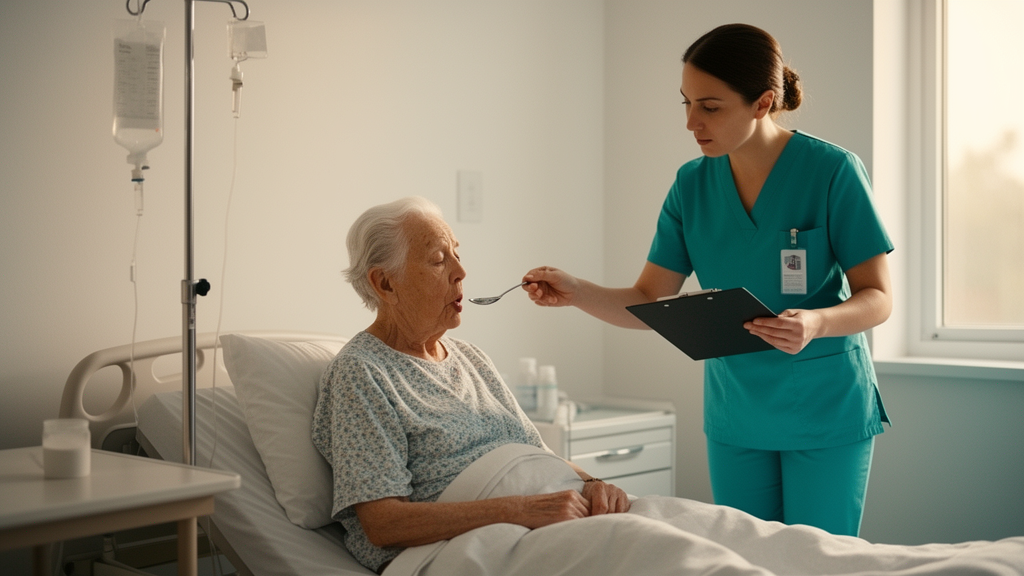
The study was conducted at a single Japanese hospital that implemented a structured dysphagia screening protocol across its general wards. The protocol was layered and nurse-led: nurses first administered the Eating Assessment Tool-10, then followed with the repetitive saliva swallowing test and mealtime observation. Because ward nurses rather than specialist clinicians carried out the assessment at admission, the approach was designed to identify patients at elevated risk of aspiration early in their hospital stay.
The researchers analyzed records from 12,374 adult patients admitted to the general wards between March 2022 and February 2023. Because the study was retrospective, patients could not be randomly assigned to screening; instead, the team compared those whose admission care adhered to the protocol with those whose care did not. This design captures real-world practice but cannot by itself prove that screening caused the lower pneumonia rate.
Cases of hospital-acquired aspiration pneumonia were initially identified using the ICD-10 codes J69.0 through J69.9, recorded for reimbursement purposes in routine clinical practice in Japan. Every identified case was then verified by the researchers through a review of the medical charts, a step intended to filter out coding errors before analysis. This dual identification process strengthens confidence that the outcome measure reflected clinically confirmed pneumonia rather than billing codes alone.
To estimate the association between screening adherence and pneumonia risk, the team used modified Poisson regression, a statistical method suited to estimating risk ratios for common outcomes. The model adjusted for age, sex, body mass index, dysphagia-related comorbidities, malignant disease, surgery, endoscopic procedures, radiotherapy, chemotherapy, and the month of admission. Adjusting for these variables helps ensure that the observed difference was not simply explained by sicker patients being screened more or less often.
After multivariable adjustment, protocol adherence was independently associated with a reduced risk of hospital-acquired aspiration pneumonia, with a risk ratio of 0.424. The 95 percent confidence interval ranged from 0.272 to 0.663, and the p value was less than 0.001. In practical terms, adherent patients had an estimated risk roughly 58 percent lower than non-adherent patients, though the confidence interval indicates meaningful uncertainty around that point estimate.
The risk-reducing association was observed across disease categories and was particularly evident among patients without malignancy and among those undergoing surgery. The analysis also found that cerebrovascular disease, dementia, and respiratory disease were each associated with a higher incidence of hospital-acquired aspiration pneumonia. These comorbidities are plausible markers of swallowing difficulty, and their identification may help clinicians target assessment toward the patients most likely to benefit.
The authors conclude that adherence to an admission dysphagia screening protocol was associated with a significantly lower risk of hospital-acquired aspiration pneumonia in general wards, and that systematic swallowing assessment at admission may represent a useful component of strategies aimed at preventing this complication. The wording is deliberately cautious: as an observational, single-center study, it establishes an association rather than a causal effect, and unmeasured differences between adherent and non-adherent patients could have contributed to the result. Several limitations follow from the design.
The retrospective cohort included patients from one hospital over a single year, so the findings may not generalize to institutions with different staffing, patient mixes, or screening practices. The 1,427 non-adherent patients formed a much smaller and possibly atypical comparison group than the adherent majority. With the incidence of aspiration pneumonia increasing alongside population aging, the study addresses a potentially preventable hospital complication.
For now, the results support continued evaluation of nurse-led screening protocols rather than an established standard of care.
Subject of Research: Association between admission dysphagia screening and hospital-acquired aspiration pneumonia in general wards
Article Title: Admission Dysphagia Screening and Hospital-Acquired Aspiration Pneumonia in General Wards: A Retrospective Cohort Study
Article References: Yamauchi, T., Ikebuchi, M., Toyoda, H., Yasuhara, H., Nonomiya, Y., Kawai, R., Okubo, K., Ioka, M., Nishida, H., Kawashima, M., Shintani, A., & Shuto, T. (2026). Admission Dysphagia Screening and Hospital-Acquired Aspiration Pneumonia in General Wards: A Retrospective Cohort Study. Journal of General Internal Medicine. https://doi.org/10.1007/s11606-026-10770-3
Image Credits: AI Generated
DOI: 10.1007/s11606-026-10770-3
Keywords: dysphagia screening, aspiration pneumonia, hospital-acquired infection, nurse-led protocol, retrospective cohort study, general wards, EAT-10, patient safety, swallowing assessment, geriatric medicine, Japan, Admission
News Source: Ophelia Keating. (October 26, 2026). Nurse-Led Swallowing Screening at Admission Linked to Lower Aspiration Pneumonia Risk. Scienmag.