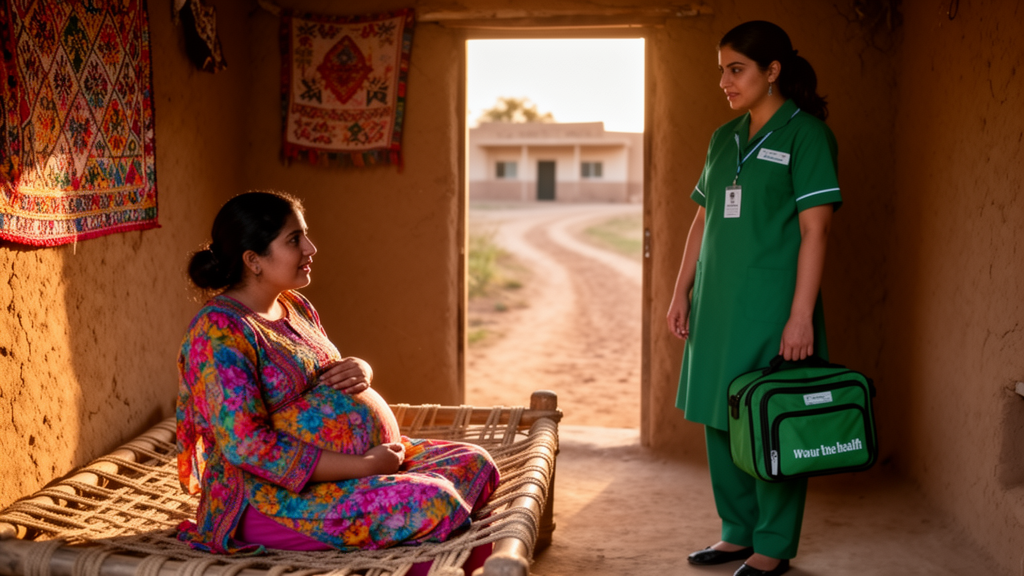
A scoping review published in Discover Public Health has mapped the evidence on why women in Sindh, Pakistan, use—or fail to use—antenatal care (ANC) and skilled birth attendance (SBA), finding that utilization is shaped by interconnected barriers operating at individual, household and community, and health-system levels. The review, led by Salma Memon and colleagues, synthesized ten studies conducted in the province and concluded that no single factor adequately explains the persistent inequalities in maternity-care use documented across Sindh.
The scale of those inequalities is stark. Drawing on the Sindh Multiple Indicator Cluster Survey (MICS) 2018–19, the review’s authors report that antenatal care utilization among women in the poorest wealth quintile stood at 57.7 percent, compared with 94.7 percent among women in the richest quintile. Education carved a similarly deep divide: ANC utilization was 68.7 percent among women with no or pre-primary education, against 96.82 percent among those with higher education. Geographic variation was equally pronounced, with skilled ANC coverage ranging from 57.1 percent in rural Mirpur Khas to 88.0 percent in urban Karachi, and district-level estimates spanning from 52 percent in Tharparkar to 96 percent in Karachi Central.
Overall utilization figures underscore how much of the province falls short of recommended care. Only 44.3 percent of women reported receiving four or more antenatal care visits, while 21.7 percent reported receiving no antenatal care at all during their most recent pregnancy. Skilled birth attendance showed a pronounced urban–rural gap, with coverage of approximately 93 percent in urban areas compared with approximately 74 percent in rural areas. The authors argue that these disparities indicate ANC and SBA utilization in Sindh is not uniform and likely reflects the combined influence of factors at multiple levels rather than any single deficiency.
To assemble the evidence base, the researchers searched MEDLINE, CINAHL, Google Scholar, and PakMediNet with no restrictions on publication date, following the methodological framework proposed by Arksey and O’Malley in 2005 with subsequent refinements by Levac and colleagues, and reporting in accordance with the PRISMA-ScR extension for scoping reviews. The searches identified 3,243 records. After the removal of 418 duplicates, 2,825 records underwent title and abstract screening, 215 articles were retrieved for full-text assessment, and ten studies reporting findings from Sindh made it into the final synthesis. Eligible studies had to examine ANC, SBA, or related maternity-care utilization and report factors associated with utilization among women in Sindh; Pakistan-wide or multisite studies were retained only when Sindh-specific findings could be identified, and studies that did not report Sindh-specific results were excluded.
The ten included studies used quantitative, qualitative, and mixed-methods approaches and spanned community and health-facility settings across different districts of the province. Findings were charted on standardized forms by two independent reviewers and synthesized descriptively and thematically through content analysis, organized into three domains: individual-level factors, household and community-level factors, and health-system factors. The authors emphasize that the synthesis aimed to identify patterns, similarities, differences, and gaps rather than to estimate pooled effects or establish causal relationships—a deliberate constraint of the scoping review design, given the heterogeneity of the underlying studies in design, population, geography, and outcome definitions.
At the individual level, educational attainment and health knowledge or awareness emerged as the most consistently reported factors associated with maternity-care utilization. Women with higher levels of education were more likely to use ANC and facility-based maternity services than women with limited or no formal education, and lower educational attainment was associated with reduced use of skilled care during childbirth. The review suggests education may enhance women’s ability to obtain and understand health information, recognize pregnancy-related risks, communicate with providers, and navigate services. Yet the evidence also shows education does not operate in isolation: women with greater educational attainment or knowledge may still face barriers related to household decision-making, financial resources, mobility, transportation, geographic accessibility, and the availability and quality of health services. Maternal age and parity were also identified, with evidence from Thatta showing differences in ANC utilization and place of delivery according to these characteristics, and higher parity associated with lower utilization of some services—though the review cautions that the available evidence does not allow such explanations to be established as causal.
Household and community circumstances formed the second major domain. Women in households with greater economic resources were more likely to use ANC and facility-based childbirth services than women from poorer households, with financial constraints affecting both direct costs such as consultations, medicines, and diagnostic investigations, and indirect costs such as transportation. Women’s autonomy and participation in healthcare decision-making were repeatedly linked to utilization: women with greater involvement in decisions about their own healthcare were more likely to use skilled maternity services, while limited decision-making authority could constrain care-seeking even when women recognized the need for professional services. Qualitative evidence identified restrictions imposed by family members and the need to obtain permission to leave home as barriers, while support from husbands and other family members could facilitate timely ANC attendance and facility-based childbirth by enabling transportation, providing money, and accompanying women to facilities. Gender norms, traditional practices, and community expectations—including the social acceptance of home childbirth and traditional birth attendants in some communities—further shaped preferences and care-seeking behavior.
Health-system factors constituted the third domain, and the review found them tightly interwoven with household constraints. Geographic accessibility and transportation were repeatedly identified as barriers, particularly for women in rural and underserved communities, where distance and unreliable or unaffordable transport can impede routine ANC visits and pose even greater obstacles during labour. The availability and distribution of skilled providers emerged as a distinct concern: the physical presence of a health facility does not ensure access to skilled maternity care when appropriately trained providers are unavailable or services are inconsistently staffed. Studies of community-based maternity services highlighted challenges in initial training, clinical competencies, supportive supervision, and the capacity to recognize, manage, and refer complications. Affordability, quality and acceptability of care, referral mechanisms, infrastructure, and institutional support were also identified, with qualitative evidence pointing to weaknesses in referral processes and administrative and government support for community-based providers.
Two methodological distinctions in the review carry particular weight for interpreting its findings. First, the authors deliberately treated institutional or facility delivery as not synonymous with skilled birth attendance, excluding studies that assessed place of delivery without explicitly examining skilled attendance, because delivery in a health facility does not by itself establish that a woman received care from a trained and qualified attendant. Second, while some included studies reported an association between ANC utilization and subsequent facility delivery—suggesting antenatal contact may serve as a connection point to childbirth care—ANC attendance did not necessarily translate into skilled attendance at birth, as household preferences, financial constraints, transportation difficulties, distance, sociocultural expectations, and provider availability could still intervene.
The review’s authors are candid about its limitations. No formal risk-of-bias assessment was undertaken, consistent with the mapping purpose of a scoping review, but this limits the ability to assess the relative methodological strength of findings across studies. The protocol was developed before study selection but was not prospectively registered, which the authors acknowledge as a limitation for transparency. Evidence was more extensive for education, socioeconomic circumstances, and structural access barriers than for quality of care, provider competencies, referral systems, and interactions across levels, and because the review was restricted to Sindh, the findings may not transfer to other settings. The available evidence also does not allow the identified factors to be ranked by independent relative importance. Looking forward, the authors call for research using clear and consistent definitions of ANC and SBA, longitudinal and mixed-methods designs to examine how factors across levels interact, greater attention to provider competency and care quality, and intervention studies evaluating multi-level approaches that combine strategies addressing women’s knowledge and autonomy, family and community contexts, financial and transportation barriers, and the accessibility, availability, affordability, and quality of skilled maternity services across the province.
Subject of Research: Factors associated with antenatal care and skilled birth attendance utilization among women in Sindh, Pakistan
Article Title: Factors associated with antenatal care and skilled birth attendance utilization in Sindh, Pakistan: a scoping review
Article References: Memon, S., Khowaja-Punjwani, S., Sattar, F., & Banu, R. (2026). Factors associated with antenatal care and skilled birth attendance utilization in Sindh, Pakistan: a scoping review. Discover Public Health, 23(1), Article 1727. https://doi.org/10.1186/s12982-026-03192-3
Image Credits: AI Generated
DOI: 10.1186/s12982-026-03192-3
Keywords: antenatal care, skilled birth attendance, Sindh, Pakistan, scoping review, maternal health, health inequalities, women's autonomy, health-system barriers, MICS 2018-19, maternity care utilization, rural health access
News Source: Ophelia Keating. (October 28, 2026). Scoping review maps the barriers keeping women in Sindh, Pakistan, from antenatal care and skilled birth attendance. Scienmag.