• HOME
  • NEWS
  • EXPLORE
    • CAREER
      • Companies
      • Jobs
    • EVENTS
    • iGEM
      • News
      • Team
    • PHOTOS
    • VIDEO
    • WIKI
  • BLOG
  • COMMUNITY
    • FACEBOOK
    • INSTAGRAM
    • TWITTER
Monday, May 11, 2026
BIOENGINEER.ORG
No Result
View All Result
  • Login
  • HOME
  • NEWS
  • EXPLORE
    • CAREER
      • Companies
      • Jobs
        • Lecturer
        • PhD Studentship
        • Postdoc
        • Research Assistant
    • EVENTS
    • iGEM
      • News
      • Team
    • PHOTOS
    • VIDEO
    • WIKI
  • BLOG
  • COMMUNITY
    • FACEBOOK
    • INSTAGRAM
    • TWITTER
  • HOME
  • NEWS
  • EXPLORE
    • CAREER
      • Companies
      • Jobs
        • Lecturer
        • PhD Studentship
        • Postdoc
        • Research Assistant
    • EVENTS
    • iGEM
      • News
      • Team
    • PHOTOS
    • VIDEO
    • WIKI
  • BLOG
  • COMMUNITY
    • FACEBOOK
    • INSTAGRAM
    • TWITTER
No Result
View All Result
Bioengineer.org
No Result
View All Result
Home NEWS Science News Biology

Scientists unravel the evolution and relationships for all European butterflies in a first

Bioengineer by Bioengineer
June 15, 2020
in Biology
Reading Time: 2 mins read
0
IMAGE
Share on FacebookShare on TwitterShare on LinkedinShare on RedditShare on Telegram

IMAGE

Credit: Dr Martin Wiemers

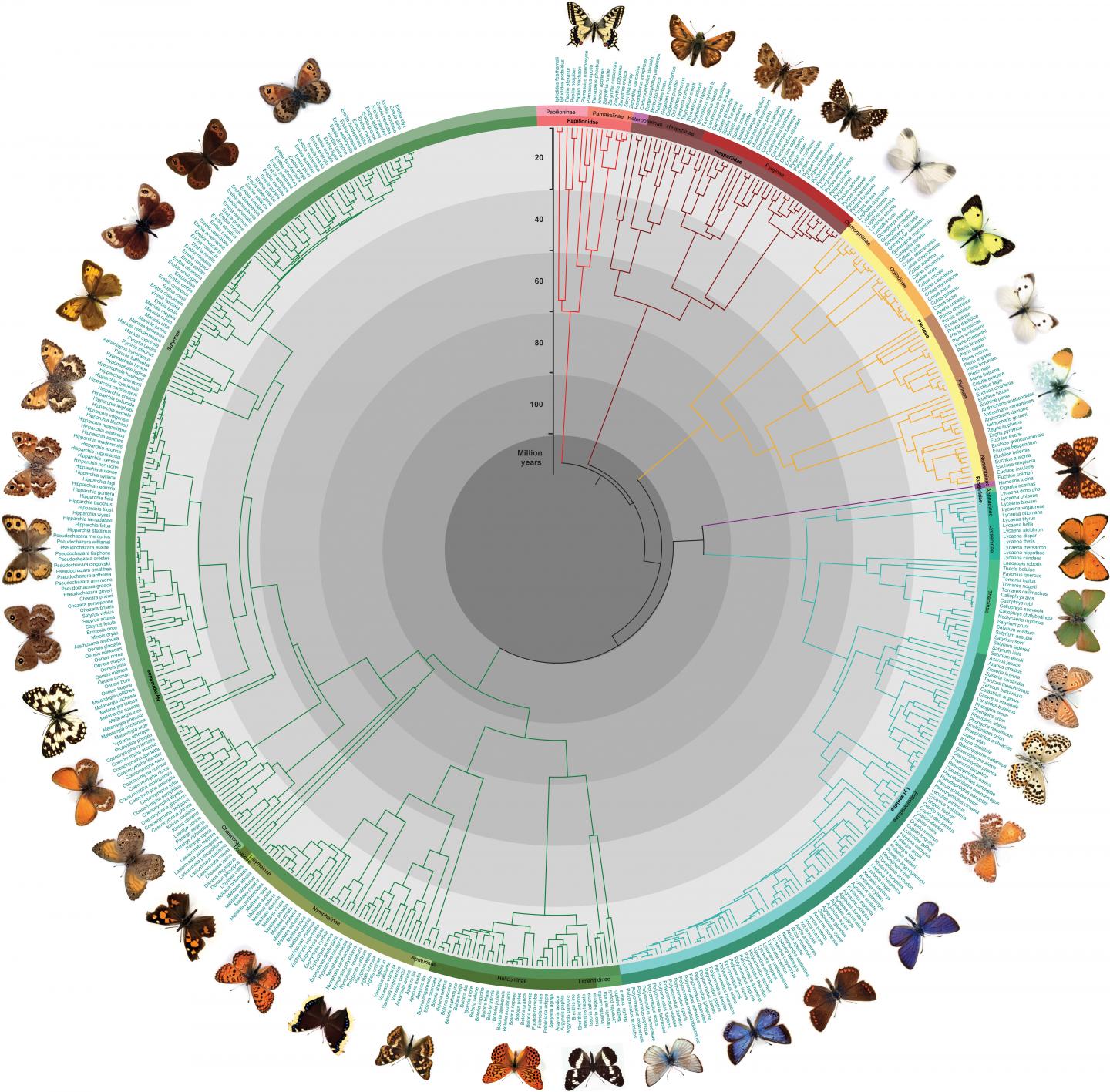
For the first time, a complete time-calibrated phylogeny for a large group of invertebrates is published for an entire continent.

In a recent research paper in the open-access, peer-reviewed academic journal ZooKeys, a German-Swedish team of scientists provide a diagrammatic hypothesis of the relationships and evolutionary history for all 496 European species of butterflies currently in existence. Their study provides an important tool for evolutionary and ecological research, meant for the use of insect and ecosystem conservation.

In order to analyse the ancestral relationships and history of evolutionary divergence of all European butterflies currently inhabiting the Old continent, the team led by Martin Wiemers – affiliated with both the Senckenberg German Entomological Institute and the Helmholtz Centre for Environmental Research – UFZ, mainly used molecular data from already published sources available from NCBI GenBank, but also contributed many new sequences, some from very local endemics for which no molecular data had previously been available.

Butterflies, the spectacular members of the superfamily Papilionoidea, are seen as an important proponent for nature conservation, as they present an excellent indicator group of species, meaning they are capable of inferring the environmental conditions of a particular habitat. All in all, if the local populations of butterflies are thriving, so is their habitat.

Furthermore, butterflies are pollinating insects, which are of particular importance for the survival of humans. There is no doubt they have every right to be recognised as a flagship invertebrate group for conservation.

In recent times, there has been a steady increase in the molecular data available for research, however, those would have been only used for studies restricted either to a selected subset of species, or to small geographic areas. Even though a complete phylogeny of European butterflies was published in 2019, also co-authored by Wiemers, it was not based on a global backbone phylogeny and, therefore, was also not time-calibrated.

In their paper, Wiemers and his team point out that phylogenies are increasingly used across diverse areas of macroecological research, such as studies on large-scale diversity patterns, disentangling historical and contemporary processes, latitudinal diversity gradients or improving species-area relationships. Therefore, this new phylogeny is supposed to help advance further similar ecological research.

###

Original source:

Wiemers M, Chazot N, Wheat CW, Schweiger O, Wahlberg N (2020) A complete time-calibrated multi-gene phylogeny of the European butterflies. ZooKeys 938: 97-124. https://doi.org/10.3897/zookeys.938.50878

Media Contact
Dr Martin Wiemers
[email protected]

Related Journal Article

http://dx.doi.org/10.3897/zookeys.938.50878

Tags: BiodiversityBiologyClimate ChangeEcology/EnvironmentEntomologyEvolutionPhysiologyPollution/RemediationZoology/Veterinary Science
Share12Tweet8Share2ShareShareShare2

Related Posts

HIV-1 Strains Reveal Varied Paths to Antibody Escape — Biology

HIV-1 Strains Reveal Varied Paths to Antibody Escape

May 11, 2026
CRISPRi Screening Identifies Fungal-Specific Drug Targets — Biology

CRISPRi Screening Identifies Fungal-Specific Drug Targets

May 11, 2026

Transforming Jellyfish Bycatch into a Valuable Collagen Source for Cosmetics and Biotechnology

May 11, 2026

Ancient Plant Populations Reveal Fresh Insights into Climate Resilience

May 8, 2026
Please login to join discussion

POPULAR NEWS

  • Research Indicates Potential Connection Between Prenatal Medication Exposure and Elevated Autism Risk

    841 shares
    Share 336 Tweet 210
  • New Study Reveals Plants Can Detect the Sound of Rain

    728 shares
    Share 290 Tweet 182
  • Salmonella Haem Blocks Macrophages, Boosts Infection

    62 shares
    Share 25 Tweet 16
  • Breastmilk Balances E. coli and Beneficial Bacteria in Infant Gut Microbiomes

    57 shares
    Share 23 Tweet 14

About

We bring you the latest biotechnology news from best research centers and universities around the world. Check our website.

Follow us

Recent News

HIV-1 Strains Reveal Varied Paths to Antibody Escape

Rapid Nanopore Genomics Tracks Malaria Across Africa

Global City Growth Decouples from Fossil Fuels

Subscribe to Blog via Email

Enter your email address to subscribe to this blog and receive notifications of new posts by email.

Join 82 other subscribers
  • Contact Us

Bioengineer.org © Copyright 2023 All Rights Reserved.

Welcome Back!

Login to your account below

Forgotten Password?

Retrieve your password

Please enter your username or email address to reset your password.

Log In
No Result
View All Result
  • Homepages
    • Home Page 1
    • Home Page 2
  • News
  • National
  • Business
  • Health
  • Lifestyle
  • Science

Bioengineer.org © Copyright 2023 All Rights Reserved.