• HOME
  • NEWS
  • EXPLORE
    • CAREER
      • Companies
      • Jobs
    • EVENTS
    • iGEM
      • News
      • Team
    • PHOTOS
    • VIDEO
    • WIKI
  • BLOG
  • COMMUNITY
    • FACEBOOK
    • INSTAGRAM
    • TWITTER
Sunday, May 10, 2026
BIOENGINEER.ORG
No Result
View All Result
  • Login
  • HOME
  • NEWS
  • EXPLORE
    • CAREER
      • Companies
      • Jobs
        • Lecturer
        • PhD Studentship
        • Postdoc
        • Research Assistant
    • EVENTS
    • iGEM
      • News
      • Team
    • PHOTOS
    • VIDEO
    • WIKI
  • BLOG
  • COMMUNITY
    • FACEBOOK
    • INSTAGRAM
    • TWITTER
  • HOME
  • NEWS
  • EXPLORE
    • CAREER
      • Companies
      • Jobs
        • Lecturer
        • PhD Studentship
        • Postdoc
        • Research Assistant
    • EVENTS
    • iGEM
      • News
      • Team
    • PHOTOS
    • VIDEO
    • WIKI
  • BLOG
  • COMMUNITY
    • FACEBOOK
    • INSTAGRAM
    • TWITTER
No Result
View All Result
Bioengineer.org
No Result
View All Result
Home NEWS Science News Chemistry

Scientists precisely measure total amount of matter in the universe

Bioengineer by Bioengineer
September 28, 2020
in Chemistry
Reading Time: 3 mins read
0
IMAGE
Share on FacebookShare on TwitterShare on LinkedinShare on RedditShare on Telegram

UC Riverside-led team’s technique relied on determining the mass of galaxy clusters
IMAGE

Credit: Mohamed Abdullah, UC Riverside.

RIVERSIDE, Calif. — A top goal in cosmology is to precisely measure the total amount of matter in the universe, a daunting exercise for even the most mathematically proficient. A team led by scientists at the University of California, Riverside, has now done just that.

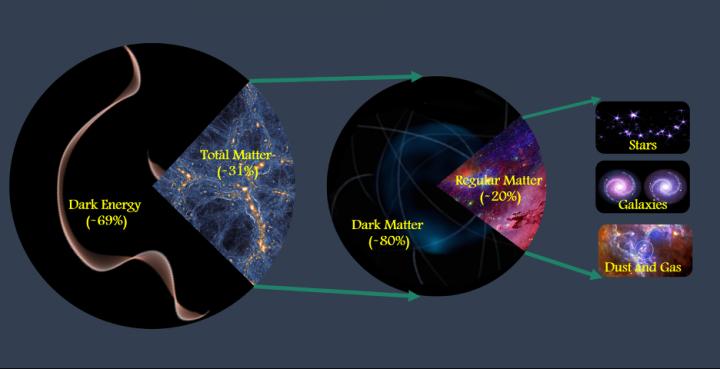
Reporting in the Astrophysical Journal, the team determined that matter makes up 31% of the total amount of matter and energy in the universe, with the remainder consisting of dark energy.

“To put that amount of matter in context, if all the matter in the universe were spread out evenly across space, it would correspond to an average mass density equal to only about six hydrogen atoms per cubic meter,” said first author Mohamed Abdullah, a graduate student in the UCR Department of Physics and Astronomy. “However, since we know 80% of matter is actually dark matter, in reality, most of this matter consists not of hydrogen atoms but rather of a type of matter which cosmologists don’t yet understand.”

Abdullah explained that one well-proven technique for determining the total amount of matter in the universe is to compare the observed number and mass of galaxy clusters per unit volume with predictions from numerical simulations. Because present-day galaxy clusters have formed from matter that has collapsed over billions of years under its own gravity, the number of clusters observed at the present time is very sensitive to cosmological conditions and, in particular, the total amount of matter.

“A higher percentage of matter would result in more clusters,” Abdullah said. “The ‘Goldilocks’ challenge for our team was to measure the number of clusters and then determine which answer was ‘just right.’ But it is difficult to measure the mass of any galaxy cluster accurately because most of the matter is dark so we can’t see it with telescopes.”

To overcome this difficulty, the UCR-led team of astronomers first developed “GalWeight”, a cosmological tool to measure the mass of a galaxy cluster using the orbits of its member galaxies. The researchers then applied their tool to observations from the Sloan Digital Sky Survey (SDSS) to create “GalWCat19,” a publicly available catalog of galaxy clusters.  Finally, they compared the number of clusters in their new catalog with simulations to determine the total amount of matter in the universe.

“We have succeeded in making one of the most precise measurements ever made using the galaxy cluster technique,” said coauthor Gillian Wilson, a professor of physics and astronomy at UCR in whose lab Abdullah works. “Moreover, this is the first use of the galaxy orbit technique which has obtained a value in agreement with those obtained by teams who used noncluster techniques such as cosmic microwave background anisotropies, baryon acoustic oscillations, Type Ia supernovae, or gravitational lensing.”

“A huge advantage of using our GalWeight galaxy orbit technique was that our team was able to determine a mass for each cluster individually rather than rely on more indirect, statistical methods,” said the third coauthor Anatoly Klypin, an expert in numerical simulations and cosmology.

By combining their measurement with those from the other teams that used different techniques, the UCR-led team was able to determine a best combined value, concluding that matter makes up 31.5±1.3% of the total amount of matter and energy in the universe.

###

The study was supported by grants from the National Science Foundation and NASA.

The research paper is titled “Cosmological Constraints on Ωm and σ8 from Cluster Abundances using the GalWCat19 Optical-spectroscopic SDSS Catalog.”

The University of California, Riverside (http://www.ucr.edu) is a doctoral research university, a living laboratory for groundbreaking exploration of issues critical to Inland Southern California, the state and communities around the world. Reflecting California’s diverse culture, UCR’s enrollment is more than 24,000 students. The campus opened a medical school in 2013 and has reached the heart of the Coachella Valley by way of the UCR Palm Desert Center. The campus has an annual statewide economic impact of almost $2 billion. To learn more, email [email protected]”>[email protected].

Media Contact
Iqbal Pittalwala
[email protected]

Related Journal Article

http://dx.doi.org/10.3847/1538-4357/aba619

Tags: AstronomyAstrophysicsAtomic/Molecular/Particle PhysicsChemistry/Physics/Materials SciencesExperiments in SpaceParticle PhysicsSpace/Planetary Science
Share12Tweet8Share2ShareShareShare2

Related Posts

Miniature Sensor Uses Light to Detect Touch — Chemistry

Miniature Sensor Uses Light to Detect Touch

May 8, 2026
Iron Minerals Determine Whether Dissolved Organic Matter Fuels Microbes or Becomes Long-Term Carbon Storage — Chemistry

Iron Minerals Determine Whether Dissolved Organic Matter Fuels Microbes or Becomes Long-Term Carbon Storage

May 8, 2026

Kate Evans Appointed Associate Lab Director for Biological and Environmental Systems Science at ORNL

May 8, 2026

Advancing Multiscale Modeling and Overcoming Operational Challenges in Autothermal CO₂-to-Methanol Reactors

May 8, 2026
Please login to join discussion

POPULAR NEWS

  • Research Indicates Potential Connection Between Prenatal Medication Exposure and Elevated Autism Risk

    840 shares
    Share 336 Tweet 210
  • New Study Reveals Plants Can Detect the Sound of Rain

    727 shares
    Share 290 Tweet 181
  • Scientists Investigate Possible Connection Between COVID-19 and Increased Lung Cancer Risk

    68 shares
    Share 27 Tweet 17
  • Salmonella Haem Blocks Macrophages, Boosts Infection

    61 shares
    Share 24 Tweet 15

About

We bring you the latest biotechnology news from best research centers and universities around the world. Check our website.

Follow us

Recent News

Evaluating Digoxin Use in Patients with Symptomatic Rheumatic Heart Disease

Evaluating the Effectiveness and Safety of Digitalis Glycosides in Treating Heart Failure

Urdu Fall Risk Questionnaire Adapted for Elderly

Subscribe to Blog via Email

Enter your email address to subscribe to this blog and receive notifications of new posts by email.

Join 82 other subscribers
  • Contact Us

Bioengineer.org © Copyright 2023 All Rights Reserved.

Welcome Back!

Login to your account below

Forgotten Password?

Retrieve your password

Please enter your username or email address to reset your password.

Log In
No Result
View All Result
  • Homepages
    • Home Page 1
    • Home Page 2
  • News
  • National
  • Business
  • Health
  • Lifestyle
  • Science

Bioengineer.org © Copyright 2023 All Rights Reserved.