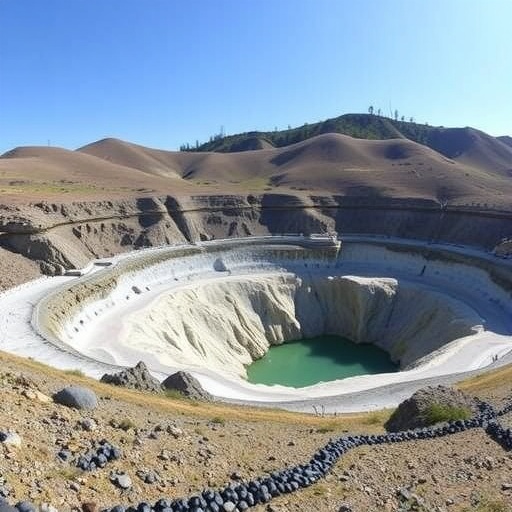
Portland State University is leading a national research effort to use artificial intelligence to make geothermal energy cheaper and less risky to develop, targeting one of the biggest obstacles facing a power source that can operate day and night regardless of weather. The project, known as ARISE—short for AI Regionalization and Informed Siting for Enhanced Geothermal Systems—has been selected for support by the U.S. Department of Energy under its Genesis Mission. The nine-month first phase will combine machine learning, geological analysis and energy economics to improve predictions of underground temperatures and identify the most valuable locations for new measurements. The team includes researchers from Portland State University, Stanford University and the U.S. Geological Survey, along with 400C Energy, a company involved in geothermal exploration and development. Together, they aim to reduce the uncertainty that makes geothermal drilling such an expensive gamble.
Geothermal power is generated by extracting heat from beneath Earth’s surface and converting it into electricity. Unlike solar and wind power, geothermal generation does not depend on sunshine or wind conditions, allowing it to provide continuous electricity for the grid. Enhanced geothermal systems, or EGS, could expand this potential into regions where naturally permeable underground reservoirs are not readily available. Engineers can create or stimulate pathways in hot rock and circulate fluid through them, bringing heat to the surface. The difficulty is determining where sufficiently hot rock exists, how deep it lies and whether the temperature will be high enough to support an economically viable project. Those questions cannot be answered with certainty without drilling, yet drilling into the Earth can cost millions of dollars before a developer knows whether the target will produce useful energy.
“You’re making a costly bet on how hot it is,” said John Lipor, Wedge Vision Associate Professor of electrical and computer engineering at Portland State University and leader of the project. “We use AI and years of historical data to make that bet less of a gamble.” At present, underground temperature estimates are assembled from scattered measurements, geological surveys and physical models. Data are often sparse at the depths relevant to geothermal development, and uncertainty generally increases with depth. A prediction that appears precise on a map may therefore conceal a wide range of possible temperatures underground. ARISE is designed to express that uncertainty explicitly, then translate it into a form developers can use when deciding whether to drill, where to drill and which additional measurement would provide the greatest economic benefit.
The project’s technical foundation combines three complementary tools. A Stanford University model estimates underground temperatures across the United States using historical observations and geological information. A second Stanford model converts temperature predictions into possible electricity prices, allowing researchers to determine how uncertainty in geology could affect the financial performance of a geothermal facility. Portland State’s contribution is an algorithm called ARID, which stands for an approach to identifying regions with similar geological characteristics. Rather than forcing one nationwide model to learn every type of landscape at once, ARID divides the country into zones whose geological conditions are more alike. The resulting regional models can focus on narrower patterns, potentially improving prediction accuracy and making the limits of those predictions easier to quantify.
The regionalization strategy addresses a common problem in machine learning: a model trained on highly varied data may perform reasonably on average while remaining unreliable in specific locations. The thermal and geological conditions of the Great Basin, for example, differ substantially from those of the Appalachian region. A single model covering both areas must account for a vast range of rock types, tectonic histories, heat flows and measurement densities. ARID instead searches for meaningful similarities among locations and groups them into regions where a dedicated model may be better suited to the available evidence. The system can then connect a predicted temperature range to a predicted range of electricity costs. This makes uncertainty visible not merely as a statistical error bar, but as a potential difference in the price and profitability of future power.
ARISE will also examine how artificial intelligence can guide data collection itself. After estimating temperatures and their economic consequences, the system will recommend which measurement should be made next and where it should be taken. The goal is not simply to collect more data, but to identify the observation most likely to reduce uncertainty relative to its cost. A new temperature reading in one location may provide little value if it confirms what scientists already know, while a measurement in a poorly understood geological zone could substantially change the outlook for an entire region. “Deciding where to make valuable new measurements has always relied heavily on expert judgment,” said Erick Burns, a research hydrologist with the USGS. “What is new here is a way to test whether machine learning can improve data collection strategies while optimizing both information content and cost savings.”
The team will test the approach using real records from the Utah FORGE site, a Department of Energy-funded research facility dedicated to enhanced geothermal systems. Researchers will replay the site’s exploration history, assessing what ARISE would have recommended at each stage and comparing those recommendations with the decisions engineers actually made. This type of retrospective test can reveal whether the algorithm identifies useful measurements before the results are known, rather than simply explaining them afterward. During the first phase, the researchers are aiming to narrow the range of geothermal cost estimates by at least 10 percent on average compared with current methods. They will also produce a new underground temperature map for Oregon, where volcanic and tectonic features create both significant geothermal promise and substantial geological complexity.
The economic stakes extend beyond individual drilling projects. Electricity use by data centers worldwide is expected to more than double by 2030, while data centers in the United States could account for as much as 12 percent of national electricity demand. That rising demand is intensifying the search for low-carbon energy sources that can provide power continuously. Department of Energy analyses suggest that enhanced geothermal systems could increase U.S. geothermal capacity from approximately 4 gigawatts today to between 90 and 300 gigawatts by 2050, but reaching those levels will depend on reducing the cost and risk of exploration. “Geothermal has enormous potential, but the cost of finding out what is underground has held it back,” said Roland Horne, professor of energy science and engineering at Stanford University and director of the Stanford Geothermal Program. “We’re looking forward to taking the next step to making geothermal energy more widely available.”
The algorithm being used in the project grew from a master’s thesis by Portland State graduate student Joshua Sills, who remains involved in the research. Its development reflects the increasingly collaborative nature of energy innovation, in which computer scientists, geologists, economists, federal researchers and private companies must solve different parts of the same problem. The team plans to make its models, data and code publicly available through the DOE Geothermal Data Repository, allowing other scientists and geothermal developers to inspect, reproduce and build on the results. If the first phase meets its targets, ARISE could develop into a planning tool for complete exploration campaigns and be tested in additional areas, including Oregon’s Newberry volcanic region. By connecting geological prediction to measurement strategy and project economics, the researchers hope to turn artificial intelligence from a forecasting tool into a practical guide for deciding where the next geothermal breakthrough should be pursued.
Subject of Research: Artificial intelligence for geothermal exploration, underground temperature prediction, enhanced geothermal systems, geological regionalization and data-driven measurement planning.
Article Title: AI Project Aims to Make Geothermal Energy Cheaper by Predicting Underground Heat
Web References: https://www.pdx.edu/profile/john-lipor ; https://www.energy.gov/undersecretaryforscience/genesis-mission/genesis-mission ; https://www.pdx.edu/
References: Portland State University project information; U.S. Department of Energy Genesis Mission materials; statements from John Lipor, Erick Burns and Roland Horne; information on the Utah FORGE geothermal research site and DOE geothermal capacity projections.
Image Credits: Courtesy of John Lipor, Portland State University.
Keywords
Artificial intelligence, geothermal energy, enhanced geothermal systems, machine learning, Portland State University, Stanford University, USGS, ARISE algorithm, underground temperature, clean energy, renewable power, energy economics, geothermal exploration, Utah FORGE, Genesis Mission
Tags: AI for geothermal resource assessmentAI-driven geothermal reservoir characterizationenhanced geothermal systems developmentgeothermal drilling risk mitigationgeothermal energy cost reductiongeothermal energy economicsgeothermal power reliability and sustainabilitygeothermal site selection optimizationmachine learning in geothermal explorationregionalization of geothermal energy potentialU.S. Department of Energy geothermal researchunderground temperature prediction using AI