• HOME
  • NEWS
  • EXPLORE
    • CAREER
      • Companies
      • Jobs
    • EVENTS
    • iGEM
      • News
      • Team
    • PHOTOS
    • VIDEO
    • WIKI
  • BLOG
  • COMMUNITY
    • FACEBOOK
    • INSTAGRAM
    • TWITTER
Wednesday, May 13, 2026
BIOENGINEER.ORG
No Result
View All Result
  • Login
  • HOME
  • NEWS
  • EXPLORE
    • CAREER
      • Companies
      • Jobs
        • Lecturer
        • PhD Studentship
        • Postdoc
        • Research Assistant
    • EVENTS
    • iGEM
      • News
      • Team
    • PHOTOS
    • VIDEO
    • WIKI
  • BLOG
  • COMMUNITY
    • FACEBOOK
    • INSTAGRAM
    • TWITTER
  • HOME
  • NEWS
  • EXPLORE
    • CAREER
      • Companies
      • Jobs
        • Lecturer
        • PhD Studentship
        • Postdoc
        • Research Assistant
    • EVENTS
    • iGEM
      • News
      • Team
    • PHOTOS
    • VIDEO
    • WIKI
  • BLOG
  • COMMUNITY
    • FACEBOOK
    • INSTAGRAM
    • TWITTER
No Result
View All Result
Bioengineer.org
No Result
View All Result
Home NEWS Science News Biology

Scientists engineer unique ‘glowing’ protein

Bioengineer by Bioengineer
May 30, 2019
in Biology
Reading Time: 2 mins read
0
IMAGE
Share on FacebookShare on TwitterShare on LinkedinShare on RedditShare on Telegram

IMAGE

Credit: Vera Nazarenko et al.

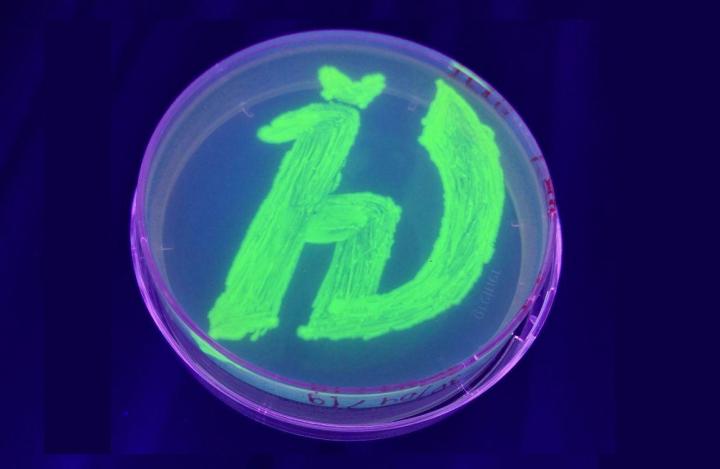
Biophysicists from the Moscow Institute of Physics and Technology have joined forces with colleagues from France and Germany to create a new fluorescent protein. Besides glowing when irradiated with ultraviolet and blue light, it is exceedingly small and stable under high temperatures. The authors of the paper, published in the journal Photochemical & Photobiological Sciences, believe the protein holds prospects for fluorescence microscopy. This technique is used in research on cancer, infectious diseases, and organ development, among other things.

Fluorescence microscopy is a method for studying living tissue that relies on induced luminescence. After being exposed to laser radiation at a particular wavelength, some proteins emit light at a different wavelength. This induced “glow” can be analyzed using a special microscope. Researchers append such fluorescent proteins to other proteins via genetic engineering to make the latter ones visible to the microscope and observe their behavior in cells. Fluorescence microscopy proved so scientifically valuable that one Nobel Prize was awarded for its discovery, followed by another one for radically improving the method’s accuracy.

Up until now, the fluorescent proteins used for such observations had several flaws. They were vulnerable to heat, fairly bulky, and only glowed in the presence of oxygen.

“For one thing, our protein is more thermostable than its analogues: It only denaturates at 68 degrees Celsius,” said the paper’s lead author Vera Nazarenko from the MIPT Laboratory of Structural Analysis and Engineering of Membrane Systems. “It is also miniature, while most of the currently used fluorescent proteins are rather bulky. On top of that, it can emit light in the absence of oxygen.”

The team originally identified the protein with these remarkable properties in the cells of a the thermophilic bacterium — that is, one which lives in high-temperature environments, such as hot springs. The researchers then genetically engineered a DNA sequence that reproduced the protein’s fluorescent segment but not the other parts, which would make the molecule larger.

By introducing the gene that encodes the protein into the cells of another bacterium, Escherichia coli, the team turned it into a factory mass-producing the fluorescent protein with unique properties.

Researchers studying the processes that occur in living cells have been waiting for a protein combining these crucial features for a long time. By introducing it into cells, they can now obtain essential data on cell life and death. To name a few applications, fluorescence microscopy is seen as one of the best tools for investigating the mechanism behind malignant tumor genesis and development. It is also useful for research on cell signaling and organ development.

The proteins previously used in fluorescence microscopy were bulky and thermally unstable, putting limitations on the method. Thanks to the MIPT team, that obstacle has been eliminated.

###

Media Contact
Varvara Bogomolova
[email protected]

Original Source

https://mipt.ru/english/news/scientists_engineer_unique_glowing_protein

Related Journal Article

http://dx.doi.org/10.1039/c9pp00067d

Tags: BacteriologyBioinformaticsBiologyBiomedical/Environmental/Chemical EngineeringBiotechnologyCell Biology
Share13Tweet8Share2ShareShareShare2

Related Posts

Using Real-Time Brain Signals to Forecast and Prevent Attention Lapses in Children — Biology

Using Real-Time Brain Signals to Forecast and Prevent Attention Lapses in Children

May 13, 2026
Cutting-Edge Genomic Techniques Reveal Unexpected Cellular Changes in the Aging Brain — Biology

Cutting-Edge Genomic Techniques Reveal Unexpected Cellular Changes in the Aging Brain

May 12, 2026

USC Researchers Initiate Study on the Most Advanced Lab-Grown Kidney Structures

May 12, 2026

Childbirth in Humans Is Not Uniquely Challenging Among Mammals, New Research Shows

May 12, 2026
Please login to join discussion

POPULAR NEWS

  • Research Indicates Potential Connection Between Prenatal Medication Exposure and Elevated Autism Risk

    842 shares
    Share 337 Tweet 211
  • New Study Reveals Plants Can Detect the Sound of Rain

    728 shares
    Share 290 Tweet 182
  • Salmonella Haem Blocks Macrophages, Boosts Infection

    62 shares
    Share 25 Tweet 16
  • Breastmilk Balances E. coli and Beneficial Bacteria in Infant Gut Microbiomes

    57 shares
    Share 23 Tweet 14

About

We bring you the latest biotechnology news from best research centers and universities around the world. Check our website.

Follow us

Recent News

Perimenopause Presents a Key Window for Heart Disease Prevention in Women

Penn Scientists Develop AI Tool to Accelerate Antibiotic Discovery

MIT-MGH Team Develops Novel Cancer Vaccine Strategy That Enhances T Cell Potency

Subscribe to Blog via Email

Enter your email address to subscribe to this blog and receive notifications of new posts by email.

Join 82 other subscribers
  • Contact Us

Bioengineer.org © Copyright 2023 All Rights Reserved.

Welcome Back!

Login to your account below

Forgotten Password?

Retrieve your password

Please enter your username or email address to reset your password.

Log In
No Result
View All Result
  • Homepages
    • Home Page 1
    • Home Page 2
  • News
  • National
  • Business
  • Health
  • Lifestyle
  • Science

Bioengineer.org © Copyright 2023 All Rights Reserved.