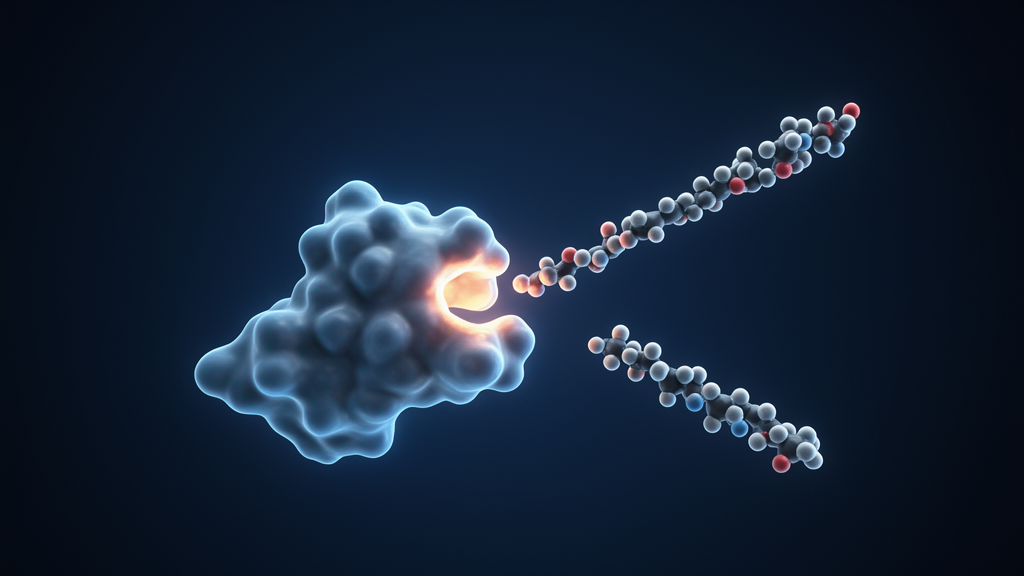
Protein designers have long dreamed of building enzymes that can do what biology’s most sophisticated catalysts do: slice through the peptide bonds that hold proteins together. That dream has now taken a major step toward reality. A team led by David Baker’s group at the Institute for Protein Design at the University of Washington, working with collaborators including Donald Hilvert at ETH Zurich, reports in Nature the successful de novo design of cysteine proteases — artificial enzymes, invented on a computer and built from scratch, that hydrolyze the polypeptide backbone in a sequence-dependent manner. The work, published on 14 October 2026, represents one of the most demanding challenges yet tackled by computational enzyme design, because the amide bonds that link amino acids are extraordinarily stable, persisting for hundreds of years in neutral aqueous solution owing to the high energy barrier to hydrolysis.
The difficulty of the problem is what makes the result so striking. Previous successes in de novo enzyme design have largely been confined to low-energy-barrier model reactions, which are chemically forgiving in ways that peptide bond cleavage is not. Natural cysteine proteases such as papain, TEV protease and the SARS-CoV-2 main protease achieve their catalytic prowess through precisely preorganized active sites, in which a cysteine nucleophile is activated by a histidine-aspartate dyad and an oxyanion hole stabilizes the tetrahedral intermediates that form during catalysis. Reproducing that level of geometric and electrostatic finesse in a protein fold that has no evolutionary history was the central challenge the team set out to overcome.
The design pipeline combined recent advances in deep-learning-based protein modeling into an iterative cycle. The researchers used RFdiffusion2, a diffusion-based backbone generation method that can scaffold enzyme active sites with atom-level control, to generate protein backbones around the desired catalytic machinery. Sequences were then assigned with ProteinMPNN, and candidate structures were evaluated with AlphaFold 3, which predicted whether each designed sequence would fold into the intended conformation and position the catalytic residues correctly. Designs that passed computational filters were expressed in bacteria and screened experimentally for their ability to cleave target peptide substrates, creating a tight feedback loop between computation and the laboratory bench.
The success rate was remarkable by the standards of the field. Of 69 designs tested, 13 showed cleavage activity — a hit rate of roughly 19 percent. The best enzymes accelerated the hydrolysis reaction by up to 3 × 10⁷-fold over the uncatalyzed background reaction, a rate enhancement that places these artificial catalysts firmly in the realm of genuinely functional proteases. Mass spectrometry confirmed that cleavage occurred at the designed sites, and knockout experiments in which the catalytic cysteine, histidine or oxyanion-hole residues were mutated to nonfunctional alternatives abolished activity, confirming that the designed active sites were responsible for catalysis rather than some adventitious contaminating activity.
Perhaps the most important structural finding is that the designed proteases do not mimic nature’s solutions. When the team searched the Protein Data Bank using the structure-comparison tool Foldseek, the designed folds showed no close resemblance to any natural protease, with template-modeling scores below 0.50 — a threshold indicating fundamentally different topologies. Six crystal structures were determined, and all were very close to the computational design models, with Cα root-mean-square deviations of less than 1.2 Å. This combination of novelty and accuracy demonstrates that the design methodology generalizes: it can produce catalytically competent proteins built on scaffolds that evolution never explored, and the models that guide the design are faithful representations of what the molecules actually look like in the crystal.
Still, the designed enzymes remain far from matching the most proficient natural cysteine proteases. To understand where the gap lies, the researchers turned to computational analyses of the catalytic cycle, including PLACER-based modeling of conformational ensembles for the acyl-enzyme intermediate and transition states, alongside molecular dynamics simulations of the catalytic dyad geometry. These analyses pointed to two culprits: imperfections in the preorganization of the active site, meaning the catalytic residues are not held in ideal register throughout the reaction, and suboptimal positioning of the substrate within the binding groove. Native enzymes achieve near-perfect preorganization through millions of years of refinement; the artificial designs, built in a single pass, retain measurable geometric wobble.
The team attacked these weaknesses with both rational and computational strategies. A pLDDT-guided redesign workflow applied to one parent design, named Dokki, produced 89 variants, of which 24 outperformed the original, with rate improvements ranging from 1.2-fold to 31-fold. Mutational screening of the improved variant Dokki-15, focusing on residues within 4.5 Å of the catalytic machinery, identified beneficial single mutations that were then combined combinatorially to yield further gains in catalytic efficiency. The stepwise improvement in oxyanion-hole geometry across the Dokki series, visible when comparing crystal structures and AlphaFold 3 models, illustrates how iterative design cycles can progressively close the gap between artificial and natural catalysis.
Beyond the test tube, the designed proteases proved functional in living cells. In a reporter assay in HeLa cells, the enzymes efficiently cleaved their target substrates, relocalizing a split fluorescent signal in a manner that depended on catalytic activity — catalytically inactive C100A mutants showed no effect. This demonstration opens the door to a wide range of synthetic biology applications. Programmable proteases could serve as genetically encoded switches that cut specific protein targets on demand, enabling new kinds of protein circuits, therapeutic logic gates in which an enzyme activates a drug only in the presence of a disease marker, and controllable tools for probing signaling pathways inside cells.
The implications extend across medicine and biotechnology. Cysteine proteases are validated drug targets in parasitic diseases, cancer and viral infection, and engineered variants of viral proteases are workhorses of recombinant protein production. A design platform that can generate sequence-specific proteases with novel folds, tuned substrate specificities and no evolutionary baggage offers a way to create cleavage reagents tailored to any peptide sequence of interest, without the cross-reactivity that plagues repurposed natural enzymes. The design pipeline, structural data and analysis code have been made publicly available, with atomic coordinates deposited in the Protein Data Bank under six accession codes, allowing other laboratories to build on the work immediately.
What this study ultimately signals is a maturing of the de novo enzyme design enterprise. The field has moved from proof-of-principle reactions with modest rate enhancements to one of biology’s hardest chemical problems, achieving double-digit hit rates and seven-order-of-magnitude accelerations in a single campaign. The remaining distance to native-level catalytic proficiency is now a well-characterized engineering problem rather than an open question of principle, and the authors’ own analysis identifies preorganization and substrate positioning as the levers to pull. If iterative design, mutational tuning and machine-learning-guided refinement continue at the pace demonstrated here, artificially evolved proteases designed entirely on computers may soon sit alongside their natural counterparts — not as imitations, but as an entirely new branch of catalytic protein chemistry.
Subject of Research: De novo computational design of cysteine protease enzymes that hydrolyze peptide bonds
Article Title: De novo design of cysteine proteases
Article References: Choi, H., Bauer, M. S., Coventry, B., Venkatesh, P., Chen, A., Kim, D., Bera, A. K., Kang, A., Nguyen, H., Sadre, S., Decarreau, J., Joyce, E., Shankaran, B., Thompson, T. R., Greenstein, G., Didi, K., Schaaf, L. L., Gershon, J. M., Shida, A. F., … Baker, D. (2026). De novo design of cysteine proteases. Nature. https://doi.org/10.1038/s41586-026-11143-w
Image Credits: AI Generated
DOI: 10.1038/s41586-026-11143-w
Keywords: protein design, cysteine proteases, de novo enzymes, RFdiffusion2, AlphaFold 3, peptide bond hydrolysis, catalysis, synthetic biology, crystallography, University of Washington, Institute for Protein Design, enzyme engineering
News Source: Denise Maddox. (October 16, 2026). Scientists Design Artificial Enzymes That Cleave Protein Chains From Scratch. Scienmag.