Extensive simulations seek the ideal distancing scenario to reduce severe coronavirus cases with minimal social disruption
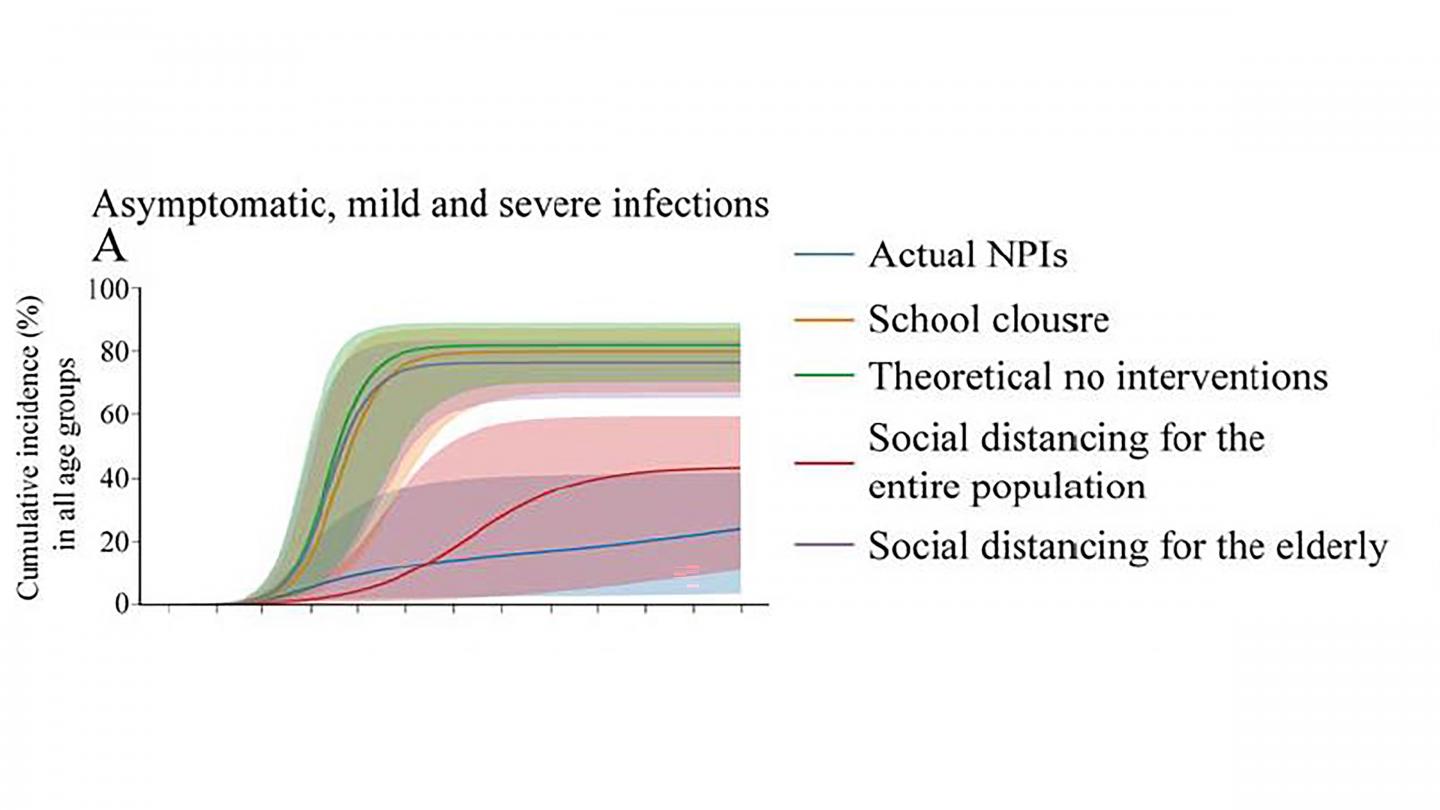
Credit: Jiannan Yang, Qingpeng Zhang, Zhidong Cao, Jianxi Gao, Dirk Udo Pfeiffer, Lu Zhong, and Daniel Zeng
WASHINGTON, February 9, 2021 — School closures, the loss of public spaces, and having to work remotely due to the coronavirus pandemic have caused major disruptions in people’s social lives all over the world.
Researchers from City University of Hong Kong, the Chinese Academy of Sciences, and Rensselaer Polytechnic Institute suggest a reduction in fatal coronavirus cases can be achieved without the need for so much social disruption. They discuss the impacts of the closures of various types of facilities in the journal Chaos, from AIP Publishing.
After running thousands of simulations of the pandemic response in New York City with variations in social distancing behavior at home, in schools, at public facilities, and in the workplace while considering differences in interactions between different age groups, the results were stunning. The researchers found school closures are not largely beneficial in preventing serious cases of COVID-19. Less surprisingly, social distancing in public places, particularly among elderly populations, is the most important.
“School only represents a small proportion of social contact. … It is more likely that people get exposure to viruses in public facilities, like restaurants and shopping malls,” said Qingpeng Zhang, one of the authors. “Since we focus here on the severe infections and deceased cases, closing schools contributes little if the elderly citizens are not protected in public facilities and other places.”
Because New York City is so densely populated, the effects of schools are significantly smaller than general day-to-day interactions in public, because students are generally the least vulnerable to severe infections. But keeping public spaces open allows for spread to occur from less-vulnerable young people to the more-vulnerable older population.
“Students may bridge the connection between vulnerable people, but these people are already highly exposed in public facilities,” Zhang said. “In other cities where people are much more distanced, the results may change.”
Though the present findings are specific to New York, replacing the age and location parameters in the model can extend its results to any city. This will help determine the ideal local control measures to contain the pandemic with minimal social disruptions.
“These patterns are unique for different cities, and good practice in one city may not translate to another city,” said Zhang.
The authors emphasized that while these findings have promising implications, the model is still just a model, and it cannot capture the intricacies and subtle details of real-life interactions to a perfect extent. The inclusion of mobile phone, census, transportation, or other big data in the future can help inform a more realistic decision.
“Given the age and location mixing patterns, there are so many variables to be considered, so the optimization is challenging,” said Zhang. “Our model is an attempt.”
###
The article “The impact of non-pharmaceutical interventions on the prevention and control of COVID-19 in New York City” is authored by Jiannan Yang, Qingpeng Zhang, Zhidong Cao, Jianxi Gao, Dirk Udo Pfeiffer, Lu Zhong, and Daniel Zeng. The article will appear in Chaos on Feb. 9, 2021 (DOI: 10.1063/5.0040560). After that date, it can be accessed at https:/
ABOUT THE JOURNAL
Chaos is devoted to increasing the understanding of nonlinear phenomena in all areas of science and engineering and describing their manifestations in a manner comprehensible to researchers from a broad spectrum of disciplines. See https:/
Media Contact
Larry Frum
[email protected]
Related Journal Article
http://dx.