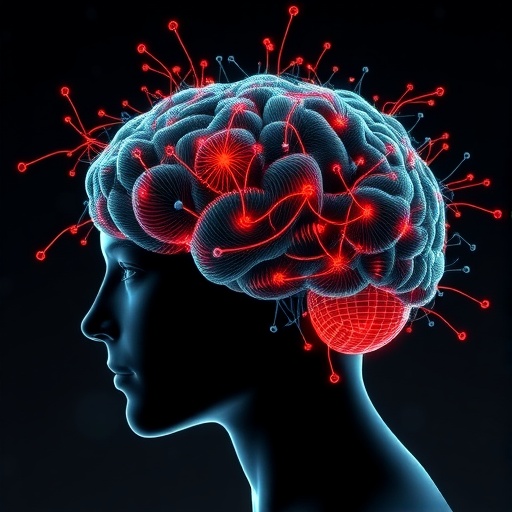
Researchers have developed a computer model of the human cortex that connects molecular-scale chemistry with brain-wide patterns of activity, offering new evidence that differences in receptor density can influence how information travels through the brain. The study, published in the Proceedings of the National Academy of Sciences, uses detailed maps of muscarinic acetylcholine receptors to show how the same neuromodulatory signal can have different effects in different cortical regions.
The work addresses a longstanding problem in systems neuroscience: how can events occurring at the level of molecules and receptors shape the coordinated activity of billions of neurons? Many whole-brain models simplify the cortex by assigning similar physiological properties to every region. While this approach makes simulations easier to construct, it can overlook an important feature of real brains—the cortex is chemically and functionally heterogeneous. Different areas contain different concentrations of receptors, possess distinct cellular properties, and participate in different anatomical networks.
To investigate the consequences of this heterogeneity, the researchers built their model using The Virtual Brain, an open-source platform for simulating activity across the entire brain. The model combined the brain’s structural connectivity—the physical network of long-distance pathways linking cortical regions—with regional maps of muscarinic acetylcholine receptor density. These receptors are activated by acetylcholine, a neuromodulator involved in attention, arousal, learning, memory, and transitions between sleep and wakefulness.
The model represented 68 cortical regions, each with its own receptor-defined response characteristics. Rather than treating acetylcholine as a uniform influence across the cortex, the researchers allowed its effects to vary according to the local density of muscarinic receptors. In technical terms, receptor maps were used to alter the dynamical properties of individual regions within a network model, while anatomical connections determined how activity could spread between them. This created a simulation in which local chemistry and global communication were linked within the same computational framework.
The researchers then examined how the simulated cortex behaved across a range of brain states, from wakefulness to sleep. When regional receptor differences were included, the model produced stronger coordination between areas and more effective information flow than a control model in which all cortical regions were assigned identical properties. The result suggests that biological variation is not simply a source of noise or complexity. When it is spatially organised and aligned with the brain’s structural network, heterogeneity can help the cortex generate richer and more flexible patterns of activity.
The findings also reveal why neuromodulators cannot be expected to act in the same way everywhere. A chemical signal such as acetylcholine may increase or decrease the excitability of a region depending on which receptor populations are present and how they interact with local network dynamics. A high-receptor area may respond strongly to a change in neuromodulatory input, while a neighbouring region with a different receptor profile may respond more weakly or in another manner. The resulting pattern of activity depends not only on chemistry, but also on the pathways connecting those regions to the rest of the brain.
One of the most striking outcomes was the model’s ability to reproduce localised slow waves. In real brains, slow, sleep-like activity can sometimes appear in limited cortical areas while other regions remain in a more awake-like state. Such local sleep patterns have been associated with attentional lapses, sleep deprivation, and the presence of brain lesions. The simulated phenomenon emerged spontaneously, without requiring every region to enter the same global state at once, suggesting that regional differences in neuromodulatory sensitivity may contribute to the brain’s ability to occupy mixed or transitional states.
This behaviour is important because conventional descriptions of sleep and wakefulness often treat them as whole-brain conditions. In reality, brain states can be fragmented: some networks may become less responsive while others continue to support perception, attention, or internally directed thought. By incorporating receptor distributions into a model of the cortical connectome, the researchers provide a possible mechanism for this partial decoupling. Local chemistry may help determine which regions are vulnerable to state changes, while structural connections influence whether those changes remain local or spread through the network.
The study’s authors say this type of multiscale modelling could eventually help explain abnormal state transitions in conditions involving brain damage or impaired consciousness. Lesions can disrupt structural connectivity, while disease or injury may also alter receptor expression and neuromodulatory systems. A model that represents both factors could help researchers test how local damage changes global dynamics and why some brain regions continue to function while others display sleep-like activity. The work does not yet provide a clinical tool, but it offers a framework for generating predictions that can be tested with neuroimaging, electrophysiology, and pharmacological experiments.
More broadly, the findings challenge the idea that brain-wide dynamics can be understood from anatomy alone. The physical wiring of the cortex provides the routes along which activity can move, but receptor distributions help determine how each region responds when activity arrives. By combining molecular maps with structural connectivity, whole-brain simulations may become more biologically realistic without needing to model every neuron individually. The researchers suggest that this approach could improve future studies of attention, sleep, consciousness, and neuromodulation—and bring computational neuroscience closer to explaining how microscopic biology gives rise to the shifting states of the human brain.
Subject of Research: The influence of spatially structured muscarinic acetylcholine receptor density on large-scale human cortical dynamics.
Article Title: Spatially structured heterogeneity shapes large-scale cortical dynamics in a model of the human cortex
Web References:
https://www.pnas.org/doi/10.1073/pnas.2532072123
https://ebrains.eu/data-tools-services/tools/the-virtual-brain
https://ebrains.eu/impact/projects/ebrains-20
https://www.virtualbraintwin.eu
References: Proceedings of the National Academy of Sciences, DOI: 10.1073/pnas.2532072123
Keywords
Neuroscience, human cortex, computational neuroscience, whole-brain modelling, The Virtual Brain, acetylcholine, muscarinic receptors, neuromodulation, brain connectivity, sleep, consciousness, cortical dynamics
Tags: brain chemistry influencebrain-wide neural connectivitychemical modulation of neural activitycortical receptor densityhuman cortex computer simulationlarge-scale neural activity modelingmolecular basis of brain dynamicsmuscarinic acetylcholine receptorsneuromodulatory signals in brain functionregional heterogeneity in brain chemistrysystems neuroscience and receptor mappingThe Virtual Brain platform