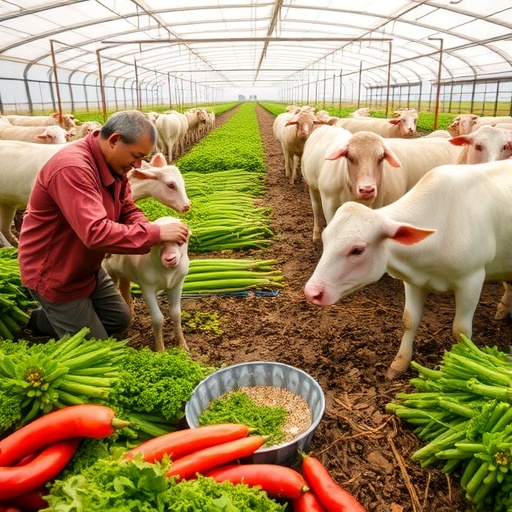
Agricultural trade between the United States and China is usually discussed in terms of tariffs, prices and food security. But a new study suggests that the specific products moving between the two countries could also determine how much nitrogen pollution and greenhouse gas emissions the global food system produces. According to the analysis, replacing much of the current trade in animal feed with trade in animal-derived foods could deliver major environmental gains while increasing U.S. agricultural revenue by billions of dollars.
The research examines a trade relationship dominated by U.S. exports of soybeans, maize and other crops used to feed livestock in China. Under the alternative scenario, meat, milk and eggs would be produced in the United States and exported to China instead of shipping large quantities of feed across the Pacific. The researchers estimate that this shift could reduce global agricultural nitrogen loss by 38%, lower greenhouse gas emissions by 17% and cut environmental damage costs by 32% compared with the current feed-based trading system. U.S. agricultural trade revenue could rise by approximately US$10.5 billion, with an uncertainty range of ± US$2.4 billion.
The findings, published in Nitrogen Cycling, are based on comparisons of three trade scenarios using data from 2022. The first represented highly restricted agricultural trade between the United States and China. The second reflected the current system, in which the United States primarily exports feed crops to support livestock production in China. The third modeled a food-trade system in which livestock production would be expanded in the United States and animal-derived products would be exported to China.
The current feed trade already offers some environmental advantages over producing the same crops entirely in China. The study estimates that existing U.S.-China feed trade reduces global nitrogen loss by about 32% and greenhouse gas emissions by roughly 7%. One reason is that U.S. agriculture generally uses nitrogen more efficiently. Nitrogen fertilizer is essential for high crop yields, but nitrogen that is not absorbed by plants can escape into soil, rivers and the atmosphere, where it contributes to water pollution, algal blooms, air pollution and climate change.
However, shipping feed across the Pacific also creates a major nutrient-recycling gap. Soybeans and maize are grown largely in the United States, while the animals that consume them are raised mainly in China. More than 40% of the nitrogen contained in imported feed is eventually lost as manure in China, according to the researchers. Instead of being returned to the cropland that produced the feed, this nitrogen is often concentrated near livestock facilities, where storage and disposal can become difficult. The result is a fragmented nutrient cycle in which one country produces the feed and another manages most of the waste.
Producing livestock closer to the crops that supply their feed could help reconnect those parts of the agricultural system. In the food-trade scenario, the researchers found that less feed nitrogen would be needed to produce the same amount of meat, milk and eggs because livestock production in the United States was estimated to be more efficient in the modeled system. As a result, greenhouse gas emissions associated with the trade relationship could fall from approximately 57 ± 8 million metric tons of carbon dioxide equivalent to 48 ± 7 million metric tons.
The potential benefits would not be distributed evenly across the United States. Expanding livestock production could increase nitrogen losses and greenhouse gas emissions in several major agricultural regions, including parts of Iowa, North Carolina, California, Texas and the Great Plains. More animals would mean greater amounts of manure, and without adequate storage, treatment and application systems, local pollution could intensify even while global emissions declined. The result highlights a central challenge of climate-smart agriculture: a policy that improves global averages can still create serious environmental pressures in particular communities.
To address that risk, the researchers also examined strategies for improving nutrient management. Recycling plant-based food waste as animal feed could reduce the demand for newly grown feed crops, while better manure recovery could capture nitrogen and return it to agricultural soils as fertilizer. Combining these approaches with a shift toward animal-product exports could substantially reduce the additional environmental burden created by increased U.S. livestock production. In technical terms, the strategy aims to close nutrient loops, reduce nitrogen leakage and make more efficient use of nutrients already present in the food system.
The authors stress that their results do not mean the United States should simply expand livestock production or replace all feed exports with meat and dairy exports. The study instead presents trade composition as an overlooked environmental policy tool. Decisions about agricultural commerce are typically guided by market prices, geopolitical concerns and food availability, but the environmental consequences depend heavily on where crops are grown, where animals are raised and where nutrients end up after harvest. “The environmental impact of agricultural trade depends not only on how much countries trade, but also on what they trade and where production takes place,” said corresponding author Xin Zhang.
The study suggests that future trade agreements could be evaluated using a broader set of indicators, including nitrogen loss, greenhouse gas emissions, manure-management capacity, water pollution and economic returns. A carefully designed portfolio of feed and food trade, supported by food-waste recycling and improved manure recovery, could make international agriculture more resource-efficient. As the global demand for animal products continues to grow, the research offers a provocative message: changing the direction and form of food trade may be almost as important as increasing production efficiency on individual farms.
Subject of Research: Agricultural trade, nitrogen cycling, livestock production, nutrient recycling and greenhouse gas emissions
Article Title: Shifting U.S.−China trade from feed to food reduces global agricultural nitrogen loss and greenhouse gas emissions
News Publication Date: 27 July 2026
Web References: https://doi.org/10.48130/nc-0026-0011
References: Wang Y, Gu B, Zhang X. 2026. “Shifting U.S.−China trade from feed to food reduces global agricultural nitrogen loss and greenhouse gas emissions.” Nitrogen Cycling 2: e024. DOI: 10.48130/nc-0026-0011
Image Credits: Yanyu Wang, Baojing Gu and Xin Zhang
Keywords
U.S.-China agricultural trade, animal feed, animal-derived foods, nitrogen loss, nitrogen cycle, greenhouse gas emissions, livestock production, manure management, food-waste recycling, sustainable agriculture, agricultural emissions, environmental economics
Tags: environmental impact of food tradefood trade scenario analysisglobal food system environmental footprintgreenhouse gas emissions from agricultureimpact of meat and dairy exportsnitrogen cycling in agriculturenitrogen pollution reductionreducing environmental damage costssustainable food systemtrade in animal feed vs. animal productsU.S. agricultural revenue from food tradeU.S.-China agricultural trade