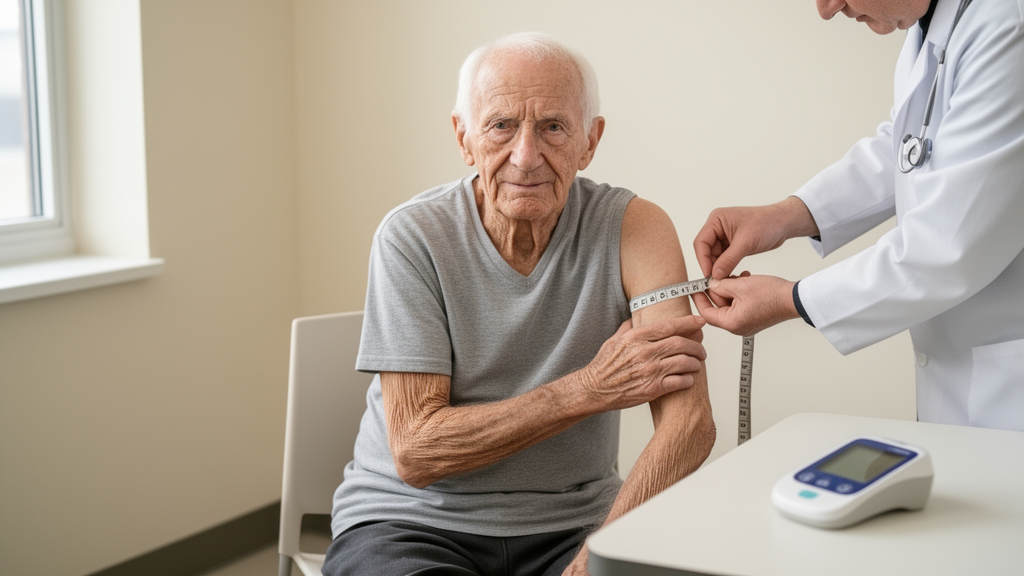
Sarcopenia—the progressive loss of muscle mass and strength—was present in just over half of older adults with type 2 diabetes enrolled in a new cross-sectional study, according to findings published in BMC Endocrine Disorders. Among 115 adults aged 60 to 75 years with type 2 diabetes mellitus, 61 participants met the diagnostic criteria for sarcopenia, yielding a prevalence of 53.0 percent with a 95 percent confidence interval of 43.5 to 62.4 percent. The condition was somewhat more frequent in women, affecting 37 of 63 women (58.7 percent) compared with 24 of 52 men (46.2 percent).
Because the study was observational and cross-sectional, it captured a single point in time and can identify associations but cannot establish causal relationships between metabolic factors and muscle loss.
To identify which clinical, metabolic and renal characteristics were linked to sarcopenia, the investigators applied several statistical safeguards. Skewed variables, including the urinary albumin-to-creatinine ratio (UACR), were log10-transformed before analysis. Univariate comparisons were adjusted using the Benjamini–Hochberg false discovery rate to limit spurious findings across multiple tests. A four-predictor logistic regression model was chosen to maintain more than 10 events per variable, and handgrip strength and raw triglycerides were deliberately excluded from the model because of incorporation bias and collinearity, respectively.
After false-discovery-rate adjustment, participants with sarcopenia were older and had lower body mass index and lower appendicular skeletal muscle mass index than those without the condition. They also took longer to complete a gait test, showed lower handgrip strength, carried a higher body-fat percentage, and displayed higher triglycerides, a higher triglyceride-to-high-density lipoprotein cholesterol (TG/HDL-C) ratio, and greater urinary albumin-to-creatinine ratios.
In the multivariable analysis, four factors remained independently associated with sarcopenia. Each additional second of gait time raised the odds by 54 percent (adjusted odds ratio 1.54; 95 percent CI 1.16–2.05). A higher TG/HDL-C ratio, a marker of atherogenic dyslipidaemia, was associated with 26 percent higher odds per unit increase (aOR 1.26; 95 percent CI 1.08–1.48). Greater body-fat percentage carried 11 percent higher odds per percentage point (aOR 1.11; 95 percent CI 1.03–1.20), and higher log10-transformed UACR, reflecting albuminuria, was associated with 22 percent higher odds (aOR 1.22; 95 percent CI 1.02–1.46).
The logistic model showed apparently good discrimination, with an area under the curve of 0.842 (95 percent CI 0.771–0.913). The authors note, however, that this figure reflects apparent performance within the same dataset and would need validation in independent cohorts before the model could be considered reliable elsewhere.
The findings paint a coherent picture of sarcopenia in type 2 diabetes as a condition tied not only to reduced physical performance but also to body composition and metabolic disturbances. The simultaneous links with adiposity, atherogenic lipid profile and albuminuria suggest that muscle loss in this population may travel alongside broader cardiometabolic and renal risk, although the cross-sectional design cannot determine whether these factors precede sarcopenia, follow it, or share common causes.
The authors conclude that sarcopenia was highly prevalent in older adults with type 2 diabetes and was associated with poorer physical performance, adiposity, atherogenic dyslipidaemia and albuminuria. They emphasise that these cross-sectional associations do not establish causality and call for confirmation in larger, independent, prospective multicentre studies.
Subject of Research: Prevalence and associated factors of sarcopenia in older adults with type 2 diabetes
Article Title: Prevalence and associated factors of sarcopenia in older adults with type 2 diabetes: a cross-sectional study
Article References: Behera, K. K., Mishra, A., Venkateswarlu, M., Singla, V., Dutta, P., & Shaharyar, A. (2026). Prevalence and associated factors of sarcopenia in older adults with type 2 diabetes: a cross-sectional study. BMC Endocrine Disorders. https://doi.org/10.1186/s12902-026-02594-3
Image Credits: AI Generated
DOI: 10.1186/s12902-026-02594-3
Keywords: sarcopenia, type 2 diabetes, older adults, cross-sectional study, handgrip strength, gait speed, albuminuria, TG/HDL-C ratio, body-fat percentage, Asian Working Group for Sarcopenia, muscle mass, BMC Endocrine Disorders
News Source: Ophelia Keating. (October 27, 2026). Sarcopenia Found in Half of Older Adults with Type 2 Diabetes in Cross-Sectional Study. Scienmag.