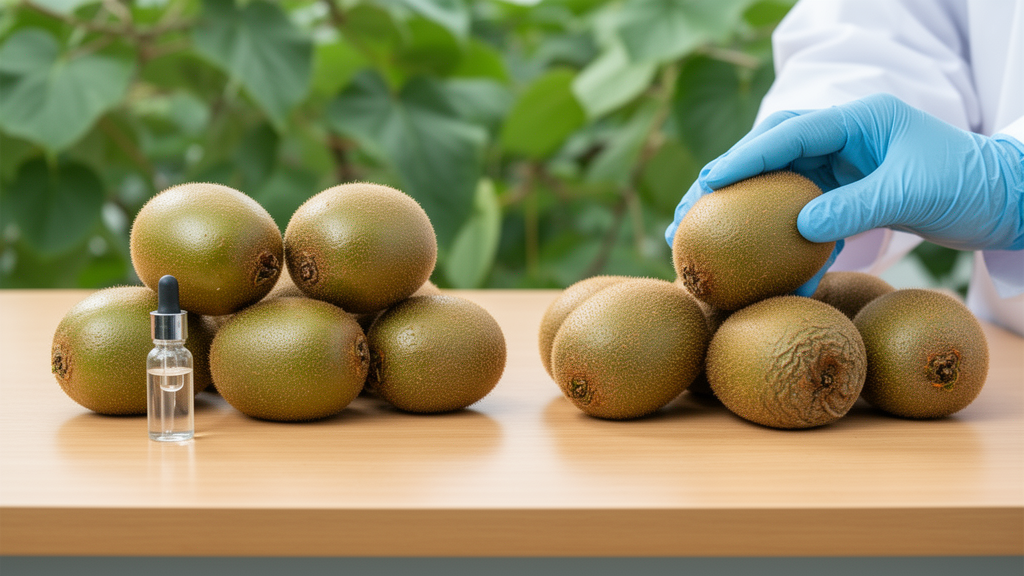
Thidiazuron (TDZ), a synthetic plant growth regulator, can substantially slow the postharvest softening of kiwifruit, according to a study published in BMC Plant Biology. Rapid softening is a central limitation on the storage and shelf life of kiwifruit, and the research set out to clarify how TDZ influences the transcriptional changes that accompany this process.
The researchers integrated measurements of six physiological traits with 36 RNA-seq libraries to characterize fruit responses to a 600 mg per litre TDZ treatment, evaluating effects at matched times from 4 to 20 days after harvest. The physiological contrast was stark: at 20 days after harvest, treated fruit retained a firmness of 27.72 newtons, compared with just 3.78 newtons in untreated controls. Titratable acidity, starch, pectin and hemicellulose were also better retained in the treated fruit, indicating that TDZ slowed the breakdown of the structural and storage compounds that determine fruit texture.
Transcriptome sequencing revealed that gene-expression differences between treated and control fruit were already detectable at 4 to 8 days after harvest and became more pronounced at 12 to 20 days after harvest. A treatment-by-time analysis identified 15,607 interaction-responsive genes, which the team organized into six temporal clusters. Co-expression analysis then prioritized three modules and twelve candidate genes spanning ethylene signalling and biosynthesis, starch and sugar metabolism, and cell-wall precursor metabolism and remodelling.
The temporal pattern of these candidates was not uniform. Several of the twelve genes increased in expression between 20 and 40 days after TDZ treatment, whereas others changed little or decreased over the same interval. This staggered behaviour underpins the authors’ proposed temporal-displacement model, in which delayed softening reflects coordinated, time-shifted changes across ethylene, carbohydrate and cell-wall programmes rather than a single uniform switch.
The authors conclude that the twelve prioritized candidates offer a focused starting point for investigating the regulation of TDZ-mediated softening delay in kiwifruit. As the article is shared as an accepted manuscript carrying a permanent DOI ahead of final editorial production, the findings are citable in their current peer-reviewed form, with a final Version of Record to follow.
Subject of Research: How thidiazuron delays postharvest softening in kiwifruit through shifts in ethylene, starch and cell-wall gene expression
Article Title: Thidiazuron delays postharvest kiwifruit softening with temporal shifts in ethylene, starch and cell-wall programmes
Article References: Li, W., Song, H., Liang, B., Xu, S., Lin, M., & Duan, Z. (2026). Thidiazuron delays postharvest kiwifruit softening with temporal shifts in ethylene, starch and cell-wall programmes. BMC Plant Biology. https://doi.org/10.1186/s12870-026-10300-7
Image Credits: AI Generated
DOI: 10.1186/s12870-026-10300-7
Keywords: kiwifruit, thidiazuron, postharvest, fruit softening, ethylene, RNA-seq, cell wall, starch metabolism, gene expression, 1-methylcyclopropene, plant hormone, BMC Plant Biology
News Source: Juliet Wilcox. (October 27, 2026). Plant Hormone Treatment Keeps Harvested Kiwifruit Firm for Longer. Scienmag.