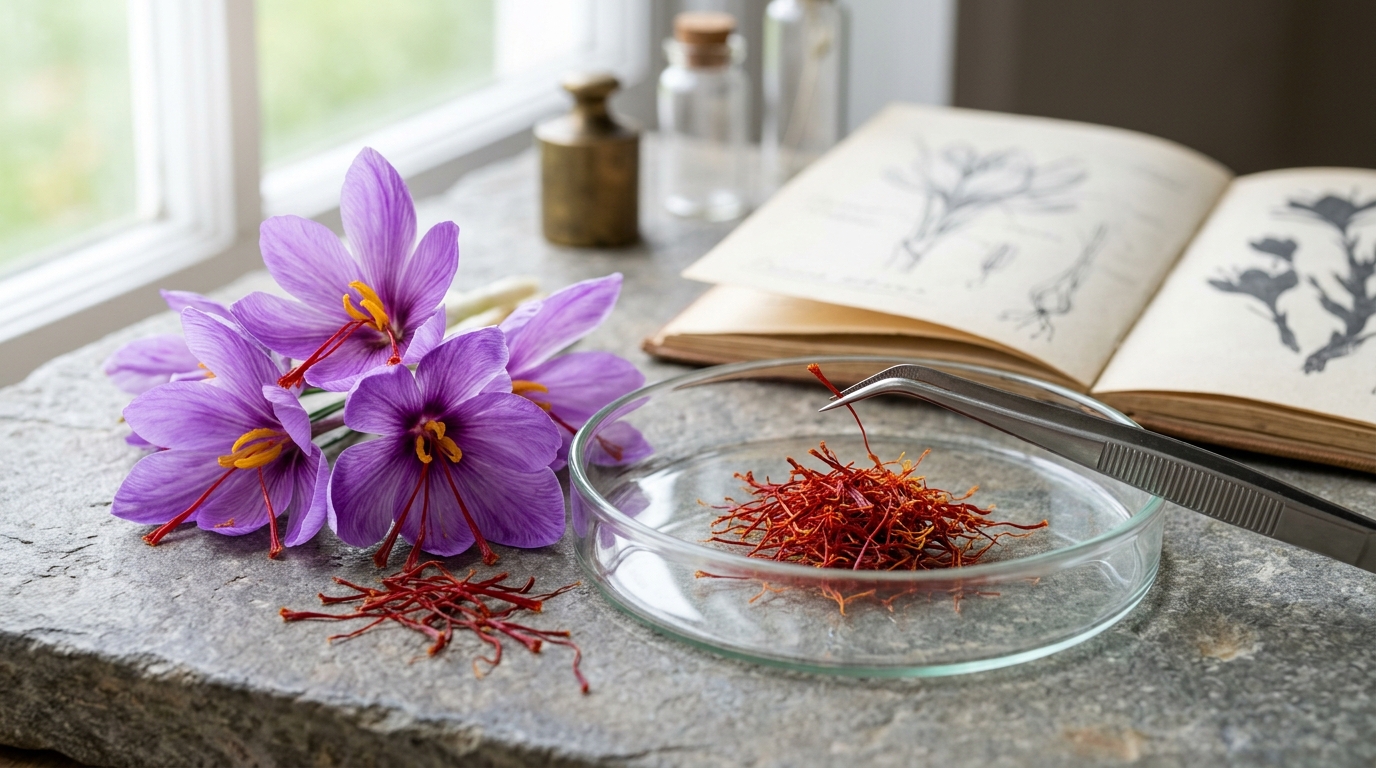
Cultivated saffron, the world’s most expensive spice, has spent roughly 3,600 years in a genetic holding pattern. A review published in Plant Cell Reports describes Crocus sativus as a sterile autotriploid clone with 24 chromosomes, propagated exclusively by dividing its underground corms since a single auto-triploidisation event gave rise to the crop. Because the plant cannot produce viable seed, no F2 population, recombinant inbred line, QTL mapping population or genome-wide association study has ever been generated for saffron, and triploid meiosis forecloses recombination-based breeding outright.
The scale of that stagnation is measurable. Sequence-level polymorphism across the global saffron crop barely reaches 4%, meaning that plants grown from Spain to Kashmir are, for practical breeding purposes, near-identical copies of one ancestral genome. The review’s authors, led by Mehrajuddin Sofi and colleagues, argue that this genetic standstill now coincides with an accelerating production crisis. Kashmir has lost more than 70% of its historical stigma yield, the thread-like flower parts that give saffron its value, while global stigma output has fallen by roughly 35% over recent decades.
What little heritable variation remains accessible lies largely outside the DNA sequence itself. Across the World Saffron and Crocus Collection, methylation polymorphism, chemical marks attached to the genome that can alter gene activity without changing the underlying letters, runs eight times higher than sequence polymorphism. The authors identify this epigenetic divergence as the only substantial non-mutagenic source of heritable variation currently available to breeders, elevating epigenomic selection from a niche idea to a central strategy for the crop.
The threats converging on saffron fields are equally specific. Heat, drought, cold stress and disease driven by the fungus Fusarium all impinge on two compact biological targets: the florigen activation complex, which governs the transition to flowering, and the apocarotenoid pathway, which produces the pigmented compounds that define saffron quality. Within these pathways the review singles out a short list of lead targets, including the flowering gene CsatSVP2, the carotenoid cleavage enzyme gene CsCCD2, and a defined catalogue of NBS-LRR resistance genes relevant to disease defence.
That target list matters because the genomic infrastructure surrounding saffron has changed dramatically. The review evaluates current strategies against a fully phased 8.42-gigabase triploid assembly of the saffron genome, a reference that resolves the three ancestral chromosome sets separately rather than collapsing them into a single muddled sequence. With such a reference in hand, the authors argue, improvement is no longer limited mainly by a shortage of molecular targets or tools.
Instead, the decisive constraints are a small number of translational bottlenecks, and the most formidable is the absence of any published whole-plant regeneration pipeline for edited tissue. Without a reliable method to grow an entire saffron plant from a cell whose genome has been altered, even a precisely targeted edit remains trapped in culture. The review ranks these bottlenecks by dependency, treating regeneration as the gate through which every other intervention must pass.
Against that infrastructure, the authors assess the strategies open to the crop: epigenomic selection, clean-stock reform to eliminate pathogen loads from planting material, induced mutagenesis, somaclonal selection of variation arising in tissue culture, pre-breeding with wild Crocus relatives, and CRISPR, base and prime editing. Each approach sidesteps the sexual recombination that triploid meiosis denies the plant, but each also depends on the regeneration and delivery systems that remain unfinished.
Wild-relative pre-breeding illustrates both the promise and the difficulty. Wild Crocus species carry genetic diversity that domesticated saffron has lost, and crossing programmes could in principle transfer traits such as disease resistance or stress tolerance into the crop. Yet any such programme must still contend with the triploid barrier that blocks conventional seed-based breeding, making the pathway slower and more technically demanding than in diploid or tetraploid crops.
The review sets out the authors’ own view of research priorities for the next five to fifteen years, framing saffron as a test case for crops whose biology defeats standard breeding. The picture that emerges is not one of missing tools but of a narrow, well-defined gap between genome sequence and edited plant. Closing that gap, the authors argue, will determine whether a crop cloned for three and a half millennia can finally be bred at all.
Subject of Research: Genetic constraints and breeding strategies for the sterile triploid saffron crop under climate and production pressure
Article Title: Breeding the unbreedable: bottlenecks and genetic pathways to climate-resilient saffron (Crocus sativus L.)
Article References: Sofi, M., Reshi, S. M., Khan, M. H., Qureshi, A. M. I., Mustafa, S., & Butter, B. S. (2026). Breeding the unbreedable: bottlenecks and genetic pathways to climate-resilient saffron (Crocus sativus L.). Plant Cell Reports, 45(11), Article 351. https://doi.org/10.1007/s00299-026-04035-w
Image Credits: AI Generated
DOI: 10.1007/s00299-026-04035-w
Keywords: saffron, Crocus sativus, autotriploid, epigenomics, CRISPR editing, Fusarium, stigma yield, genome assembly, plant breeding, Kashmir, apocarotenoid pathway, CsCCD2
News Source: Juliet Wilcox. (November 6, 2026). Saffron’s genetic standstill: why the world’s costliest spice resists breeding. Scienmag.