A nationwide investigation of protected natural habitats in Poland has revealed that macroclimatic factors and major transport corridors represent the primary drivers of alien plant invasions, while local human population density and protective legal designations exert no statistically significant deterrent effect. Drawing upon empirical surveillance records from the Polish State Environmental Monitoring programme, researchers evaluated 2,096 monitoring sites distributed across the country to examine the mechanisms governing non-native plant establishment. The investigated network comprised 15 representative habitat types protected under the European Union Habitats Directive, grouped into five broad formations: broadleaf deciduous forests, riverine habitats, dry grasslands, mesic and wet grasslands, and mires. By combining standardized botanical observations with 38 environmental and anthropogenic variables, the authors discovered that regions characterized by milder winter minimum temperatures, greater winter precipitation, and higher temperature seasonality exhibit elevated invasion probabilities. Furthermore, proximity to major rivers and primary highways significantly facilitated alien plant establishment, whereas surrounding land-cover structures and local human presence showed no significant correlation with invasion.
The Natura 2000 network represents the largest coordinated conservation framework globally, comprising over 26,000 protected sites that span 17.5 percent of the European land surface. In Poland, Natura 2000 sites were established following accession to the European Union in 2004 and presently cover 19.6 percent of the national territory. Under Article 17 of Council Directive 92/43/EEC, commonly designated the Habitats Directive, member states are obligated to monitor and report periodically on the conservation status of designated habitat types. Invasions by alien plant species represent a pervasive threat to global nature conservation, causing severe ecological degradation by displacing native vegetation, diminishing biodiversity, and altering geochemical nutrient cycles. While the destructive influence of invasive plants has been extensively documented in heavily transformed agricultural and urban landscapes, systematic field investigations within protected European conservation areas remain scarce. Consequently, substantial knowledge gaps have persisted regarding the specific abiotic and anthropogenic factors that drive non-native plant establishment inside protected natural habitats.
To resolve these knowledge gaps, the authors analyzed botanical monitoring data compiled by the Polish State Environmental Monitoring programme between 2016 and 2021. This state-coordinated monitoring framework is supervised by the Chief Inspectorate of Environmental Protection and financed by the National Fund for Environmental Protection and Water Management. Qualified botanical experts surveyed vegetation along semi-permanent transects measuring 10 by 200 meters across continuous patches of target habitats, adapting transect dimensions for smaller, fragmented communities such as muddy riverbank Chenopodion rubri and Bidention vegetation. Information on alien plant occurrences was recorded at two distinct administrative tiers: habitat-specific status indicators assessing non-native vegetative cover in canopies and undergrowth, and formal threat assessments cataloged under the invasive alien species reporting code. For each monitoring location, researchers extracted data from the most recent surveillance round, retaining only plant taxa officially recognized as invasive species within national botanical assessments to construct an analytical presence-absence dataset.
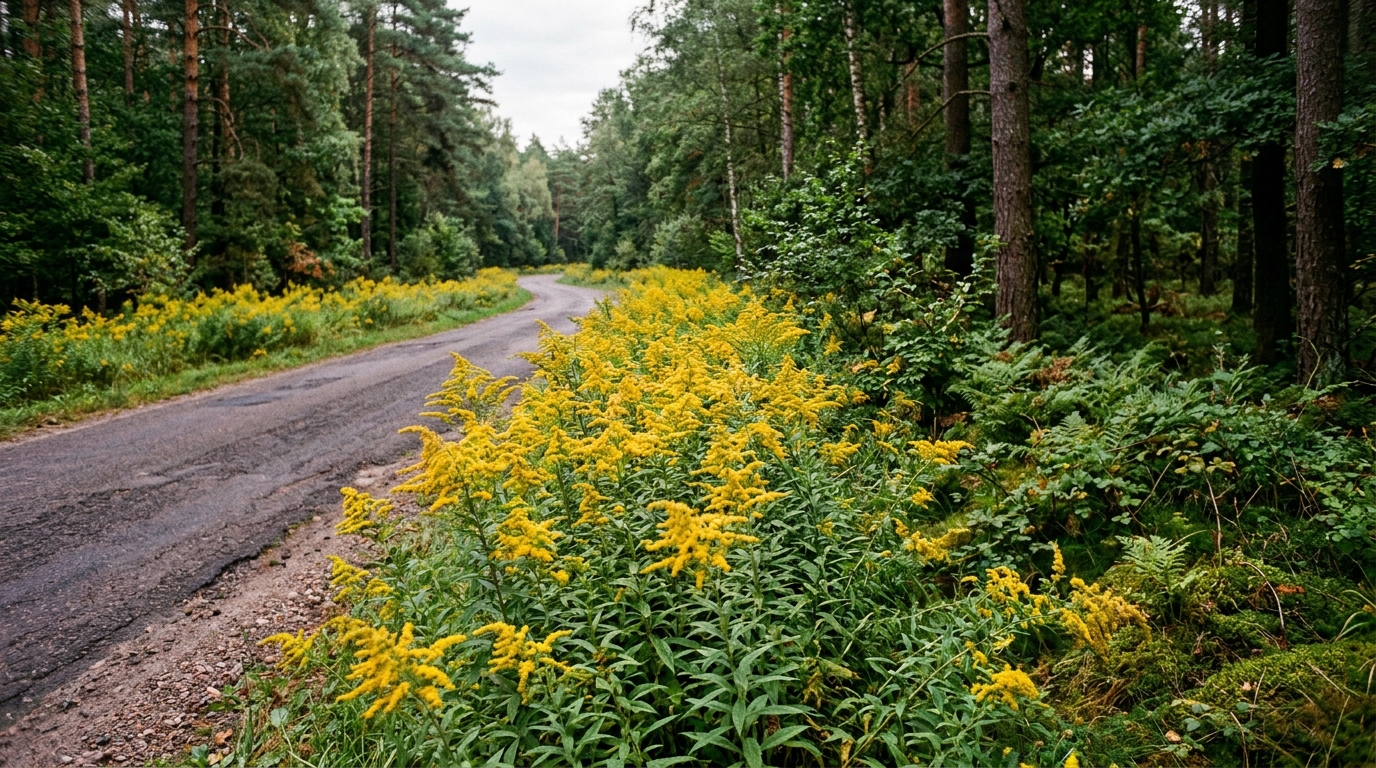
Across the 2,096 surveyed sites, field observers documented the complete absence of invasive plants at 1,133 sites, whereas invasive species were detected at 963 sites. Because nearly half of the monitored sites remained uninvaded and exactly 553 invaded locations hosted only a single non-native species, the analysis modeled the binary probability of invasion rather than absolute species richness or canopy cover. The empirical dataset identified 45 invasive plant species alongside two potentially invasive plant species across the monitoring network. Small balsam, Impatiens parviflora, an annual species native to Asia, emerged as the most frequent invader, recorded at 396 sites and occupying 50.5 percent of surveyed broadleaf forest patches. The remaining predominant invaders originated from North America, led by black cherry (Prunus serotina) across 124 sites, giant goldenrod (Solidago gigantea) at 121 sites, horseweed (Erigeron canadensis) at 89 sites, Canada goldenrod (Solidago canadensis) at 66 sites, devil’s beggarticks (Bidens frondosa) at 58 sites, and northern red oak (Quercus rubra) across 49 sites.
To isolate the predictors influencing invasion probabilities independently of habitat type, researchers evaluated 38 independent variables describing physical, ecological, and human dimensions. These candidate predictors included broad habitat group designations, surrounding land-use categories within a five-kilometer radius, landscape disturbance regimes, and nature protection status. Land-use attributes derived from CORINE Land Cover captured the proportional area of artificial surfaces, arable land, semi-natural surfaces, wetlands, and inland water bodies, alongside Shannon land-cover heterogeneity indices. Cumulative anthropogenic transformation was quantified using the Global Human Modification index, which synthesizes 13 distinct human stressors across five categories. Additional human impact proxies included population density from WorldPop, road density from the Global Roads Inventory Project, and travel times to cities with populations exceeding 50,000 inhabitants. Potential migration corridors were represented by geographic distances to the nearest major river from the Map of Poland’s Hydrographic Division, as well as distances to primary roads and railways derived from OpenStreetMap.
Climatic variables were compiled from the CHELSA database, encompassing 19 standard bioclimatic indicators alongside mean January minimum temperatures and July maximum temperatures from 1990 to 2010. Following min-max scaling to standardize variables between zero and one, the investigators performed a two-step predictor selection procedure to eliminate collinearity. From each variable pair displaying absolute Pearson correlation coefficients of 0.7 or higher, only the predictor demonstrating superior importance based on random forest percentage increase in mean squared error was retained. Initial generalized linear modeling revealed significant spatial autocorrelation among residuals (Moran’s test, p < 0.001) due to geographical clustering of monitoring transects. To account for this clustering, the team applied a generalized additive model (GAM) using the mgcv package in R, incorporating ATPOL ten-by-ten kilometer geobotanical grid cells as a smooth spatial term. This smooth term resolved spatial autocorrelation (Moran’s test, p = 0.219), with the final GAM explaining 42.9 percent of deviance and achieving an adjusted R-squared of 0.439.
The generalized additive model demonstrated that macroclimatic variables exerted the strongest influence on the probability of alien plant invasion across protected habitats. Mean daily minimum near-surface air temperature in the coldest month emerged as the single most influential climatic predictor, showing a strong positive relationship with invasion probability. Milder winter minimum temperatures significantly enhance the overwinter survival of alien plant seeds and vegetative tissues, facilitating persistent establishment into subsequent growing seasons. Mean monthly precipitation during the coldest quarter also exhibited a statistically significant positive effect, indicating that greater winter moisture increases invasion risk, potentially by preventing physiological winter drought and insulating overwintering tissues through snow cover. Furthermore, temperature seasonality displayed a statistically significant positive correlation with invasion probability. These climatic patterns correspond closely with Poland’s macroclimatic continentality gradient, which intensifies from west to east; colder, more continental winter conditions in eastern Poland and high-altitude southern mountain regions provide natural environmental resistance against non-native plant establishment.
Baseline vegetation structure also strongly influenced susceptibility to invasion, as revealed by post-hoc Wald tests comparing predicted invasion probabilities among habitat classifications. Riverine habitats and broadleaf deciduous forests exhibited the highest predicted invasion probabilities across the network, showing no statistically significant difference between each other (p = 0.382).
The modeling highlighted transportation networks and major waterways as vital corridors enabling the migration of invasive plants into protected habitats. Geographic distance to the nearest major river proved to be a highly significant negative predictor of invasion (p < 0.001), demonstrating that habitat patches situated closer to large rivers face substantially higher probabilities of invasion. Major river systems function as natural migration corridors, transporting seeds and vegetative fragments via hydrochory while creating recurrent bank disturbances that facilitate colonization. Proximity to major roads—specifically motorways, expressways, and primary national highways—likewise significantly increased invasion likelihood (p = 0.021). Conversely, overall road density within a five-kilometer radius, which includes minor local roads, showed no statistically significant association with invasion, indicating that primary transit corridors, rather than general local road density, act as the decisive facilitators of non-native plant spread.
Surprisingly, surrounding human population density, travel time to major cities, and the proportion of surrounding agricultural land showed no statistically significant relationship with invasion probability in the final model. The authors noted that the predominant invasive species identified across the sites are already widely established throughout central Europe, meaning their dispersal across protected habitats no longer depends on active urban introduction hubs. Furthermore, location within a strictly protected area, such as a national park or nature reserve, or within standard Natura 2000 boundaries, did not confer a statistically significant reduction in invasion likelihood.
Subject of Research: Macroclimatic and corridor drivers of plant invasions in Polish Natura 2000 habitats
Article Title: Plant invasions in Natura 2000 habitats in Poland are driven primarily by macroclimatic factors
Article References: Święcicki, S., Chojnowska, N., Kozub, Ł., & Dembicz, I. (2026). Plant invasions in Natura 2000 habitats in Poland are driven primarily by macroclimatic factors. NeoBiota, 110, 65-85. https://doi.org/10.3897/neobiota.110.187603
Image Credits: AI Generated
DOI: 10.3897/neobiota.110.187603
Keywords: plant invasions, Natura 2000, macroclimate, invasive species, habitat conservation, corridor ecology, Habitats Directive, Poland, Plant, invasions, Natura, habitats
News Source: Drew Townsend. (November 6, 2026). Climate and Transport Corridors Drive Plant Invasions Across Polish Protected Habitats. Scienmag.