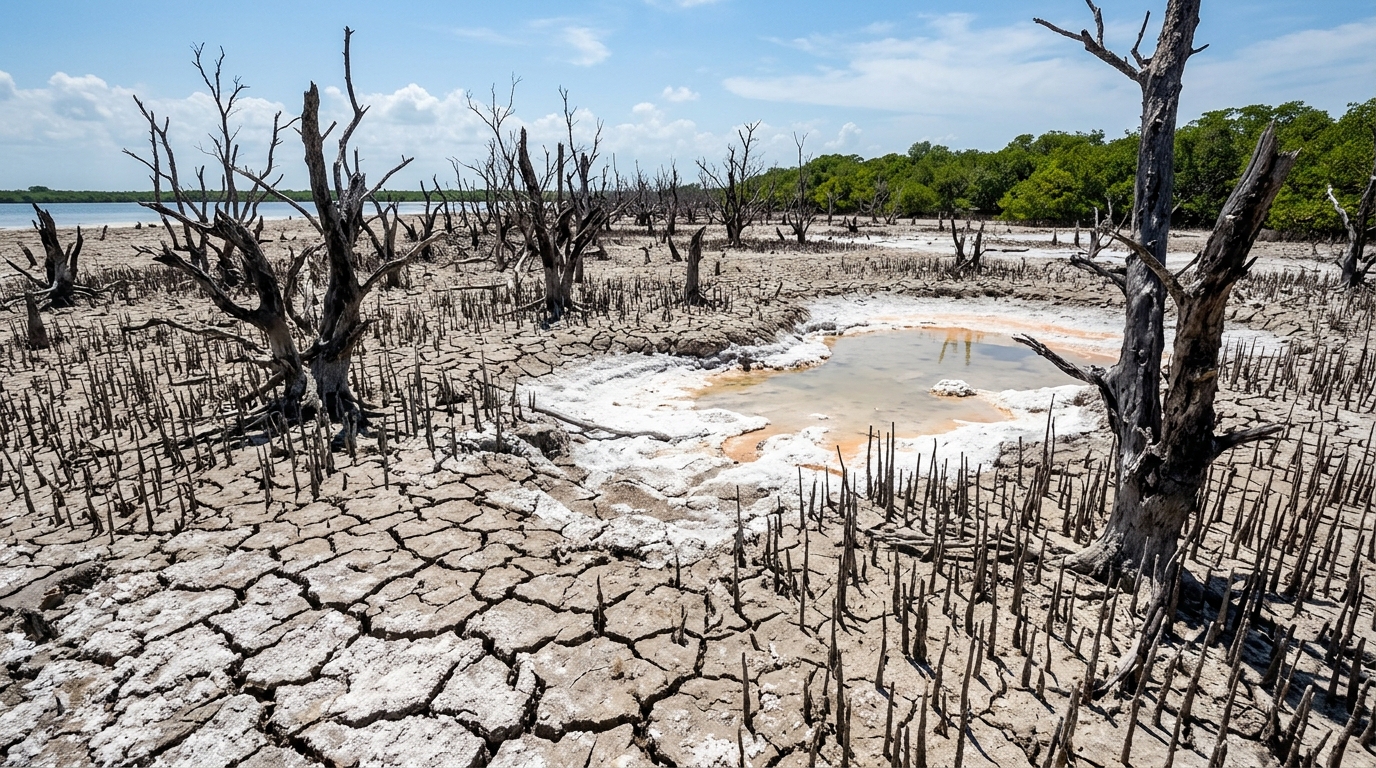
In the estuarine tidal network of Estero Pargo, located within the Laguna de Términos system in southeastern Campeche, Mexico, mass mortality of black mangrove (Avicennia germinans) stands has transformed extensive tracts of previously healthy basin forest into degraded, hypersaline mudflats. Field investigations spanning multiple seasons identified that this widespread die-back across a 22,686-square-meter mortality zone is primarily driven by seasonal hydrological isolation and intense biogeochemical stress. By combining spatial gradient analyses, manipulative field experiments, and a long-term monitoring initiative conducted between October 2012 and May 2016, researchers uncovered the precise environmental thresholds responsible for canopy collapse. The investigation revealed that during prolonged dry seasons, the severing of tidal and freshwater exchange lowers the groundwater table beyond thirty centimeters beneath the soil surface. This drop in the water table coincides with severe interstitial water hypersalinity exceeding seventy parts per thousand and strongly reducing, anaerobic soil conditions falling below minus one hundred millivolts, initiating a rapid decline in forest viability.
The study system in Estero Pargo spans a 5.9-kilometer tidal channel positioned at geographic coordinates 18°39’01” N and 91°45’35” W, an area historically recognized for its distinct, intact mangrove zonation despite regional urban pressures. Naturally structured communities in this coastal estuary shift systematically along an elevation gradient, beginning with red mangrove (Rhizophora mangle) fringe forests bordering open water channels, advancing through mixed stands, and terminating in expansive inland basin forests dominated by Avicennia germinans. However, acute canopy die-off has disrupted this sequence, leaving large areas dominated by standing dead trunks, bare sediment, and scattered halophyte colonization. Because Avicennia germinans typically displays exceptional physiological flexibility, tolerating extreme salt concentrations through foliar salt excretion and aerating below-ground tissues via specialized pneumatophores, its widespread mortality indicated that local environmental conditions had surpassed the physiological tipping points of one of the world’s most resilient mangrove species.
To evaluate the structural and environmental progression of the die-back, researchers established three continuous sampling transects ranging from 100 to 290 meters in length, oriented perpendicular to the shoreline across the full ecological gradient. Sampling stations positioned at ten- to twenty-meter intervals were classified into three categorical ecological zones based on canopy condition: healthy live zones retaining greater than eighty percent canopy cover with active reproduction; intermediate transition zones exhibiting between twenty and eighty percent canopy cover with intermixed living and dead trees; and dead zones characterized by less than twenty percent canopy cover and an absence of natural regeneration. Monthly physicochemical assessments at each station sampled interstitial porewater at a depth of fifteen centimeters using field piezometers, recording pH, water salinity, electrical conductivity, total dissolved solids, temperature, and oxidation-reduction potential standardized to temperature-corrected redox values.
The spatial gradient data confirmed a pronounced biogeochemical divergence that was not attributable to land surface elevation alone, as topographic leveling demonstrated that surface elevation remained relatively stable across the transects, varying within a narrow band between approximately 55 and 80 centimeters above sea level. Fringe forest soils adjacent to open water maintained positive redox potentials near positive one hundred millivolts and porewater salinities fluctuating between 18 and 30 parts per thousand during wet periods, rising to 40 to 55 parts per thousand in the inner basin. In contrast, the inland dead zone exhibited extreme seasonal hypersalinity surpassing 70 parts per thousand alongside highly reducing redox potentials dropping beneath minus one hundred millivolts. In addition, soil bulk density increased from 0.187 plus or minus 0.022 grams per cubic centimeter in healthy stands to 0.226 plus or minus 0.018 grams per cubic centimeter in mortality zones, while basin soil moisture frequently exceeded eighty percent, reflecting severe drainage impairment and persistent water stagnation.
Long-term hydrological tracking over thirty-four monthly campaigns across four complete annual cycles (2012 to 2016) demonstrated that this spatial mortality pattern directly reflects the cumulative impact of recurring seasonal hydrological disconnection rather than a static environmental gradient. During the dry seasons of 2013, 2014, and 2015, water levels within the dead zone experienced dramatic drawdowns, falling to mean zonal levels of minus 17.8 centimeters in August 2013, minus 42.0 centimeters in May 2015, and minus 40.4 centimeters in March 2016, with individual station extremes plunging past minus 80 centimeters. These drops were accompanied by sustained porewater hypersalinity that breached the critical 70 parts per thousand threshold between September and December 2013 and remained above 60 parts per thousand for extended periods. In contrast, water levels in the live zone rarely dropped below minus ten centimeters, whereas transition zones reached intermediate drops of minus twenty to minus thirty centimeters.
To determine the functional barriers preventing natural mangrove recovery, the research team implemented controlled factorial seedling transplant experiments within each ecological zone using nursery-grown Avicennia germinans saplings of thirty centimeters uniform height. Five experimental blocks per zone contained three 0.49-square-meter plots subjected to distinct microtopographic treatments: excavated plots lowered twenty centimeters below ground to simulate permanent waterlogging, control plots maintained at natural soil level, and elevated mounds raised twenty centimeters above ground level to enhance drainage. Over a ten-week monitoring period, seedling survival in the healthy fringe exceeded eighty percent across all water treatments, with greatest height gains and leaf production occurring in elevated and normal plots. In transition zones, survival decreased to sixty to seventy percent, with elevated plots outperforming flooded substrates. The most dramatic divergence occurred in the mortality zone, where survival dropped below twenty percent in flooded plots but improved to forty to fifty percent on elevated mounds.
Statistical evaluation of the seedling trial confirmed highly significant main effects of ecological zone and hydrological manipulation, as well as a significant interaction term between zone and treatment. Although raw differences between hydrological treatments in measured soil metrics appeared modest, ranging from five to ten parts per thousand in salinity and twenty to forty millivolts in redox potential, these differences crossed key physiological limits. Interstitial salinities above fifty parts per thousand impose heavy energetic and osmotic costs on Avicennia germinans, while redox potentials below minus one hundred millivolts induce toxic sulfide accumulation that suppresses root respiration and nutrient uptake. Complementary experiments evaluating biotic pressures and seed provenance demonstrated that while herbivory exclusion cages reduced insect damage and arthropod pressure, provenance comparisons between local Estero Pargo propagules and Pacific coast seedlings from Parque Nacional Lagunas de Chacahua in Oaxaca showed no significant survival differences, proving that abiotic hydrological constraints outweigh genetic seed origin.
A critical discovery within the degraded basin was the vital ecological function performed by fourteen isolated, surviving Avicennia germinans adult trees that persisted within the mortality zone. Detailed monthly monitoring of seven isolated individuals from September 2014 to September 2015 revealed that their canopies created localized microenvironmental refugia that mitigated extreme abiotic stress. Beneath surviving adult canopies, average soil redox potential remained around minus forty millivolts compared to values below minus one hundred millivolts in exposed soils just one meter outside the pneumatophore zone. Interstitial salinity under the canopy averaged approximately 50 parts per thousand compared to over 57 parts per thousand in adjacent open mudflats, and soil moisture was moderated at 78 percent versus near-saturated open sediment.
The biological benefits of these canopy-mediated microrefugia were verified through seedling transplants positioned directly beneath remnant trees versus one meter outside their root perimeter. Seedlings planted under remnant canopies achieved eighty-five percent survival after four months, producing vigorous new leaves and adventitious roots, whereas seedlings planted in open mudflats suffered heavy mortality, with less than thirty percent surviving beyond six weeks. Remnant canopies also provided biological protection, as seedling herbivory rates were substantially lower under the canopy at eighteen percent compared to forty-one percent in adjacent exposed areas. Multivariate principal component analysis indicated that three dominant axes explained more than seventy percent of the total environmental variance across Estero Pargo, highlighting porewater salinity, redox potential, and distance from the tidal channel as primary factors, while canopy presence, pneumatophore density, and seedling survival defined the secondary axis of ecological stability.
The synthesis of temporal, spatial, and experimental findings indicates that the die-back in Estero Pargo is sustained by destructive positive feedback mechanisms that push degraded stands toward an alternative stable state of unvegetated hypersaline flats. When canopy loss exceeds eighty percent, increased solar irradiance heats the exposed sediment and accelerates evaporative water loss, concentrating salts and driving porewater salinity higher. Concurrently, the decomposition of dead root systems destabilizes hydric soils and eliminates the pneumatic aeration that oxygenates rhizosphere sediments, creating an environment inhospitable to natural recruitment. Annual surveys confirmed that dead zones expanded consistently, with some transition edges losing fifteen to twenty percent of canopy cover each year and experiencing salinity jumps of fifteen to twenty parts per thousand within months of tree death. Effective ecological restoration in Estero Pargo and comparable Gulf of Mexico mangrove wetlands cannot rely on static replanting, but must combine hydrological reconnection, microtopographic drainage elevation, and strict preservation of remnant nurse trees.
Subject of Research: Drivers of black mangrove mortality and microenvironmental refugia in Estero Pargo, Mexico
Article Title: Hydrological isolation, feedback mechanisms, and microenvironmental refugia drive black mangrove (Avicennia germinans) mortality in Estero Pargo, Laguna de Términos, Mexico
Article References: Rosas Meléndez, N. S., Garrido Abreu, C. G., Arjona Jiménez, C. F., Gómez Tolosa, M., Agraz Hernández, C. M., & López Rosas, H. (2026). Hydrological isolation, feedback mechanisms, and microenvironmental refugia drive black mangrove (Avicennia germinans) mortality in Estero Pargo, Laguna de Términos, Mexico. Discover Life, 56(1), Article 26. https://doi.org/10.1007/s11084-026-09747-3
Image Credits: AI Generated
DOI: 10.1007/s11084-026-09747-3
Keywords: Avicennia germinans, mangrove dieback, hydrological isolation, soil hypersalinity, Laguna de Terminos, Estero Pargo, ecosystem restoration, microenvironmental refugia, Hydrological, isolation, feedback, mechanisms
News Source: Drew Townsend. (November 6, 2026). Hydrological Isolation and Feedback Loops Drive Black Mangrove Mortality in Mexico. Scienmag.