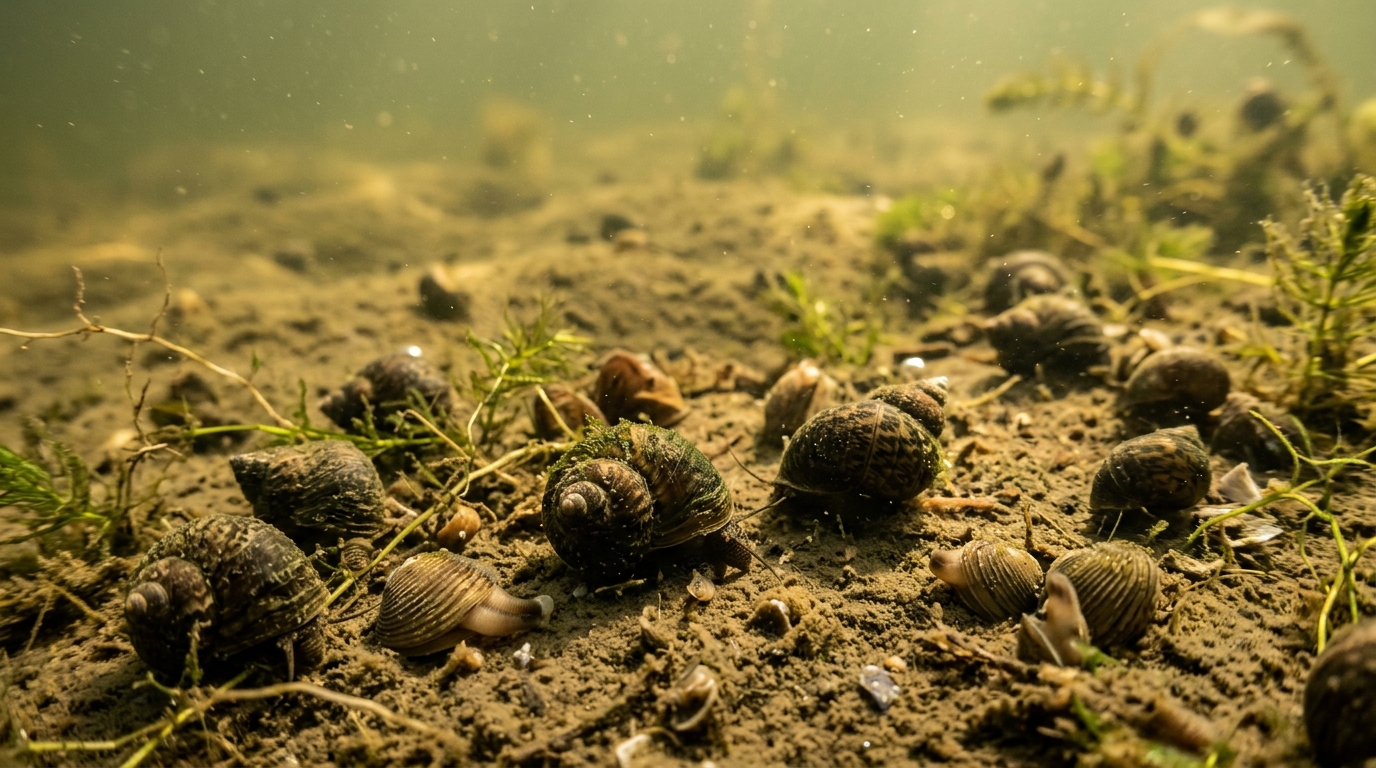
A seven-year quarterly monitoring study conducted in Lake Chaohu, China, between 2018 and 2024 revealed that benthic macroinvertebrate communities remained persistently dominated by oligochaetes and chironomids, even as relative abundances, functional diversity, and taxonomic distinctness underwent significant temporal shifts. Benthic macroinvertebrates serve as vital indicators of freshwater ecosystem health because of their sensitivity to environmental stress, limited mobility, and key roles in nutrient cycling and organic matter decomposition. Researchers surveyed eight fixed sampling stations across seven consecutive years to evaluate temporal dynamics in community structure and examine how environmental parameters correlate with multidimensional biodiversity metrics in a large, shallow eutrophic lake.
Lake Chaohu covers approximately 770 square kilometers in Anhui Province and has long experienced substantial ecological pressures, including nutrient loading, algal blooms, and habitat deterioration. To capture the lake’s environmental gradients, including spatial differences between the western and eastern basins and areas near river inflows and outflows, scientists established eight fixed sampling sites designated C1 through C8. Sites C1 through C4 were situated in the western basin, while sites C5 through C8 were located in the eastern basin. Sampling was carried out across all four quarters of each year from 2018 through 2024 without omission, yielding a comprehensive dataset of 224 site-by-sampling-occasion observations.
Field collections were conducted using a modified Petersen grab with a sampling area of one-sixteenth of a square meter, taking three replicate sediment samples at each site to average taxon-specific density and biomass. Sediments were sieved through a 0.45-millimeter mesh in the field, after which organisms were preserved in formalin and identified in the laboratory. Across the entire survey period, researchers identified a total of 33 macroinvertebrate taxa belonging to 15 families, 11 orders, 7 classes, and 3 phyla. Concurrently, eleven water-column environmental variables were measured, including water temperature, pH, electrical conductivity, Secchi depth, dissolved oxygen, ammonium nitrogen, total nitrogen, total phosphorus, chlorophyll-a, permanganate index, and chemical oxygen demand.
Statistical evaluations showed that density and biomass varied significantly across both years and quarters, whereas species richness exhibited no statistically significant main effect of year. In a two-way repeated-measures analysis of variance, density showed significant interannual variation, with higher densities recorded in 2020 than in 2022, as well as seasonal variation where the first and second quarters exceeded the third quarter. Biomass displayed significant main effects for both year and quarter alongside a significant interaction between the two factors, reflecting elevated biomass in the third and fourth quarters of 2024 compared to 2020. Species richness varied significantly among quarters and displayed a significant interaction between year and quarter, demonstrating that seasonal richness patterns differed depending on the specific monitoring year.
Permutational multivariate analysis of variance demonstrated that overall community composition differed significantly among years and quarters, with a statistically significant interaction term confirming that seasonal patterns shifted across years. Dominance was consistently shared between oligochaetes and chironomids, but their relative proportions fluctuated markedly. In 2020, oligochaetes reached an annual mean relative abundance of 80.62 percent, significantly higher than in 2018 and the 2021 through 2024 period. In contrast, chironomid relative abundance declined to 19.05 percent in 2020 and 31.55 percent in 2019, before recovering to roughly 40 to 50 percent between 2021 and 2024. Polychaetes gradually increased in later years, rising from 0.18 percent in 2020 to 18.87 percent in 2024.
Functional trait analysis, evaluating ten trait groups encompassing 35 categories, demonstrated a community structured around disturbance-tolerant life-history strategies. Across all survey years, collector-gatherers dominated the assemblage with an average relative abundance of 80.07 percent, while predators formed the second largest group at 19.28 percent, and scrapers, shredders, and collector-filterers remained scarce or absent. Organisms characterized by burrowing habits, cuticular membrane or chitinous exoskeletons, and passive dispersal mechanisms overwhelmingly predominated. However, in 2024, shifts emerged among several traits: predators rose to 43.61 percent, taxa in the Size4 body category increased to 18.91 percent, and organisms relying on gill respiration expanded to 69.24 percent, while burrowers and collector-gatherers still maintained dominant baselines.
Evaluation of biodiversity dimensions showed contrasting behavior between conventional richness indices and multidimensional metrics. While the Shannon and Margalef alpha diversity indices showed no significant interannual differences across the seven-year period, Pielou’s evenness and the Simpson index exhibited significant temporal variation. Functional diversity indices, including functional richness, functional evenness, functional divergence, and functional dispersion, all varied significantly across years, showing distinct drops around 2020 followed by increases. Similarly, taxonomic distinctness indices, including Delta, Delta star, Lambda plus, and Delta plus, showed significant interannual differences, with lower values in 2020 coinciding with heightened oligochaete dominance and reduced chironomid proportions.
Distance-based redundancy analysis revealed that measured water-column physicochemical parameters accounted for 11.59 percent of the total variation in the standardized biodiversity index matrix. Permutation tests of marginal effects identified total nitrogen, chemical oxygen demand, and ammonium nitrogen as the only three measured variables exerting significant independent explanatory effects. Ammonium nitrogen and total nitrogen were associated with different ordination gradients, while chemical oxygen demand was positively aligned with both primary axes. In contrast, variables such as water temperature, total phosphorus, dissolved oxygen, chlorophyll-a, and pH showed no significant independent marginal effects within the multivariate model.
Linear mixed-effects models incorporating random intercepts for sampling site, year, and quarter further characterized relationships between individual environmental predictors and composite biodiversity scores. Water temperature and ammonium nitrogen were negatively associated with composite alpha diversity scores, while permanganate index was negatively associated with taxonomic diversity, and functional diversity exhibited a positive relationship with taxonomic diversity. Diagnostic evaluations, however, indicated departures from residual normality and non-constant variance in certain models. Sensitivity checks omitting individual sampling sites or single observations altered the statistical significance of the ammonium nitrogen and permanganate index relationships, indicating that these specific linear formulations should be interpreted as exploratory associations.
The researchers noted that water-column measurements leave 88.41 percent of the variation in the biodiversity matrix unexplained, reflecting key study limitations. Crucially, sediment physicochemical parameters, such as sediment total nitrogen, phosphorus, organic matter content, and grain size characteristics, were not measured, preventing direct evaluation of benthic substrate quality and sediment-water interface processes. Additionally, quarterly surveys cannot detect short-term environmental fluctuations or fully account for delayed biological responses, hydrodynamic mixing, and complex trophic interactions, such as those that may stem from the lake-wide ten-year fishing ban instituted in 2020. The authors concluded that tracking multiple biodiversity dimensions alongside coordinated water and sediment sampling provides a necessary foundation for evaluating shallow lake ecosystems undergoing management and ecological restoration.
Subject of Research: Temporal variation and environmental drivers of benthic macroinvertebrate diversity in Lake Chaohu
Article Title: Temporal variation in multidimensional benthic macroinvertebrate diversity in Lake Chaohu, China, from 2018 to 2024
Article References: Chu, J., Ji, L., Cui, J., Da, J., Zhang, Q., Hu, Z., Zhang, K., & Liu, G. (2026). Temporal variation in multidimensional benthic macroinvertebrate diversity in Lake Chaohu, China, from 2018 to 2024. Frontiers in Ecology and Evolution, 14, Article 1980245. https://doi.org/10.3389/fevo.2026.1980245
Image Credits: AI Generated
DOI: 10.3389/fevo.2026.1980245
Keywords: Lake Chaohu, benthic macroinvertebrates, freshwater ecology, eutrophication, functional diversity, taxonomic distinctness, water quality, aquatic ecology, Temporal, variation, multidimensional, benthic
News Source: Drew Townsend. (November 6, 2026). Seven-Year Survey Tracks Multidimensional Benthic Invertebrate Diversity in Lake Chaohu. Scienmag.