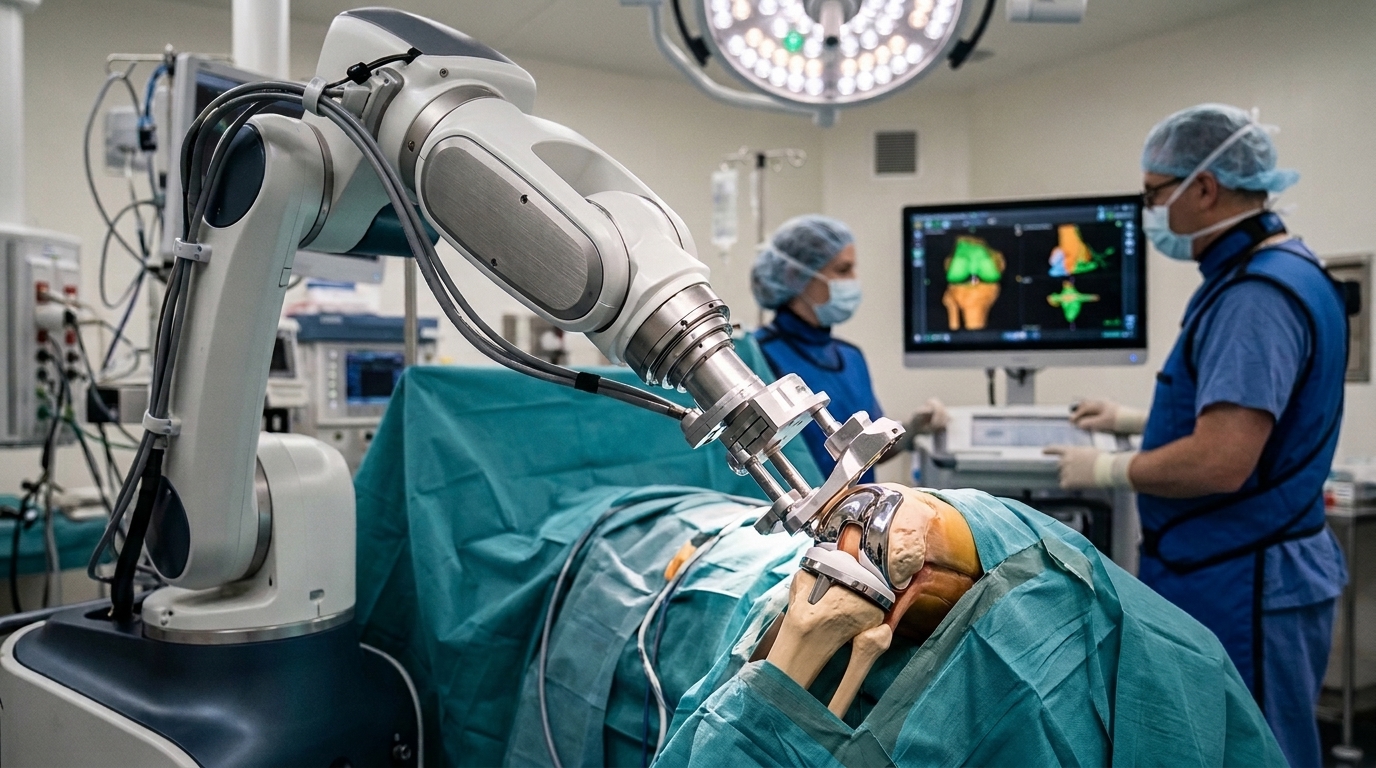
Direct clinical evidence demonstrating that artificial intelligence provides incremental patient-level benefit beyond conventional robotic assistance in total knee arthroplasty remains limited, according to a narrative review and evidence map published in Arthroplasty. In clinical discussions, robotic execution, computer navigation, and predictive algorithms are frequently combined under the umbrella label of AI-assisted robotic surgery. This synthesis demonstrates that while robotic and navigation platforms possess mature evidence supporting technical precision in bone resection and alignment, artificial intelligence models operate primarily within adjacent tasks across the pathway. These tasks include radiographic interpretation, implant sizing prediction, patient selection, dissatisfaction forecasting, risk stratification, and postoperative monitoring. The authors conclude that artificial intelligence cannot currently be treated as a single validated surgical intervention, but represents emerging pathway-level functions requiring function-specific verification.
To evaluate the field without conflating distinct surgical and analytical roles, the investigators searched PubMed, Embase, Web of Science, and Google Scholar, alongside citation searching from relevant reviews. The search encompassed peer-reviewed English literature published between January 2015 and January 2025, capturing a decade marked by the clinical expansion of robotic platforms and orthopaedic machine-learning prediction literature, with the final search run on 15 April 2026. Search concepts targeted total knee arthroplasty, robotic-assisted surgery, computer navigation, digital planning, artificial intelligence, machine learning, predictive modelling, implant sizing, decision support, patient selection, postoperative monitoring, implementation, and economic evaluation. Studies were categorized according to explicit operational definitions across pathway stages. Because existing literature exhibits profound heterogeneity, the authors deliberately refrained from quantitative pooling or meta-analysis, noting that combining disparate interventions into single comparative estimates would obscure clinical evidence. Literature screening was conducted by a single reviewer, which the authors identify as a methodological constraint that was partially mitigated through review and approval by all co-authors.
The review establishes a distinction between physical surgical execution and algorithmic prediction by tracing the technological evolution of knee replacement. Conventional manual total knee arthroplasty remains the clinical benchmark, supported by decades of registry data and follow-up for end-stage knee osteoarthritis. Robotic platforms such as Mako, ROSA, and CORI or NAVIO, alongside optical navigation systems, were introduced to improve the reproducibility of bone cuts, component positioning, and limb alignment while reducing radiographic outliers. Comparative studies demonstrate that these robotic and navigation systems provide mature evidence for improving technical execution accuracy relative to manual instrumentation. However, the authors emphasize that robotic systems execute pre-programmed resection boundaries or haptic guidance without incorporating machine learning. Conflating these domains by attributing the mechanical precision of a robotic arm to artificial intelligence represents an unverified leap that obscures the actual validation status of each tool.
Outside the operating room, machine-learning and statistical algorithms are evaluated for preoperative decision support, implant sizing, and outcome forecasting. The authors note that predicting clinical outcomes such as postoperative dissatisfaction, length of stay, and complications is not novel, as conventional regression models have addressed these questions for over a decade. Modern machine-learning models primarily automate, scale, and standardize prediction across clinical workflows rather than establishing an entirely new evidentiary foundation. In reviewed studies assessing machine-learning models for predicting postoperative patient dissatisfaction, reported discrimination achieved moderate accuracy, with receiver operating characteristic area under the curve values ranging between 0.70 and 0.82. However, the review underscores that these studies remain predominantly retrospective, single-institution investigations with sample sizes spanning several hundred to a few thousand patients. External validation within independent cohorts was reported in only a minority of studies, while algorithmic calibration and decision-impact analyses evaluating whether predictions alter clinician decisions were rarely provided.
The review indicates that preoperative sizing models and automated planning algorithms aim to streamline surgical workflows, reduce operative preparation time, avoid intraoperative component mismatches, and optimize hospital inventory management. However, the authors caution that the majority of published evidence regarding automated sizing tools consists of retrospective technical demonstrations or isolated software performance benchmarks.
Intraoperative artificial intelligence represents an earlier stage of translational maturity and empirical validation within knee arthroplasty. The authors observe that dynamic intraoperative adaptation theoretically offers a path to transcend static preoperative cutting plans, potentially influencing postoperative joint stability, range of motion, and implant survivorship. Direct knee-specific comparative studies are remarkably scarce and limited to single-center proof-of-concept demonstrations. Future intraoperative investigations must explicitly report algorithmic input parameters, decision logic, automation levels, safety stops, surgeon override capabilities, failure modes, and documented evidence showing whether algorithmic guidance altered surgical execution or patient health.
A central theme highlighted throughout the evidence map is the persistent disconnect between technical precision and patient-centered benefit, termed the alignment-to-function gap. Although robotic assistance consistently demonstrates superior accuracy in achieving target radiographic angles and reducing alignment outliers, technical precision does not automatically produce superior clinical outcomes, pain relief, or durable implant survivorship. Postoperative patient dissatisfaction affects a substantial proportion of individuals following knee replacement and arises from complex mechanisms that radiographic alignment alone cannot resolve. Dissatisfaction frequently stems from soft-tissue imbalance, preoperative pain sensitization, unrealistic expectations, psychological vulnerabilities, comorbidity burdens, rehabilitation challenges, or anatomical variations. A patient with radiographically accurate implant alignment may remain dissatisfied due to stiffness or pain, whereas many patients undergoing conventional manual surgery achieve excellent recovery despite alignment variations. Consequently, artificial intelligence tools targeting patient selection, expectation management, and risk communication address critical determinants that robotic cutting tools cannot influence, though these tools require prospective decision-impact trials rather than retrospective discrimination metrics alone.
Following surgical discharge, artificial intelligence and connected health technologies are explored for longitudinal recovery tracking and remote patient monitoring. Recovery following total knee arthroplasty provides a logical setting for dynamic computational models, as functional restoration unfolds over months or years. However, the review emphasizes that published literature supporting postoperative artificial intelligence monitoring in knee arthroplasty relies predominantly on indirect evidence drawn from broader digital health literature, alongside retrospective or single-center pilot studies. Robust multicenter validation linking remote algorithmic monitoring directly to verified reductions in hospital readmissions, complications, or revision surgeries remains lacking, while clinician response workflows and patient compliance parameters remain unstandardized.
Beyond clinical efficacy, adopting robotic systems and artificial intelligence introduces substantial economic and operational challenges that remain inadequately evaluated. Advanced surgical technologies impose significant financial burdens through capital equipment acquisition, software licensing, disposable instruments, operating room maintenance, facility upgrades, and staff training. Within the reviewed literature, direct economic evidence specific to total knee arthroplasty remains scarce; only one study provided direct knee-specific cost and length-of-stay data, while other economic citations derived from broader orthopaedic digitalization or hip arthroplasty cohorts. The authors stress that economic evaluations must analytically separate costs attributable to robotic hardware platforms from expenses tied to software licensing and artificial intelligence algorithms. Furthermore, the review raises critical concerns regarding healthcare equity. Expensive robotic platforms tend to concentrate within well-funded academic medical centers.
To address these evidentiary gaps, the authors outline explicit reporting recommendations and methodological standards to guide future knee arthroplasty investigations. Future research must abandon the ambiguous umbrella phrase AI-assisted robotic surgery in favor of granular descriptions specifying whether computational components function preoperatively, intraoperatively, or postoperatively, alongside defined levels of surgeon autonomy. Investigational comparators must be selected with scientific rigor: robotic precision must be evaluated against conventional manual surgery, artificial intelligence decision tools must be tested against non-AI robotic platforms or standard digital templating, and predictive algorithms must be benchmarked against standard clinical risk scores. Furthermore, validation must encompass diverse demographic cohorts across varied age groups, body mass index classifications, ethnic backgrounds, deformity severities, and surgical skill levels. Acknowledging their review’s narrative design and single-reviewer screening as limitations, the authors emphasize that current evidence does not demonstrate that artificial intelligence elevates robotic total knee arthroplasty beyond established mechanical precision, requiring rigorous multicenter trials to verify whether algorithmic tools enhance long-term patient outcomes, implant survivorship, and equitable care.
Subject of Research: Evidence distinctions between artificial intelligence and robotic execution in total knee arthroplasty
Article Title: Distinguishing artificial intelligence from robotic execution in total knee arthroplasty: a narrative review and evidence map
Article References: Malik, M. A., Wu, S., Zhang, W., Huang, J., & Cao, X. (2026). Distinguishing artificial intelligence from robotic execution in total knee arthroplasty: a narrative review and evidence map. Arthroplasty, 8(1), Article 86. https://doi.org/10.1186/s42836-026-00444-0
Image Credits: AI Generated
DOI: 10.1186/s42836-026-00444-0
Keywords: total knee arthroplasty, artificial intelligence, robotic surgery, machine learning, computer navigation, orthopaedic surgery, evidence map, clinical outcomes, Distinguishing, artificial, intelligence, robotic
News Source: Blake Davidson. (November 6, 2026). Review Separates Artificial Intelligence From Robotic Execution In Total Knee Arthroplasty. Scienmag.