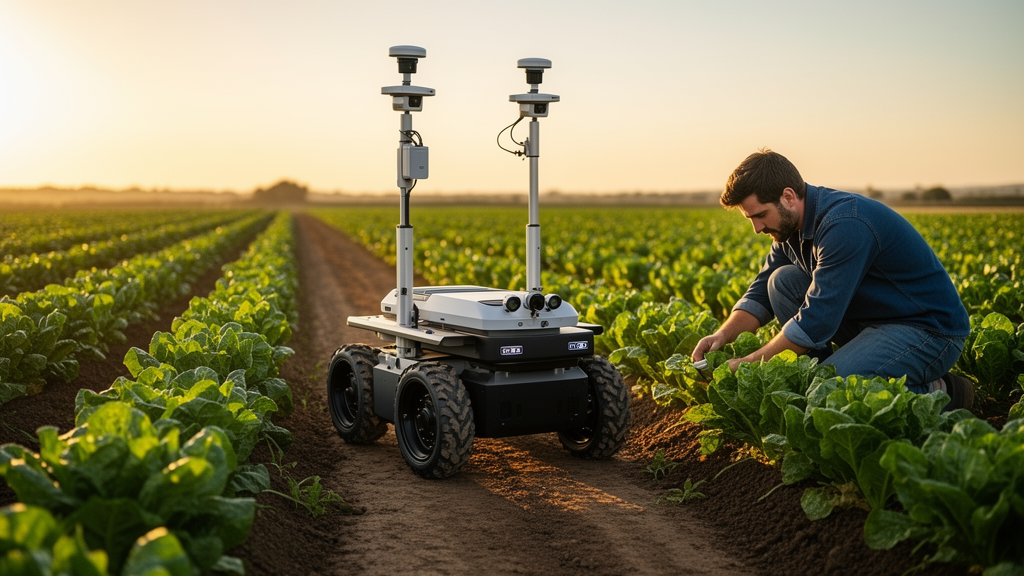
A new open-access review published in Discover Robotics on 30 September 2026 argues that the future of modern farming will be intelligent, autonomous and data-driven, but that high-performance automation alone will not be enough to put robots to work in fields. For autonomous machines to operate in unstructured agricultural settings, the authors contend, systems must be able to make safe decisions, learn adaptively and collaborate effectively with human operators. The review, led by Muhammad Khizar Hayat and colleagues, organizes trustworthy agricultural autonomy around three interrelated pillars: robot learning and perception, safe control and resilient planning, and human-robot interaction.
The review notes that agriculture is the source of livelihood for about 2.5 billion people globally and accounts for nearly 38 percent of the terrestrial surface of the earth, while the global population is projected to approach 9.7 billion by 2050. Precision agriculture already deploys satellite navigation, Internet of Things sensors, artificial intelligence, robotics, drones and cloud computing to enable site-specific crop management and more targeted use of fertilizer, pesticides and water, although the magnitude of reported input savings varies substantially among technologies, crops and management conditions. What makes farming uniquely difficult for robots, however, is the environment itself. Unlike the factory floor with its relatively constant lighting, surfaces and object positions, the open field presents continuously varying illumination, rain, fog, mud, dust, uneven terrain, wind-induced movement of crops and large biological variability between plants.
Against that backdrop, the first pillar of the framework is reliable perception and adaptive learning. Deep learning-based computer vision, particularly convolutional neural networks and Vision Transformers, has significantly improved discrimination of crop and weed, fruit detection, disease diagnosis and yield estimation. Yet RGB cameras remain sensitive to shadows, glare and changing illumination, which is why the review emphasizes sensor fusion: combining RGB cameras, LiDAR, hyperspectral imaging, radar, inertial measurement units and satellite navigation yields complementary spatial and spectral information for obstacle detection and navigation. LiDAR provides three-dimensional crop structures for canopy modelling and row following, while hyperspectral sensors can capture subtle physiological changes before visual symptoms appear. The authors are careful to note that integrated perception systems have reported high detection performance in selected agricultural tasks, but that accuracy varies substantially with crop type, dataset composition, sensor combination, environmental conditions and evaluation protocol.
One of the more striking technical developments the review describes is simulation-to-reality transfer. Collecting labeled agricultural datasets is expensive and time-consuming because crops continuously change with growth stage, season and environmental conditions. Training robotic systems within realistic digital twins of farms, orchards and greenhouses before transferring learned policies to physical robots addresses this limitation. Domain randomization techniques expose learning algorithms to variations in lighting, weather, soil texture, plant geometry and sensor noise, enabling improved generalization during field deployment. According to the review, such frameworks substantially reduce training costs, accelerate algorithm development and minimize the risks associated with testing autonomous tractors, harvesters and spraying platforms in commercial farming environments. Deep reinforcement learning further allows robots to learn strategies for harvesting, grasping, navigation and manipulation through continuous interaction with crops, and advanced manipulators equipped with tactile sensors and force-feedback systems can vary their grip dynamically to pick delicate fruits such as strawberries, tomatoes and apples without bruising them.
The second pillar, safe control and resilient planning, confronts the fact that agricultural environments are inherently uncertain because of uneven terrain, steep slopes, loose soil, mud, changing weather, dense vegetation and the frequent presence of humans, animals and farm machinery. Model Predictive Control is preferred in this setting because it predicts the future behavior of the vehicle and optimizes steering, speed and stability simultaneously subject to physical constraints, enabling autonomous tractors and field robots to avoid collisions, wheel slippage and instability on steep slopes and uneven terrain. In parallel, formal verification methods are used to mathematically verify that safety constraints such as obstacle clearance, rollover prevention and maximum steering angles are always satisfied before control actions are executed. The review stresses that no single safety approach is sufficient across all conditions: model predictive control becomes computationally demanding as model complexity increases, control barrier functions provide lightweight online safety filtering whose guarantees depend on reliable state estimation, and formal verification scales poorly to highly adaptive perception and learning components. A layered architecture combining predictive control, runtime monitoring, sensor redundancy and a fail-safe fallback is likely to be more practical than reliance on any single technique.
Resilience also means surviving failure. Cameras may become covered with dust, mud, raindrops or pesticide residues, LiDAR may be ineffective in dense fog or heavy rain, and satellite signals are often degraded in dense tree canopies, greenhouses or near tall structures, leading to localization errors. Reliable autonomous systems are therefore equipped with fault detection, diagnosis and recovery mechanisms that continuously check sensor health and automatically trigger redundant sensing modalities in case of failures. Accurate localization is maintained even if individual sensors fail through multi-sensor fusion of cameras, LiDAR, radar, inertial units, wheel odometry and real-time kinematic satellite positioning, with uncertainty estimated dynamically using Bayesian filtering, extended Kalman filters and particle filters. Cloud-edge computing architectures additionally offer continuous tracking of system diagnostics and enable predictive maintenance to avoid catastrophic failures.
The International Labor Organization says agriculture employs about 874 million people around the world, and labor shortages and an ageing farmer population are driving the adoption of autonomous technologies. Human-in-the-loop systems combine autonomous decision making with human supervision, allowing operators to monitor, override or tele-operate agricultural robots in critical situations, such as jammed seeding mechanisms, equipment blockage or uncertain obstacle detection, with real-time feedback delivered to a tablet, smartphone or tractor display. Explainable artificial intelligence has become a key part of trustworthy agricultural robotics: a robotic sprayer may report that it did not apply herbicide because weed density was still below the treatment threshold, or an autonomous tractor may report that it changed route to avoid excessive soil compaction. Interfaces that include heat maps, confidence scores and decision logs can increase operator confidence, ease of troubleshooting and technology acceptance. Notably, the review cautions that greater transparency does not automatically improve interaction, because excessive explanations, alerts or intervention requests may increase cognitive workload, so agricultural human-robot interaction requires calibrated rather than maximal transparency.
The review also frames autonomy within sustainability and economics. Agriculture is responsible for around 22 percent of anthropogenic greenhouse gas emissions globally, and conventional heavy machinery contributes to soil degradation. Soil compaction has been shown to reduce crop production by 10 to 20 percent and decrease water infiltration by 30 to 50 percent, whereas lightweight robotic platforms weighing 200 to 1,000 kilograms dramatically reduce ground pressure. Electrification enhances sustainability by replacing diesel engines with battery-electric drives, and innovations in lithium-ion batteries and solar-assisted charging have extended field operation to 6 to 12 hours per charge, with 40 to 70 percent reduction in operational carbon emissions compared to conventional diesel-powered machinery. Economic outcomes, however, vary considerably with robot configuration, task, farm scale and utilization rate: one comparative assessment reported up to 9 percent higher operational efficiency, up to 57 percent lower hourly operating cost and up to 63.3 percent lower fuel consumption for the robotic configuration under the evaluated scenarios, and the authors insist such estimates are technology- and scenario-specific rather than universal effects.
Commercial reality is already catching up with the framework. Commercial platforms such as Carbon Robotics LaserWeeder, Naïo Technologies and Blue River Technology’s See & Spray have combined deep learning-based computer vision with cameras, LiDAR and real-time control systems to identify crops and weeds at the individual plant level, with selected systems reporting high weed-classification performance and substantial reductions in broadcast herbicide application. Robotic harvesting systems for apples, strawberries, tomatoes and citrus use stereo vision, hyperspectral imaging, force sensors and deep reinforcement learning to determine fruit maturity and optimize grasping forces. Broad-acre autonomous tractors from John Deere, CNH Industrial and Monarch Tractor use satellite positioning, LiDAR, radar, computer vision and model predictive control to achieve centimeter-level navigation accuracy, with formal and continuous safety verification of steering, braking, obstacle avoidance and emergency stop functions.
Substantial challenges remain before mass adoption. The review identifies universal safety certification as an open standardization problem: existing standards such as ISO 18497-1:2024 and the ISO 25119 series provide machinery and functional-safety foundations but do not constitute a complete certification framework for continuously learning perception systems, explainable AI, cybersecurity or autonomous decision-making. Reliable internet connectivity is still a major limiting factor in rural areas, making edge computing on the robots themselves essential, with localized processing reducing communication latency to less than 50 milliseconds and hybrid cloud-edge architectures reducing communication bandwidth by 40 to 70 percent. Interoperability across heterogeneous fleets through open standards such as ISOBUS, ROS 2, MQTT and OPC Unified Architecture, together with emerging swarm robotics approaches and digital twin integration, will form the technological base for the next generation of autonomous systems. The authors conclude that progress will depend on stronger field validation, transparent safety assurance, cybersecurity, economically viable deployment models and regulatory frameworks capable of accommodating learning-enabled systems, and that performance remains highly dependent on environmental conditions, system architecture, task requirements and the quality of field validation.
Subject of Research: A review of trustworthy autonomous agricultural robotics integrating perception, safe control and human-robot interaction.
Article Title: Trustworthy agricultural autonomy integrates robot learning safe control and human robot interaction
Article References: Hayat, M. K., Cengiz, R., Arif, M., Gull, U., & Öten, M. (2026). Trustworthy agricultural autonomy integrates robot learning safe control and human robot interaction. Discover Robotics, 2(1), Article 28. https://doi.org/10.1007/s44430-026-00044-2
Image Credits: AI Generated
DOI: 10.1007/s44430-026-00044-2
Keywords: agricultural robotics, autonomous farming, robot learning, sensor fusion, model predictive control, formal verification, human-robot interaction, explainable AI, digital twins, sustainability, safety certification, edge computing
News Source: Alan Morgan. (October 28, 2026). Robots on the farm: what it takes to make autonomous agriculture trustworthy. Scienmag.