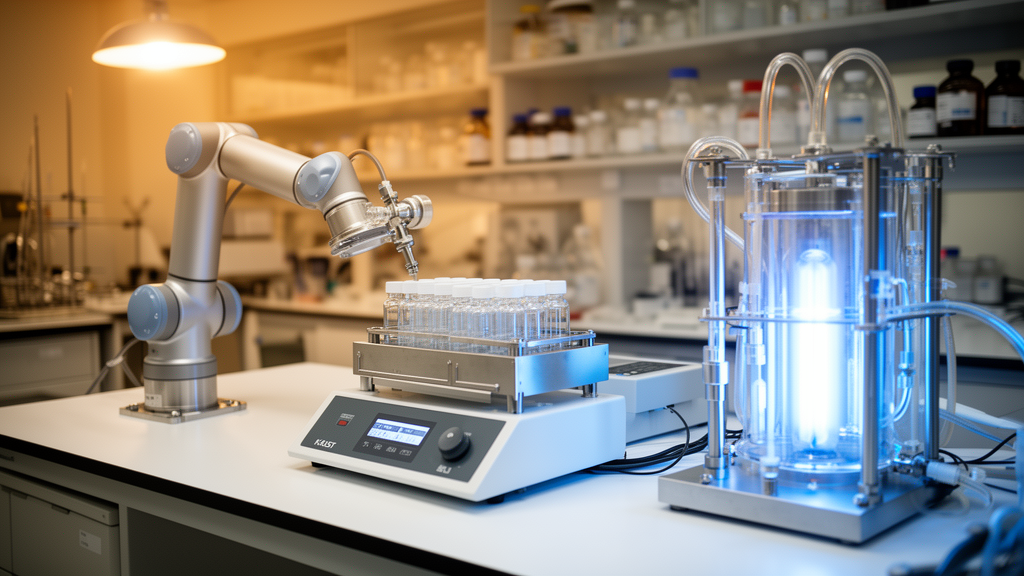
Artificial intelligence has become remarkably adept at dreaming up molecules that might one day become medicines, but a stubborn bottleneck remains between the digital blueprint and the laboratory bench: someone still has to make the compound. Even the most promising AI-designed molecule is worthless for drug development until it exists in a vial, and synthesizing it can demand weeks of repetitive, hands-on experimentation. Researchers at the Korea Advanced Institute of Science and Technology (KAIST) now report a system designed to remove that bottleneck almost entirely — an unmanned synthesis platform in which robots, automated pumps, light-driven chemistry and analytical instruments work together around the clock without a chemist touching a flask.
The platform, developed by Professor Yoonsu Park’s team in KAIST’s Department of Chemistry, automates the entire sequence from mixing raw materials to synthesis and analysis. Once a researcher prepares the equipment and sets the conditions, a raw-material dispensing robot combines the starting chemicals, and automated pumps continuously feed the resulting solution through a narrow tube at a constant rate. Visible light is then irradiated onto the tube to drive the chemical reaction, and when the reaction is complete the solution is transferred automatically to analytical equipment that determines whether the desired compound has been produced and in what quantity. No manual transfer or measurement intervenes at any stage.
The heart of the system is what chemists call a continuous-flow process, an approach in which raw materials are continuously fed through the reaction zone rather than loaded all at once into a batch vessel. The KAIST team offers an intuitive analogy: it is like continuously supplying ingredients into a small pot rather than putting everything into a large pot at once. Because the reaction takes place inside a narrow tube, light can be distributed evenly throughout the solution — a critical advantage for photochemistry, where uneven illumination in large batch reactors often produces inconsistent results. And because the process runs continuously, production volume can be increased simply by operating the same setup for a longer period, sidestepping one of the most notorious problems in chemical manufacturing.
That scaling problem deserves emphasis, because it is a quiet drag on pharmaceutical research. Even slight differences in molecular structure can require entirely new reaction conditions, and even when a small-scale synthesis succeeds, scaling it up can alter the way light or heat is transferred through the reaction mixture, forcing chemists to re-optimize everything from scratch. A flow platform largely dissolves this difficulty: the reaction environment inside the tube stays the same whether the system runs for an hour or a week, so conditions established at small scale translate far more reliably to larger production runs. For a field where each new molecule can demand its own bespoke recipe, that predictability is a significant prize.
To benchmark the automated system’s performance, the research team applied it to a single-atom editing reaction — a comparatively new technology that selectively replaces a specific atom in a molecule while keeping the overall molecular framework intact. The starting materials in this case were furans, five-membered ring compounds composed of oxygen and carbon that serve as basic molecular scaffolds for the synthesis of pharmaceuticals and other chemical substances. By swapping individual atoms within these frameworks, the platform produced N-substituted pyrroles, including the N-methyl pyrrole scaffold, a fundamental structural motif used throughout pharmaceutical development.
The scope of the demonstration was broad. The team applied the synthetic method to more than 20 furan-based compounds, and even in structurally complex natural products the desired portion could be modified while the rest of the structure was left untouched. That selectivity matters enormously in medicinal chemistry, where a molecule’s biological activity often hinges on the precise arrangement of a handful of atoms. Compounds produced through single-atom editing can change how a drug binds to proteins in the body, which is precisely why the technique has been attracting attention as a tool for refining drug candidates rather than merely generating them.
The practical payoff lies in how drug discovery actually proceeds. Developing a medicine is fundamentally a comparative exercise: researchers produce families of compounds with slightly different structures and test them against one another to see which binds most effectively to a therapeutic target protein or shows the lowest toxicity. Part of an existing compound may be modified, for example, and the variant then screened to determine whether the change improves potency or safety. Each comparison requires a fresh supply of a distinct compound, and the sheer volume of synthesis this entails has historically limited how many candidates a laboratory can explore. By automating production, the KAIST platform is expected to make it far more efficient to obtain the compounds needed for such comparisons, widening the range of drug candidates a team can realistically evaluate.
Professor Park framed the advance in terms of the pace of discovery itself. How quickly and reliably designed molecules can be synthesized, he noted, will determine the speed of future drug development. He added that the platform is expected to provide a foundation for moving toward an era of automated organic synthesis by enabling reaction conditions to be quantified and reproduced. That last point — quantification and reproducibility — may prove as consequential as the automation itself. In conventional laboratory practice, reaction conditions often live in the tacit knowledge of individual chemists; a platform that encodes them as machine-readable parameters makes every experiment a permanent, repeatable asset that other researchers or other machines can rerun on demand.
The study was a collaborative effort within KAIST. Hyeonbhin Byeon and Hojin Hong, both integrated M.S.-Ph.D. students in the Department of Chemistry, participated as co-first authors, while Professor Yoonsu Park and InnoCORE Fellow Ha Eun Kim of the InnoCORE AI-CRED Innovative Drug Research Group served as corresponding authors. The findings were published online on August 7 in JACS Au, an international journal published by the American Chemical Society, under the title Direct Access to the Simplest N-Substituted Pyrroles from Furans Enabled by Tailored Photocatalysts. The work was supported by the Korea Basic Science Institute’s Young Researcher Infrastructure Support Program and the InnoCORE AI-CRED Innovative Drug Research Group.
The broader significance of the work extends beyond a single reaction class. As AI-driven molecular design accelerates, the laboratories that can convert computational proposals into physical compounds fastest will hold a decisive advantage, and platforms like KAIST’s point toward a model in which synthesis becomes a continuous, quantified service rather than a craft performed molecule by molecule. A system that mixes, irradiates, analyzes and reports without human intervention — and that scales production by simply running longer — offers a glimpse of chemistry laboratories operating the way modern factories do: continuously, reproducibly and, when required, entirely unattended. If such platforms become routine, the limiting factor in early drug discovery may shift from the speed of a chemist’s hands to the imagination of the algorithms proposing what to make next.
Subject of Research: Automated continuous-flow photocatalytic synthesis of N-substituted pyrroles for drug candidate production
Article Title: KAIST develops '24/7 unmanned synthesis platform' using robots and light to produce drug candidates
Article References: KAIST develops '24/7 unmanned synthesis platform' using robots and light to produce drug candidates. Original publication (Bibliographic details unavailable.)
Image Credits: AI Generated
DOI: Not provided
Keywords: KAIST, automated synthesis, continuous-flow chemistry, photocatalysis, drug discovery, N-methyl pyrrole, furan, single-atom editing, organic synthesis, medicinal chemistry, laboratory automation, JACS Au
News Source: Bethany Barker. (October 19, 2026). Robots and Light Power KAIST’s Round-the-Clock Unmanned Drug Synthesis Platform. Scienmag.