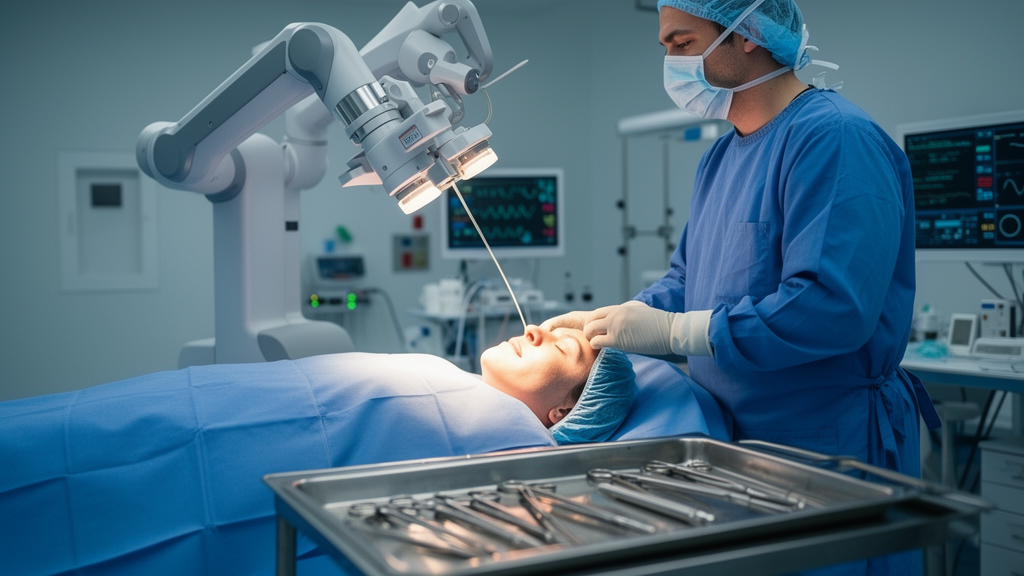
Neurosurgeons in China have reported draining six brain abscesses scattered across both hemispheres of a 21-year-old woman’s brain in a single operation, using a robotic stereotactic system to guide four precisely planned needle trajectories through her skull. The case, published in the Chinese Neurosurgical Journal, describes one of the rare instances in which robot-assisted surgery has been used to evacuate so many deep-seated infectious foci at once, rather than resorting to repeated staged procedures or a large open craniotomy.
The patient arrived at the neurosurgical unit after a seven-day history of fever, headache, and vomiting. She had initially been treated empirically for Mycoplasma pneumoniae at a local hospital, but her condition worsened, with progressive alteration of consciousness prompting transfer to specialist care. On admission she was somnolent, with a Glasgow Coma Scale score of 10, neck stiffness, and positive meningeal signs. Her Karnofsky Performance Status score, a measure of functional ability, stood at 70. Blood tests showed leukocytosis and elevated C-reactive protein, markers of an active systemic infection.
Magnetic resonance imaging revealed the scale of the problem: six ring-enhancing lesions distributed across both frontal lobes and the right temporal and occipital lobes. The largest, in the right temporal lobe, measured 3.9 by 3.3 centimeters. Every lesion showed central necrosis, surrounded by pronounced perifocal edema and significant mass effect, with compression of the lateral ventricles and a leftward shift of the midline structures of the brain. These imaging features were consistent with deep, multifocal brain abscesses, a presentation that carries a serious risk of rapid neurological deterioration and potentially fatal brain herniation.
Brain abscesses are localized intracranial infections that can cause progressive mass effects and irreversible neurological impairment if not treated promptly. When abscesses are multifocal and deep-seated, the challenge intensifies: the lesions sit close to critical neural structures, and conventional management often involves draining only the dominant lesion while treating smaller ones with antibiotics alone, or performing staged operations that may delay definitive control of the infection. Given the patient’s rapid decline, the radiographic mass effect, and the narrow therapeutic window before impending herniation, the treating team judged conservative therapy alone to be inappropriate.
After a multidisciplinary discussion involving neurosurgery, infectious disease, neuroradiology, and critical care specialists, the team opted for emergent robot-assisted stereotactic aspiration. They used the Sinovation Robot with SinoPlan planning software, fusing intraoperative CT images acquired under cranial fixation with the preoperative MRI to create a precise three-dimensional model of the abscess cavities and the surrounding anatomy, including cortical vessels, sulci, ventricles, and eloquent cortex.
The trajectory planning followed three principles: choosing the shortest safe path to each abscess to minimize cortical penetration, avoiding critical structures such as functional areas, major vessels, sulci, and ventricles, and aligning the paths parallel to major white matter tracts to reduce the risk of functional disruption. Entry points were targeted at the posterior or inferior third of each abscess cavity to allow optimal drainage. For lesions that lay along similar axes, the surgeons used sequential access through a single cortical entry, a design they describe as one puncture, two injections. In total, four puncture paths gave access to all six abscesses. Robotic arm positioning aligned the instruments with the planned trajectories, each cavity was aspirated and thoroughly irrigated with a gentamicin-saline solution until the effluent ran clear, and the needle was withdrawn along the same trajectory to reduce the risk of seeding infection along the track.
An immediate postoperative CT scan confirmed restoration of the midline structures with no evidence of hemorrhage. Empirical broad-spectrum antibiotics, meropenem combined with vancomycin, had been started preoperatively in line with the institution’s protocol for severe intracranial infections. Culture of the aspirated material later grew Streptococcus intermedius, and susceptibility testing allowed the team to narrow the therapy. After two weeks of intravenous treatment, the regimen was switched to oral linezolid. Because the patient had significant perifocal edema and mass effect, the team also administered a short course of low-dose dexamethasone, carefully monitored, to reduce swelling while limiting the immunosuppression that prolonged corticosteroid use can cause in intracranial infections.
The clinical response was rapid. Fever and meningeal signs improved within 72 hours, and consciousness recovered quickly. One month after surgery, MRI showed complete disappearance of the abscesses, with the abscess walls almost entirely vanished. The patient achieved a full functional recovery, with a Karnofsky Performance Status score of 100 and no complications such as epilepsy. At the three-month follow-up, MRI confirmed full recovery, and no recurrence was observed during follow-up at six months and one year.
The authors place the case in a limited evidence base. According to their literature review, reports describing robot-guided aspiration of multiple abscesses in a single procedure are particularly rare; earlier accounts of multifocal abscess management relied mainly on frame-based stereotactic aspiration, often targeting only the dominant lesion or using staged procedures. Robotic systems, by contrast, allow automated positioning of instruments along preplanned trajectories with high reproducibility and submillimeter accuracy, while frame-based systems require repeated manual adjustments when multiple trajectories are needed and frameless navigation can be affected by surgeon-dependent registration variability. Preoperative MR-CT fusion, the authors note, enabled visualization of major vessels and ventricular boundaries, and shared trajectories reduced the number of cortical entry points, limiting surgical invasiveness while rapidly reducing the intracranial mass effect and yielding material for microbiological diagnosis.
The report also weighs the risks and limitations of the technique. Multiple puncture paths may theoretically increase the risk of inflammatory reactions or abscess seeding along the tracts, so careful planning, minimal cortical entries, thorough gentamicin-saline irrigation, and withdrawal along the same path are critical safeguards. Robotic stereotactic surgery itself carries drawbacks: registration errors during image fusion can cause targeting inaccuracies, particularly with intraoperative brain shift, and the systems demand specialized equipment, additional training, and higher costs that may limit widespread adoption. The authors emphasize that this single case suggests robot-assisted stereotactic aspiration may be a feasible and potentially effective strategy for multifocal deep-seated brain abscesses in selected patients, but that larger clinical studies are needed to define the role of robotic techniques in complex intracranial infections.
Subject of Research: Robot-assisted stereotactic aspiration of multiple brain abscesses in a single operation
Article Title: Robot-guided stereotactic single‐stage evacuation of six intracranial abscesses: a rare case report with literature review
Article References: Wei, Y., Zhu, C., Wang, H., Wang, J., Guo, P., Ou, S., & Wang, J. (2026). Robot-guided stereotactic single‐stage evacuation of six intracranial abscesses: a rare case report with literature review. Chinese Neurosurgical Journal, 12(1), Article 16. https://doi.org/10.1186/s41016-026-00436-8
Image Credits: AI Generated
DOI: 10.1186/s41016-026-00436-8
Keywords: brain abscess, robotic surgery, stereotactic aspiration, neurosurgery, Streptococcus intermedius, case report, minimally invasive surgery, cerebral edema, intracranial infection, trajectory planning, dexamethasone, Chinese Neurosurgical Journal
News Source: Ophelia Keating. (October 30, 2026). Robot-guided surgery drains six brain abscesses in a single operation. Scienmag.