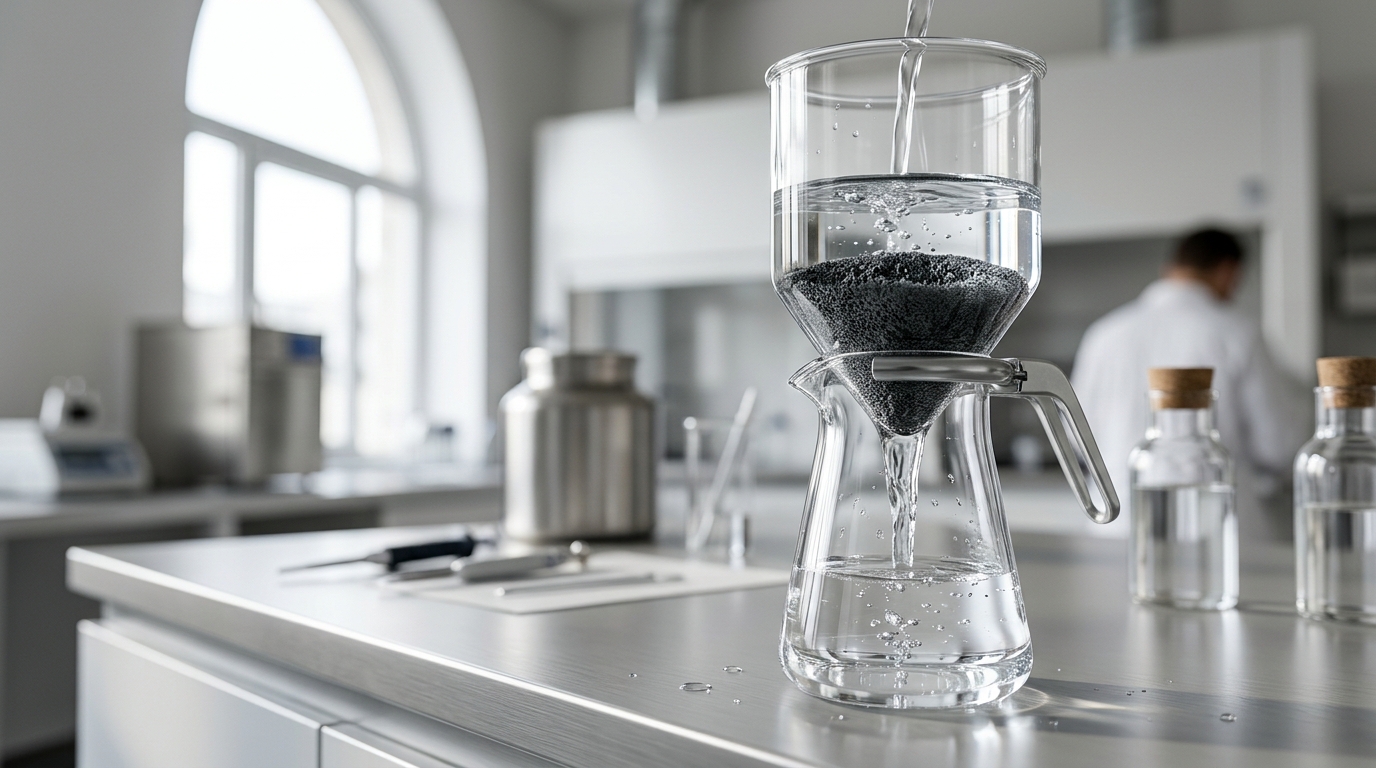
Ciprofloxacin, a widely used fluoroquinolone antibiotic, does not simply vanish once it leaves the body. Residues discharged in excess into aquatic systems pose significant environmental risks. A new study reports an adsorption-based answer: a titanium dioxide/graphene oxide nanocomposite, labeled TiO₂/GO-NC, that pulls the antibiotic out of aqueous solutions and can be recovered and used again.
The material was synthesized through a sol-gel route in which titanium dioxide was deposited onto graphene oxide nanosheets. Characterization with several techniques confirmed the successful integration of TiO₂ with the GO support. The composite’s textural properties proved substantial: a surface area of 194.5 square meters per gram, a pore volume of 0.16 cubic centimeters per gram, and a mean pore width of 18.23 nanometers. The composite's textural properties were reported as a surface area of 194.5 square meters per gram, a pore volume of 0.16 cubic centimeters per gram, and a mean pore width of 18.23 nanometers.
To squeeze the maximum performance out of the adsorbent, the researchers designed experiments around four key process variables: the pH of the working solution, the dosage of the adsorbent, the initial concentration of ciprofloxacin, and the temperature. Experiments were designed to optimize the four selected key process variables using response surface methodology (RSM). An artificial neural network (ANN) model was subsequently developed to validate the RSM-optimized condition.
The equilibrium data were evaluated using two-, four-, and five-parameter isotherm models. Kinetic analysis pointed to a chemisorption mechanism, meaning the antibiotic attaches through chemical interactions rather than weak physical attraction. The kinetic analysis indicated that the adsorption process was controlled by a chemisorption mechanism.
Thermodynamic studies added another layer of understanding: the adsorptive removal of ciprofloxacin proceeded spontaneously and exothermically. Thermodynamic studies indicated that the adsorptive removal of ciprofloxacin proceeded spontaneously and exothermically.
Perhaps the most consequential finding concerns reuse. Regeneration studies demonstrated that the prepared TiO₂/GO-NC could be effectively recovered using 1 N sodium hydroxide, and the material retained stable performance over six consecutive adsorption and desorption cycles. Regeneration studies demonstrated that the prepared TiO₂/GO-NC could be effectively recovered using 1 N NaOH and retained stable performance over six consecutive adsorption and desorption cycles.
The authors conclude that the prepared adsorbent is robust and reusable for pharmaceutical wastewater treatment. The study, published in Discover Chemical Engineering on 31 October 2026, is available as open access research, with the shared version citable under a permanent DOI ahead of the final Version of Record.
The nanocomposite was synthesized through a sol-gel route by depositing TiO₂ onto GO nanosheets, and the resulting adsorbent was characterized by different techniques, confirming the successful integration of TiO₂ with GO. To maximize the CIP adsorption potential of the prepared adsorbent, experiments were designed to optimize four selected key process variables: the pH of the working solution, the dosage of the adsorbent, the initial concentration of CIP, and the temperature. The RSM-optimized condition was validated by a subsequently developed ANN model, and the equilibrium data were evaluated using two-, four-, and five-parameter isotherm models.
In the study, a sol-gel-synthesized TiO₂/GO-NC, regenerated with 1 N NaOH, removed ciprofloxacin from aqueous solutions and retained stable performance over six consecutive adsorption and desorption cycles, with the process variables optimized by RSM and the optimized condition validated by an ANN model. The authors conclude that the prepared adsorbent is robust and reusable for pharmaceutical wastewater treatment.
Subject of Research: Adsorptive removal of the antibiotic ciprofloxacin from aqueous solution using a reusable titanium dioxide–graphene oxide nanocomposite optimized by RSM and ANN
Article Title: Adsorptive removal of Ciprofloxacin from aqueous solution using a reusable titanium dioxide and graphene oxide nanocomposite optimized by RSM and ANN
Article References: Balasubramani, K., Jayabalan, V., Suresh, N., Venkatesa Prabhu, S., Sivarajasekar, N., Mothil, S., Pandiarajan, S., & Sahele, K. (2026). Adsorptive removal of Ciprofloxacin from aqueous solution using a reusable titanium dioxide and graphene oxide nanocomposite optimized by RSM and ANN. Discover Chemical Engineering. https://doi.org/10.1007/s43938-026-00156-6
Image Credits: AI Generated
DOI: 10.1007/s43938-026-00156-6
Keywords: ciprofloxacin, titanium dioxide, graphene oxide, nanocomposite, adsorption, response surface methodology, artificial neural network, pharmaceutical wastewater, chemisorption, regeneration, Adsorptive, removal
News Source: Neil Sanderson. (November 5, 2026). Reusable Titanium Dioxide–Graphene Oxide Nanocomposite Strips Antibiotic Ciprofloxacin from Water. Scienmag.