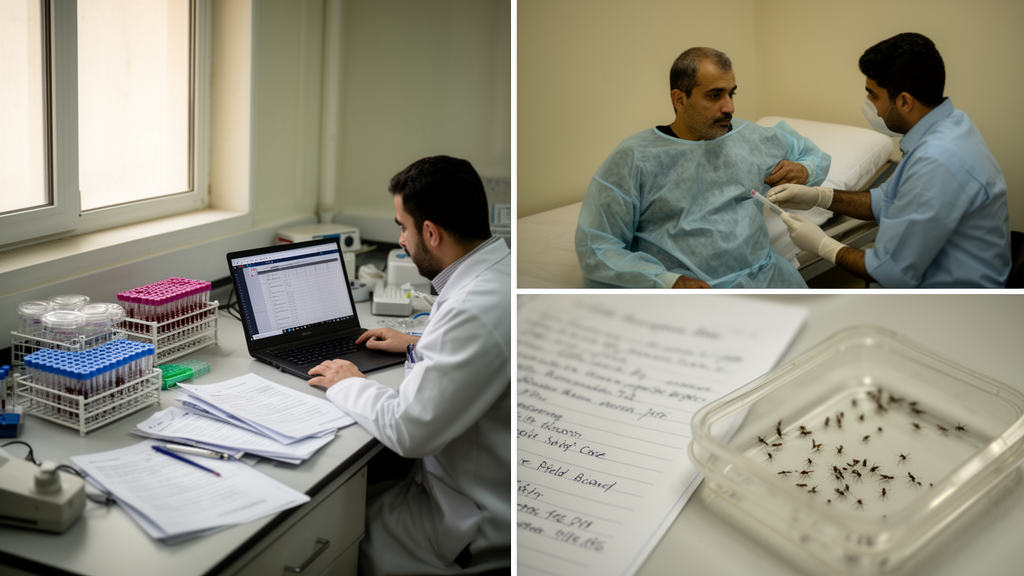
A retrospective surveillance study of suspected Crimean-Congo hemorrhagic fever (CCHF) in Thi-Qar governorate, southern Iraq, identified fever, thrombocytopenia and injection-site bleeding as clinical factors independently associated with PCR-confirmed infection. Epidemiological exposure and urban residence were also associated with a positive result, whereas subcutaneous bleeding was not statistically significant after adjustment for other variables.
The analysis included 806 suspected patients whose records were reported between January 2023 and December 2024. PCR results classified 190 patients as positive. Researchers used univariate and multivariable logistic regression to evaluate which clinical and epidemiological factors were independently associated with laboratory-confirmed CCHF. This observational approach measures associations within the study population and does not establish that any factor caused infection.
Fever had the largest reported adjusted association with PCR-confirmed CCHF, producing an adjusted odds ratio of 13.70 and a 95% confidence interval of 3.25–58.82. Thrombocytopenia was also strongly associated with confirmation, with an adjusted odds ratio of 9.26 and a 95% confidence interval of 3.61–23.81. Both associations had P values below 0.001. The broad confidence interval for fever, particularly its lower bound of 3.25 and upper bound of 58.82, indicates uncertainty about the magnitude of the estimated association despite its statistical significance.
Bleeding at an injection site remained associated with confirmed CCHF after adjustment for other variables, although its adjusted odds ratio of 1.85 was smaller than those for fever and thrombocytopenia. Its 95% confidence interval was 1.05–3.25, with P = 0.002. Subcutaneous bleeding did not remain statistically significant after other variables were considered. Epidemiological exposure had an adjusted odds ratio of 8.13 (95% CI 5.15–12.66; P < 0.001), and urban residence had an adjusted odds ratio of 1.906 (95% CI 1.272–2.857; P = 0.002). These regional findings should not be treated as universal risk estimates for CCHF.
The investigators also evaluated a three-point screening score that assigned one point for each of three findings: fever, thrombocytopenia and injection-site bleeding. PCR positivity rose significantly with increasing score, from 0% among patients with a score of zero to 41.5% among those scoring three points (P < 0.001). Receiver operating characteristic analysis indicated modest discrimination, with an area under the curve of 0.643 and a 95% confidence interval of 0.601–0.684.
At a cutoff of two or more points, the score had a sensitivity of 98.4%, a specificity of 24.2% and a negative predictive value of 98.0% in the study population. These results show that nearly all PCR-positive patients were captured by the threshold, but the low specificity means that many patients who tested negative also met the two-point criterion. The negative predictive value was also conditional on the study population and its observed PCR-positive proportion, rather than representing a universal performance estimate.
The combined findings indicate that the three clinical signs were useful as indicators of PCR confirmation among people already suspected of having CCHF, but they were insufficient to distinguish confirmed infection reliably on their own. Epidemiological exposure was also strongly associated with confirmation in the multivariable analysis. The authors therefore characterized the proposed score as exploratory and stated that it requires further internal and external validation before routine clinical use.
Important limitations accompany the results. The study was retrospective and surveillance-based, drew on records from one Iraqi governorate, and included only suspected cases whose outcomes could be classified by PCR. The sample also included a substantial proportion of non-confirmed patients, with 190 positive results among 806 suspected patients. The modest area under the curve, low specificity and retrospective single-region setting constrain how directly the score can be transferred to other populations, healthcare settings or periods. The study therefore supports clinical prioritisation as a possibility for further evaluation, rather than demonstrating a validated stand-alone diagnostic rule.
Subject of Research: Clinical predictors of PCR-confirmed Crimean-Congo hemorrhagic fever among suspected cases in Thi-Qar, Iraq
Article Title: Beyond thrombocytopenia: clinical predictors of PCR-confirmed Crimean-Congo hemorrhagic fever in Thi-Qar, Iraq (2023–2024)
Article References: Hommod, S. A., Alasadi, R. A., Razzaq, A. K., & Roomi, A. B. (2026). Beyond thrombocytopenia: clinical predictors of PCR-confirmed Crimean-Congo hemorrhagic fever in Thi-Qar, Iraq (2023–2024). BMC Infectious Diseases. https://doi.org/10.1186/s12879-026-14617-4
Image Credits: AI Generated
DOI: 10.1186/s12879-026-14617-4
Keywords: Crimean-Congo hemorrhagic fever, CCHF, PCR confirmation, clinical predictors, thrombocytopenia, injection-site bleeding, screening score, surveillance study, Iraq, Beyond, clinical, predictors
News Source: Ophelia Keating. (October 20, 2026). Retrospective study of clinical predictors of PCR-confirmed CCHF in Iraq. Scienmag.