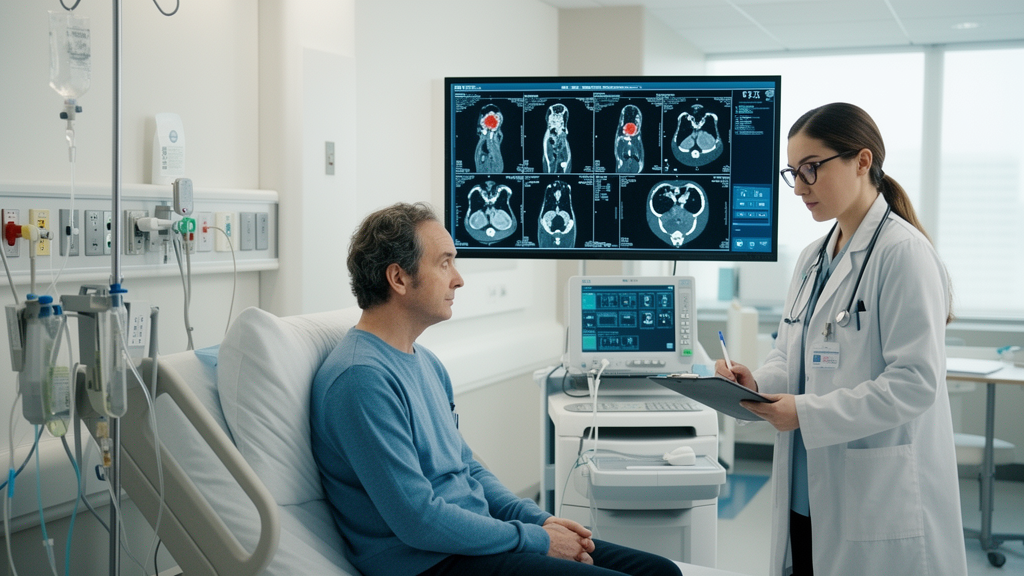
A prospective, single-arm phase II trial found high pathological response rates and manageable toxicity when toripalimab was combined with neoadjuvant chemoradiotherapy in patients with locally advanced adenocarcinoma of the esophagogastric junction. The study enrolled 40 patients with cT3–T4 or node-positive, nonmetastatic disease between September 2019 and April 2024. Thirty-one patients underwent radical surgery.
In this surgery population, 24 patients, or 77.4%, achieved a major pathological response, while 13, or 41.9%, achieved a pathological complete response. All 31 operations resulted in an R0 resection. Because the trial had no comparison group, the results demonstrate outcomes observed with the regimen but cannot determine how much, if any, were attributable specifically to toripalimab.
Before surgery, patients received radiotherapy delivered as 50 Gy/45 Gy/25 fractions, five cycles of concurrent weekly chemotherapy and four cycles of toripalimab, a PD-1 inhibitor. After radical surgery, patients received adjuvant chemoimmunotherapy. The primary endpoint was the major pathological response rate.
Secondary endpoints included pathological complete response, R0 resection, disease-free survival, overall survival, event-free survival and safety. The investigators also conducted exploratory analyses of immune correlates, including tertiary lymphoid structures, or TLS. Safety outcomes were limited in the reported cohort.
The investigators recorded one case of treatment-related toxicity of grade 4 or higher and one case of a surgical complication of grade 3 or higher. During a median follow-up of 54.4 months for overall survival and 51.6 months for disease-free survival, two- and four-year overall survival in the surgery cohort were 93.5% and 86.6%, respectively. In the whole enrolled population, which included patients who did not undergo surgery, the corresponding rates were 85.0% and 71.5%.
Two- and four-year disease-free survival in the surgery cohort were 83.9% and 80.4%, respectively. These survival estimates were calculated for different populations and should not be interpreted as directly comparable outcome estimates for a randomized treatment effect. The exploratory immune analysis found that patients with detectable TLS were more likely to achieve pathological complete response than patients without detectable structures, with p = 0.047.
This was an association observed in the study, not evidence that TLS caused the response or that its presence can reliably select patients for treatment. The lack of a randomized comparator, the small sample and the fact that only 31 of 40 enrolled patients proceeded to radical surgery also limit interpretation. Pathological and survival results were strongest in the surgery cohort and may therefore describe a selected group rather than every patient who began treatment.
Overall, the phase II findings provide evidence of substantial pathological response, relatively few severe treatment-related and surgical events, and encouraging survival estimates under the combined neoadjuvant and postoperative strategy, while leaving the independent contribution of toripalimab unresolved.
Subject of Research: Phase II evaluation of neoadjuvant toripalimab with chemoradiotherapy for locally advanced esophagogastric junction adenocarcinoma
Article Title: Neoadjuvant toripalimab plus concurrent chemoradiotherapy for locally advanced adenocarcinoma of the esophagogastric junction: a phase II trial
Article References: Li, Y., Du, R., Geng, J., Liu, Z., Sui, X., Zhu, X., Li, S., Zhang, Y., Ma, D., Cui, Y., Wang, H., Cai, Y., Wang, Z., Tang, L., Yuan, P., Li, S., Zhu, Y., Li, Z., Zhang, X., … Li, Z. (2026). Neoadjuvant toripalimab plus concurrent chemoradiotherapy for locally advanced adenocarcinoma of the esophagogastric junction: a phase II trial. BMC Medicine. https://doi.org/10.1186/s12916-026-05337-2
Image Credits: AI Generated
DOI: 10.1186/s12916-026-05337-2
Keywords: toripalimab, phase II trial, esophagogastric junction cancer, neoadjuvant therapy, chemoradiotherapy, pathological response, tertiary lymphoid structures, cancer immunotherapy, single-arm study, Neoadjuvant, plus, concurrent
News Source: Nathaniel Bowman. (October 20, 2026). Single-arm phase II trial reports strong response with junctional cancer combination. Scienmag.