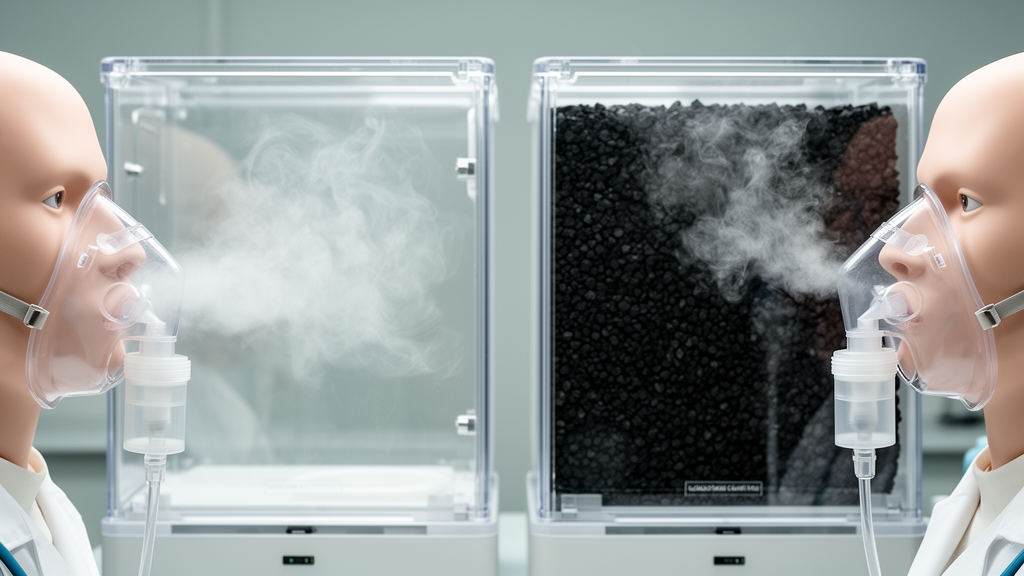
Two randomized, single-dose crossover trials found that a test budesonide inhalation suspension and the reference product Pulmicort Respules were bioequivalent in healthy Chinese adults both with and without activated-charcoal blockade. In each trial, the 90% confidence intervals for the test-to-reference geometric mean ratios of maximum plasma concentration, area under the concentration-time curve to the last measurable concentration and area under the curve to infinity all fell within the prespecified acceptance range of 80.00% to 125.00%. The charcoal-block trial therefore complemented a conventional systemic-exposure comparison with evidence collected under conditions intended to reduce absorption from the gastrointestinal tract.
The studies were designed to address a distinctive problem in evaluating inhaled corticosteroids. Budesonide acts locally in the airways, but the drug concentration measured in blood can represent material absorbed through the lungs as well as material swallowed during nebulization and subsequently absorbed from the gastrointestinal tract. Routine pharmacokinetic bioequivalence studies capture both routes, making it difficult to determine how much systemic exposure originated in the lungs. Activated charcoal can adsorb swallowed drug before substantial gastrointestinal uptake occurs, providing a more lung-focused view of systemic exposure without directly measuring the concentration of budesonide at its site of action.
Each study enrolled 36 healthy Chinese adults aged 18 to 65 years. Participants were assigned within each trial to one of two treatment sequences, either test-reference-test-reference or reference-test-reference-test, creating a fully replicated four-period crossover design. On each study day, subjects received a single 1 mg dose of test or reference budesonide inhalation suspension under fasting conditions. Doses were delivered with a PARI LC Jet Plus nebulizer connected to a PARI Master compressor. Participants completed standardized training, wore nasal clips, sat upright and inhaled slowly through a mouthpiece while following an audio guide. The administration continued until six minutes after sputtering was first heard, and consecutive periods were separated by a five-day washout.
The test suspension was manufactured by Sichuan Purity Pharmaceutical Co., Ltd., while Pulmicort Respules served as the reference. In the charcoal-block trial, participants received 3 g of activated charcoal suspended in 30 mL of water two minutes before nebulization, immediately after nebulization and one hour later. They were instructed to gargle before swallowing to increase adsorption of material remaining in the mouth. This protocol was intended to suppress gastrointestinal absorption, although the investigators could not directly verify that absorption had been completely blocked. Blood was sampled frequently during the first 15 hours after each dose, and a validated liquid chromatography-tandem mass spectrometry assay quantified budesonide in plasma.
Bioequivalence was evaluated with a mixed-effects model applied to natural-log-transformed pharmacokinetic values, with sequence, period and treatment treated as fixed effects and subjects nested within sequence. The primary endpoints were maximum plasma concentration, or Cmax, and two exposure measures: AUC0-t, calculated from dosing through the last measurable concentration, and AUC0-inf, calculated through infinite time. Geometric mean ratios and their 90% confidence intervals were derived using a two one-sided testing approach. All three endpoints met the acceptance criteria under both conditions. Without charcoal, the geometric mean ratios were 98.08% for Cmax, 98.36% for AUC0-t and 98.70% for AUC0-inf. Their respective confidence intervals were 91.41% to 105.24%, 93.40% to 103.57% and 93.89% to 103.77%.
With charcoal blockade, the corresponding geometric mean ratios were 93.61% for Cmax, 91.58% for AUC0-t and 91.65% for AUC0-inf. The 90% confidence intervals were 86.73% to 101.04% for Cmax, 87.59% to 95.74% for AUC0-t and 87.87% to 95.59% for AUC0-inf. These results support pharmacokinetic equivalence of the two formulations under both the conventional non-block condition and the condition designed to reduce gastrointestinal uptake. The analysis also identified significant period effects and formulation effects for some charcoal-block endpoints, but these individual analysis-of-variance results did not change the bioequivalence decision, which was based on whether all three confidence intervals met the prespecified limits.
Budesonide was absorbed rapidly in both trials, with a median time to maximum concentration of about 0.20 hours after dosing. Plasma concentrations then declined promptly, and the terminal elimination half-life was approximately three hours. Across treatment-period profiles, mean Cmax for the test formulation was 1,147.51 pg/mL without charcoal and 1,126.53 pg/mL with charcoal, compared with 1,189.55 and 1,228.52 pg/mL for the reference formulation. The corresponding test-formulation mean AUC0-inf values were 2,236.36 and 2,000.58 h·pg/mL, while those for the reference formulation were 2,288.22 and 2,155.25 h·pg/mL. These descriptive values show the overall pharmacokinetic profile but are separate from the confidence-interval analysis used to establish equivalence.
The charcoal-block and non-block conditions were assessed in different participants, so their direct comparison cannot be interpreted as a randomized estimate of the effect of charcoal. Nevertheless, an exploratory subject-level analysis associated charcoal blockade with numerically lower exposure. For the test formulation, mean AUC0-t fell from 2,135.20 ± 598.52 h·pg/mL without charcoal to 1,927.92 ± 543.73 h·pg/mL with charcoal, while AUC0-inf fell from 2,224.24 ± 613.06 to 2,000.58 ± 550.29 h·pg/mL. The nominal exploratory P values for those differences were 0.129 and 0.108, while the Cmax comparison gave 0.864. Similar nonsignificant patterns appeared for the reference formulation, with nominal P values of 0.720 for Cmax, 0.456 for AUC0-t and 0.432 for AUC0-inf. No multiplicity adjustment was applied, and the comparisons cannot establish that pulmonary absorption predominated.
Safety findings were similar across the formulations. In the non-block trial, 10 of 36 participants experienced treatment-emergent adverse events, compared with 9 of 36 in the charcoal-block trial. Most events were grade 1. One participant withdrew after a grade 2 upper respiratory tract infection that investigators judged unrelated to treatment, although completed dosing and pharmacokinetic data from that participant’s first two periods were retained without imputation. In the charcoal-block trial, one participant developed grade 2 chest tightness about two hours after the final dose and received nasal-cannula oxygen, after which the symptom resolved quickly. All adverse events had resolved by the final visit, and neither study reported serious adverse events.
The findings provide supportive evidence for evaluating generic nebulized budesonide products, but several limitations constrain their scope. The trials enrolled healthy volunteers rather than patients with asthma or chronic obstructive pulmonary disease, so airway geometry and inhalation behavior in clinical populations may differ. Only single-dose pharmacokinetics were assessed, leaving repeated-dose accumulation, steady-state exposure and long-term use unresolved. Charcoal effectiveness depended on participants following standardized administration and gargling instructions, and complete suppression of gastrointestinal absorption was not demonstrated. Lung deposition may also vary with nebulizer performance and inhalation technique, limiting extrapolation to other devices. The replicated crossover design, standardized dosing procedure, intensive early sampling and dedicated charcoal-block study strengthen the within-trial equivalence analysis, but the mechanistic comparison remains exploratory rather than causal.
Subject of Research: Pharmacokinetic bioequivalence of two nebulized budesonide inhalation suspensions in healthy Chinese adults with and without activated-charcoal blockade.
Article Title: Bioequivalence of budesonide inhalation suspension with and without activated charcoal in healthy Chinese subjects: two randomized four-period crossover trials
Article References: Li, Y., Qi, L., Fan, R., Zhang, Q., Liu, J., Cheng, X., & Wang, X. (2026). Bioequivalence of budesonide inhalation suspension with and without activated charcoal in healthy Chinese subjects: two randomized four-period crossover trials. Journal of Pharmacy & Pharmaceutical Sciences, 29, Article 17048. https://doi.org/10.3389/jpps.2026.17048
Image Credits: AI Generated
Keywords: budesonide, bioequivalence, activated charcoal, nebulized corticosteroids, pharmacokinetics, pulmonary absorption, drug development, healthy volunteers, inhalation, suspension, without, activated
News Source: Ophelia Keating. (October 20, 2026). Nebulized budesonide formulations match with and without charcoal blockade. Scienmag.