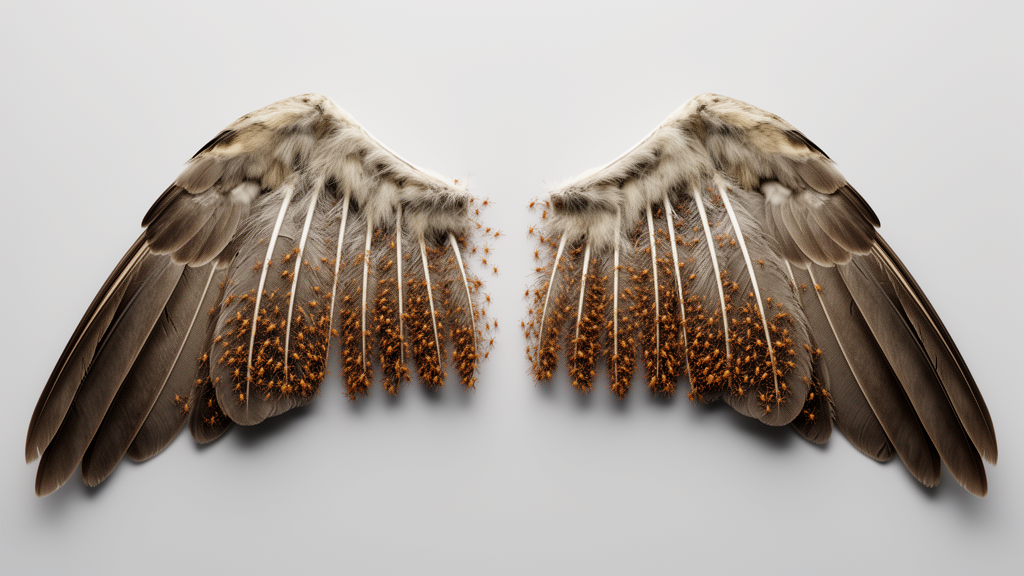
Feather mite communities on the wings of Siberian Rubythroats showed different patterns of dorsal and ventral abundance depending on position along the wing. An analysis of individual feathers found that the dorsal mite Trouessartia calliope was largely absent from the distal outer remiges, or flight feathers, and increased toward remiges closer to the body. The ventral mite Proctophyllodes sp. also exhibited a positional gradient.
When all positions were averaged, dorsal and ventral abundances were only weakly associated, but position-specific models revealed a stronger and changing relationship. The researchers examined feather-level spatial abundance associations along the proximodistal axis of the wing in Siberian Rubythroat, Calliope calliope . This axis extends from the innermost feathers near the body toward the outermost flight feathers.
Using nonlinear mixed-effects models, they assessed how the abundance of the two mite taxa varied among positions and whether mites on the dorsal and ventral surfaces followed associated patterns. The study addressed continuous variation within a host rather than dividing the wing into separate regions, allowing the relationship between the two surfaces to be assessed at multiple locations. The fitted dorsal–ventral slope was positive in the distal outer remiges, declined toward positions in the middle of the wing, and approached a weakly negative value in the innermost secondaries.
The authors caution that positive slopes in the distal outer remiges should not be taken as evidence of stable coexistence between the mite taxa. Because dorsal abundance was minimal in that region, the pattern may reflect responses to environmental constraints associated with distal wing positions rather than a persistent association between the two mites. This position-dependent pattern was detected in breeding adult birds but not in juveniles.
The researchers suggest that the difference may reflect age-related variation in within-host spatial organization. Juvenile birds may have had less time since mite transmission for their communities to assemble, whereas the pattern in adults may be more established. The analysis does not establish age as the direct cause or identify the mechanisms responsible.
In both age groups, mite abundances were bilaterally symmetrical, indicating broadly similar abundance on corresponding feathers of the left and right wings. The study also found no consistent effects of sex, date, or year. Together, the findings show that feather mite assemblages can be spatially heterogeneous even within a single host.
Pooling positions across the wing produced only weak overall dorsal–ventral associations, while the position-specific analysis revealed a relationship that ranged from positive to weakly negative. The results do not demonstrate that either mite taxon benefits from the presence of the other, nor do they show that one taxon causes changes in the abundance of the other. Instead, the study identifies wing position and bird age as important factors to consider when analyzing within-host mite communities, while bilateral symmetry and the absence of consistent date, year, or sex effects suggest a relatively stable spatial template associated with the host’s wing morphology.
Subject of Research: Spatial variation in dorsal and ventral feather mite abundance across Siberian Rubythroat wings
Article Title: Continuous and asymmetric dorsal–ventral abundance associations along the wing in feather mite communities
Article References: Takagi, M., Iwasaki, M., Yasuda, N., Shiraiwa, S., Katoh, T., & Takaku, G. (2026). Continuous and asymmetric dorsal–ventral abundance associations along the wing in feather mite communities. The Science of Nature, 113(6), Article 137. https://doi.org/10.1007/s00114-026-02182-4
Image Credits: AI Generated
DOI: 10.1007/s00114-026-02182-4
Keywords: feather mites, Siberian Rubythroat, spatial ecology, host-parasite relationships, wing morphology, mixed-effects models, community assembly, ectosymbionts, bird parasites, Continuous, asymmetric, dorsal
News Source: Drew Townsend. (October 20, 2026). Continuous and asymmetric dorsal–ventral abundance associations along the wing in feather mite communities. Scienmag.