Credit: KU Leuven – MICA Lab
Bioscience engineers from KU Leuven in Belgium have developed a new antibacterial strategy that weakens bacteria by preventing them from cooperating. Unlike with antibiotics, there is no resistance to this strategy, because the non-resistant bacteria outnumber resistant ones. The findings are published in Nature Communications.
Traditional antibiotics kill or reduce the activity of individual bacteria. Some bacteria become resistant to these antibiotics, allowing them to grow further and take over from non-resistant ones. The use of antibiotics therefore causes more and more bacteria to become resistant to antibiotics.
Bacteria, however, also exhibit group behaviour: for example, they can make a protective slime layer or biofilm that envelops their entire bacterial community. Dental plaque is an example of such a biofilm. Biofilms are often the source of bacterial infections. The social behaviour of bacteria is an interesting new target for antibacterial therapy.
Stronger together, weaker alone
The researchers showed that blocking slime production of salmonella bacteria weakens the bacterial community, making it easier to remove. They used a chemical, antibacterial substance that was previously developed at KU Leuven. “Without their protective slime layer, the bacteria can be washed away by mechanical forces and killed more easily by antibiotics, disinfectants or the immune system,” says Professor Steenackers of the MICA Lab, lead author of the study.
The scientists then compared the development of bacterial resistance to the new substance with that of classical antibiotics in a so-called evolution experiment. Evolution experiments are used to see how microorganisms adapt to a certain situation. “We saw that the bacteria, as a group, did not become resistant to our antibacterial substance, while this did happen with antibiotics, and quickly so,” Steenackers explains. “Moreover, we showed those bacteria that were resistant to the new antibacterial substance became outnumbered by non-resistant ones.
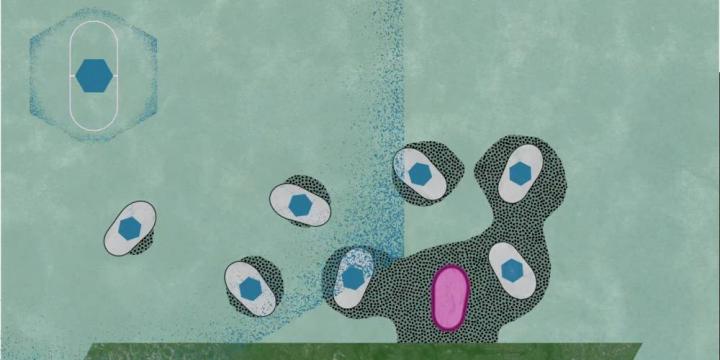
A resistant bacterium will still be able to produce slime and share this with the non-resistant bacteria in the group. However, this costs energy, while the non-resistant bacteria benefit from the protection free of charge. As a result, non-resistant bacteria can grow faster than the resistant ones, so that their share compared to the resistant bacteria increases. “In contrast to traditional antibiotics, this substance therefore does not cause selection for, but against resistance. “Antimicrobial treatments that stop bacteria from working together can therefore be a viable solution to the current problem of antibiotic resistance.”
Pill or coating
“Our aim is to introduce these new antimicrobials into clinical practice,” explains Steenackers. “They can be used as a preventive medicine in the form of a pill, or as a coating on implants to reduce the risk of infections.” The substance could also be used together with antibiotics.
Furthermore, there are several applications possible in agriculture, industry, and even our households. To this end, the researchers collaborate with experts in various applications, and with producers of animal feeds and cleaning products and disinfectants. The researchers are also investigating whether they can reproduce the phenomenon in other forms of microbial collaboration next to biofilms, and with other bacteria. “In the long term, this concept can also be used to develop alternatives to antibiotics,” concludes Steenackers.
###
Media Contact
Hans Steenackers
[email protected]
32-495-339-453
Original Source
https:/
Related Journal Article
http://dx.