• HOME
  • NEWS
  • EXPLORE
    • CAREER
      • Companies
      • Jobs
    • EVENTS
    • iGEM
      • News
      • Team
    • PHOTOS
    • VIDEO
    • WIKI
  • BLOG
  • COMMUNITY
    • FACEBOOK
    • INSTAGRAM
    • TWITTER
Wednesday, May 13, 2026
BIOENGINEER.ORG
No Result
View All Result
  • Login
  • HOME
  • NEWS
  • EXPLORE
    • CAREER
      • Companies
      • Jobs
        • Lecturer
        • PhD Studentship
        • Postdoc
        • Research Assistant
    • EVENTS
    • iGEM
      • News
      • Team
    • PHOTOS
    • VIDEO
    • WIKI
  • BLOG
  • COMMUNITY
    • FACEBOOK
    • INSTAGRAM
    • TWITTER
  • HOME
  • NEWS
  • EXPLORE
    • CAREER
      • Companies
      • Jobs
        • Lecturer
        • PhD Studentship
        • Postdoc
        • Research Assistant
    • EVENTS
    • iGEM
      • News
      • Team
    • PHOTOS
    • VIDEO
    • WIKI
  • BLOG
  • COMMUNITY
    • FACEBOOK
    • INSTAGRAM
    • TWITTER
No Result
View All Result
Bioengineer.org
No Result
View All Result
Home NEWS Science News Health

Research story tip: Down syndrome mice open door to better understanding of the disorder

Bioengineer by Bioengineer
August 18, 2020
in Health
Reading Time: 2 mins read
0
IMAGE
Share on FacebookShare on TwitterShare on LinkedinShare on RedditShare on Telegram

IMAGE

Credit: Johns Hopkins Medicine

Scientists across the globe often use mouse models in the study of human conditions to advance the pursuit of medicines and treatments. Now, Johns Hopkins Medicine researchers and their collaborators have created and characterized a new mouse replica of Down syndrome, long considered one of the most challenging disorders to simulate in laboratory animals.

A report of their research appeared June 29, 2020, in the journal eLife Sciences.

The new model may help researchers better understand how people with Down syndrome learn and develop, and eventually, lead to new therapies for potentially deadly complications of the condition, such as heart disease and thyroid problems.

Down syndrome, caused by trisomy 21, occurs when a person is born with an extra partial or entire copy of the 21st chromosome. Typically associated with distinct facial features and developmental delays, people with Down syndrome also experience difficulties with learning and memory, as well as higher rates of thyroid disease, blood and immune disorders and heart disease. Treating these conditions in people with Down syndrome is complicated by their genetics.

“There are more than 500 genes on chromosome 21 that can be overexpressed,” says Roger Reeves, Ph.D., professor of physiology at the Johns Hopkins University School of Medicine. “So, in comparison to many other genetic conditions, Down syndrome is vastly more complex.”

Further complicating the development of successful treatments is the lack of an accurate animal model to study the biology of Down syndrome and test potential therapies for conditions associated with it.

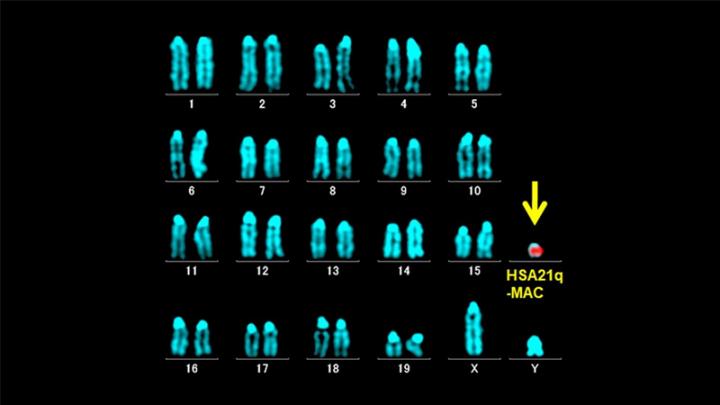
Reeves and his team endeavored to improve research efforts by creating a more precise replica of the condition in mice. They did this by inserting a human copy of chromosome 21 into mice using the rodent’s own cellular structures that organize DNA. This enables the mouse cells to reliably copy and sort the extra human chromosome into new cells as they divide. It also lets the mice pass the additional genetic material on to their offspring.

This means that these mice, named TcMAC21 by the researchers, can be used relatively easily and at low cost in long-term experiments.

The resulting TcMAC21 mice have many characteristics indicative of Down syndrome in humans, including a distinct facial structure, a greater prevalence for congenital heart defects, a smaller-than-usual cerebellum and learning difficulties.

The researchers caution that no single animal model can perfectly replicate a human condition. However, they believe that the TcMAC21 mouse model developed in this study is a good starting point to create new and better strategies for helping people with Down syndrome.

“Our goal is to improve the health of people with Down syndrome to give them the best chance at achieving their full potential,” says Reeves.

###

Media Contact
Rachel Butch
[email protected]
Tags: Medicine/HealthPhysiology
Share12Tweet8Share2ShareShareShare2

Related Posts

Intensive Caregiving Duties Linked to Accelerated Cognitive Decline, Study Finds

May 13, 2026

Nanoplatform Combats Skin Inflammation via RNA, ROS

May 13, 2026

PSU-Led Team Advances Promising New Drug Candidate for Malaria Control and Eradication

May 13, 2026

Study Finds Increased Psychosis Risk in High-Risk Groups with Combined Cannabis and Tobacco Use

May 13, 2026
Please login to join discussion

POPULAR NEWS

  • Research Indicates Potential Connection Between Prenatal Medication Exposure and Elevated Autism Risk

    842 shares
    Share 337 Tweet 211
  • New Study Reveals Plants Can Detect the Sound of Rain

    728 shares
    Share 290 Tweet 182
  • Salmonella Haem Blocks Macrophages, Boosts Infection

    62 shares
    Share 25 Tweet 16
  • Breastmilk Balances E. coli and Beneficial Bacteria in Infant Gut Microbiomes

    57 shares
    Share 23 Tweet 14

About

We bring you the latest biotechnology news from best research centers and universities around the world. Check our website.

Follow us

Recent News

Intensive Caregiving Duties Linked to Accelerated Cognitive Decline, Study Finds

Nanoplatform Combats Skin Inflammation via RNA, ROS

PSU-Led Team Advances Promising New Drug Candidate for Malaria Control and Eradication

Subscribe to Blog via Email

Enter your email address to subscribe to this blog and receive notifications of new posts by email.

Join 82 other subscribers
  • Contact Us

Bioengineer.org © Copyright 2023 All Rights Reserved.

Welcome Back!

Login to your account below

Forgotten Password?

Retrieve your password

Please enter your username or email address to reset your password.

Log In
No Result
View All Result
  • Homepages
    • Home Page 1
    • Home Page 2
  • News
  • National
  • Business
  • Health
  • Lifestyle
  • Science

Bioengineer.org © Copyright 2023 All Rights Reserved.