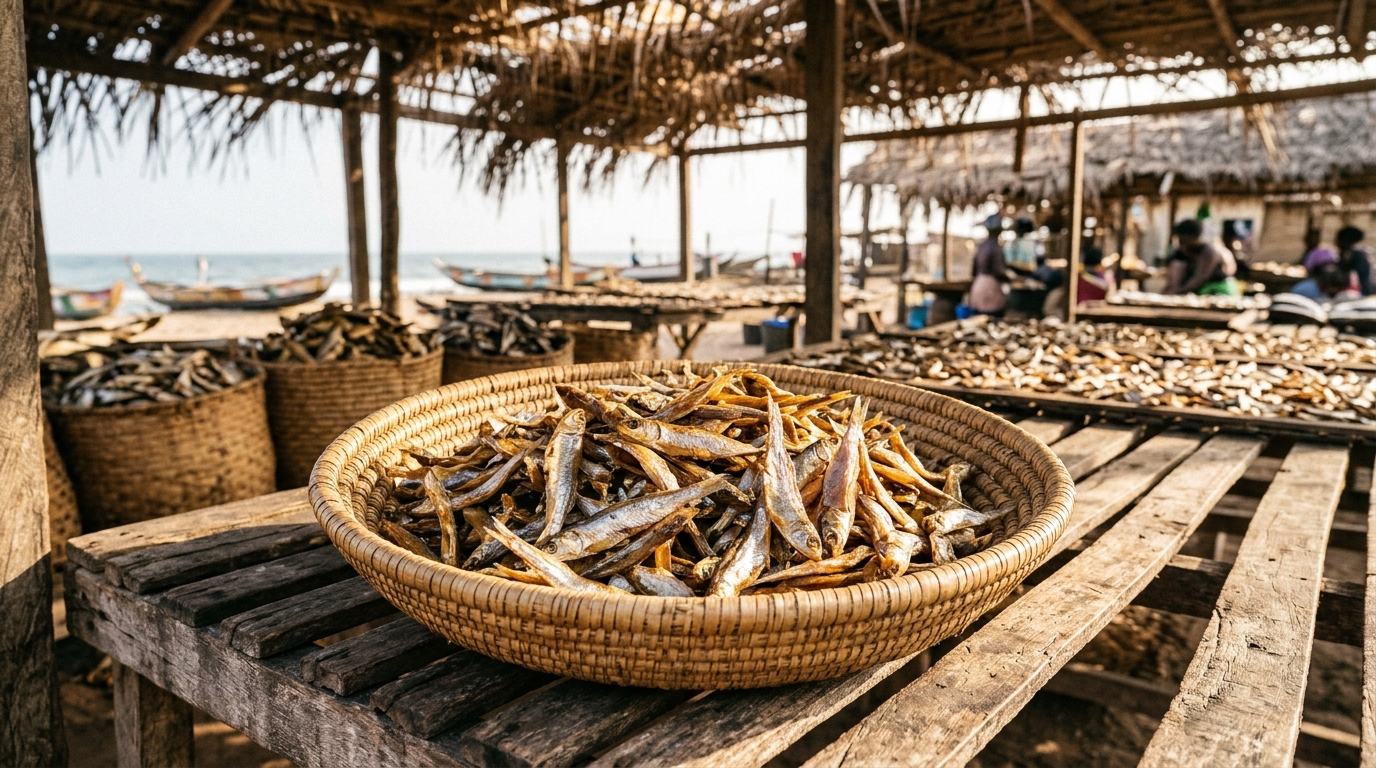
A new study has now followed those fish from the moment they left the oven or the drying ground through nine months of traditional storage, tracking bacteria, moulds and mycotoxins at every step.
The research, published in the journal Food Safety and Risk, was carried out by a team including Laura Wessels, Theophilus Annan, Amy Atter, Christoph Gottschalk, Marian Kjellevold, Felix Reich and Johannes Pucher, working with processors in three regions of Ghana: Greater Accra, Central and Volta. The study was carried out at the sites of six small-scale processors in Ghana, who handled and processed the fish as usual, without instruction from the researchers. Three processors used smoking ovens, located in Nungua, Moree and Keta, while three used sun-drying, in Tema Newtown, Ekon and Adina. The study was designed to picture the high variability of different processes in different regions, including local traditions and individual practices, so only descriptive statistical methods were used.
The fish in question was the European anchovy, Engraulis encrasicolus, a species that Ghanaian small- and medium-scale enterprises preserve by both smoking and drying. Each processor purchased between 70 and 100 kilograms of fresh anchovies from the landing beaches early in the morning, transported them immediately to the processing site, and handled and processed the fish without instruction. For smoking, the study included processors using two techniques, the Chorkor oven and the Ahotor oven. The Chorkor oven, a long-established design, uses tiered trays that allow better distribution of smoke and heat, while the newer Ahotor oven is known for fuel efficiency and large capacity. For sun-drying, the team contrasted the traditional practice of laying fish directly on the ground or on nets with a more recent alternative: elevated racks built from wire mesh, wood and fine nylon net, which improve air circulation and allow the fish to be flipped easily during drying.
Processing and the first sampling took place in January 2021. After drying or smoking, initial samples were collected aseptically, and the processed fish was packaged traditionally into baskets lined with waterproof brown paper, covered with several layers of thick black polythene and tied with ropes. The packaged fish was stored in the storage unit of the respective processor for up to nine months, after which the anchovies would have been sold. Every three months until nine months of storage, in April, July and October, samples were taken from three locations in each storage heap, the top, the middle and the bottom, and the fish was re-packaged as before. The samples were sent chilled to Germany and Norway via airfreight for analysis.
The samples were analysed for several microbial parameters and for the mycotoxins aflatoxin B1 and ochratoxin A. At the German Federal Institute for Risk Assessment in Berlin, samples were homogenised and analysed for total colony counts, moulds, coliforms, E. coli, presumptive B. cereus and Clostridium spp. following standardised ISO methods, with Salmonella spp. detected through a separate enrichment procedure. Moisture content was analysed at the Institute of Marine Research in Bergen, Norway, using freeze-drying for freshly processed fish and gravimetric oven drying at 105 °C overnight for stored samples. Mycotoxin analysis was performed by liquid chromatography tandem mass spectrometry, with samples pooled by processor, resulting in twelve samples per sampling timepoint. The limit of detection and quantification was 0.14 and 0.43 micrograms per kilogram for aflatoxin B1 and 1.6 and 4.8 micrograms per kilogram for ochratoxin A.
The microbiological findings were strikingly consistent. Both smoking techniques produced lower numbers of total colony counts, moulds, coliforms and Clostridium species than either sun-drying procedure. Anchovies processed in the Ahotor oven had the lowest total colony counts of any method, while rack-dried anchovies had the highest, a contrast with previous studies that had reported better microbiological quality in rack-dried fish than in fish dried on bare ground. Coliforms were not detected in any smoked sample right after processing, and moulds appeared only sporadically in smoked product. Salmonella and E. coli were absent from every sample analysed, both immediately after processing and throughout the nine months of storage, fulfilling the requirements set by the Ghana Standards Authorities.
Against national regulatory benchmarks, the fish performed well. Ghana’s guidance and warning limits for total colony counts in smoked fish are 5.7 and 7 log colony-forming units per gram respectively, and no smoked anchovy exceeded either threshold. No limits exist for sun-dried fish, so the team applied the smoked-fish limits for comparison, assuming similar consumption patterns. Even then, only a handful of sun-dried samples approached or crossed the thresholds: one rack-dried sample from the Volta region exceeded the warning limit right after processing at 7.5 log CFU per gram, and a small number of other samples from the same batch and from floor-dried fish after nine months exceeded the guidance limit. Bacterial counts did not increase during storage; mean total colony counts were lower after nine months than immediately after processing, and B. cereus group counts, which ranged between roughly 1.1 and 2.1 log CFU per gram across the study, remained stable, with low numbers not indicating a high pathogenic potential.
The mycotoxin results told a different story. Aflatoxin B1 was not detected in any sample, smoked or dried. Ochratoxin A, however, appeared in the sun-dried anchovies and was absent from all smoked ones. In floor-dried fish, concentrations stayed below the quantification limit during the first three months of storage, then rose above that limit after six months in samples from one processor and, after nine months, in samples from a second. In rack-dried anchovies, only the freshly processed samples measured below the quantification limit; thereafter, concentrations climbed to as much as 22.4 micrograms per kilogram. The researchers suggest that unevenly distributed moisture in the storage heaps may have allowed moulds, including Aspergillus and Penicillium species, which can produce mycotoxins, to grow in localised patches, though the study design did not allow investigation of mould growth within the storage unit.
Moisture content may connect many of these findings, as the study reports that higher moisture in sun-dried anchovies might explain their higher mould counts compared to smoked anchovies. Smoked anchovies entered storage with mean moisture contents of 9.2 and 10.2 percent for the Ahotor and Chorkor ovens respectively and ended the nine months at 12.4 and 12.9 percent, staying below the 15 percent level at which moulds showed significantly reduced growth on dried foods in a cited study. Sun-dried fish, by contrast, started at mean moisture contents of 13.8 and 14.2 percent for floor-dried and rack-dried anchovies and climbed to 16.8 and 18.3 percent respectively, with mean values around the 15 percent threshold. The researchers suggest that inconsistent drying of individual fish, imperfectly waterproof packaging and ambient humidity all contributed to the rise. Higher moisture in sun-dried fish may also have promoted bacterial growth, and the team notes that prolonged drying can allow fermentation, while some processors skipped a washing step before preservation, potentially raising the initial microbial load.
The authors conclude that all the tested preservation methods, when performed adequately, produced anchovies of marketable quality, with bacterial counts and moulds below national limit values and, from a microbiological safety standpoint, suitable for consumption, particularly if the fish are heated thoroughly before eating. Smoking delivered lower bacterial counts, lower moisture and no detectable mycotoxins, although the team cautions that smoking over an open fire leads to the development of polycyclic aromatic hydrocarbons, which are carcinogenic and have been found in high concentrations in smoked fish, and that this study did not measure them. The ochratoxin A findings, meanwhile, call for further investigation to determine the actual risk to consumers, since the study’s design could not track mould growth inside the storage units, and sun-dried fish contributes to overall dietary exposure alongside other contaminated foods. The study highlights that the development of improved technologies, such as rack-drying, is not enough on its own, but needs to be combined with adaptation to local conditions and continuous training to produce high quality processed anchovies.
Subject of Research: Microbial and mycotoxin safety of traditionally processed anchovies stored for nine months in Ghana
Article Title: Microbial food safety of sun-dried and smoked European anchovies during nine months traditional storage in Ghana
Article References: Wessels, L., Annan, T., Atter, A., Gottschalk, C., Kjellevold, M., Reich, F., & Pucher, J. (2026). Microbial food safety of sun-dried and smoked European anchovies during nine months traditional storage in Ghana. Food Safety and Risk, 13(1), Article 31. https://doi.org/10.1186/s40550-026-00154-0
Image Credits: AI Generated
DOI: 10.1186/s40550-026-00154-0
Keywords: food safety, Ghana, anchovies, fish processing, smoking, sun-drying, mycotoxins, ochratoxin A, aflatoxin B1, traditional storage, microbiology, small-scale fisheries
News Source: Morgan Morrow. (November 5, 2026). Research report: Microbial food safety of sun-dried and smoked European anchovies during nine months traditional storage in Ghana. Scienmag.