• HOME
  • NEWS
  • EXPLORE
    • CAREER
      • Companies
      • Jobs
    • EVENTS
    • iGEM
      • News
      • Team
    • PHOTOS
    • VIDEO
    • WIKI
  • BLOG
  • COMMUNITY
    • FACEBOOK
    • INSTAGRAM
    • TWITTER
Wednesday, October 21, 2026
BIOENGINEER.ORG
No Result
View All Result
  • Login
  • HOME
  • NEWS
  • EXPLORE
    • CAREER
      • Companies
      • Jobs
        • Lecturer
        • PhD Studentship
        • Postdoc
        • Research Assistant
    • EVENTS
    • iGEM
      • News
      • Team
    • PHOTOS
    • VIDEO
    • WIKI
  • BLOG
  • COMMUNITY
    • FACEBOOK
    • INSTAGRAM
    • TWITTER
No Result
View All Result
Bioengineer.org
No Result
View All Result
Home NEWS Science News Technology

Research report: Large-area textile-based piezoresistive sensor array for hull stress distribution mapping

by
October 21, 2026
in Technology
Reading Time: 2 mins read
0
Research report: Large-area textile-based piezoresistive sensor array for hull stress distribution mapping

Research report: Large-area textile-based piezoresistive sensor array for hull stress distribution mapping

Share on FacebookShare on TwitterShare on LinkedinShare on RedditShare on Telegram

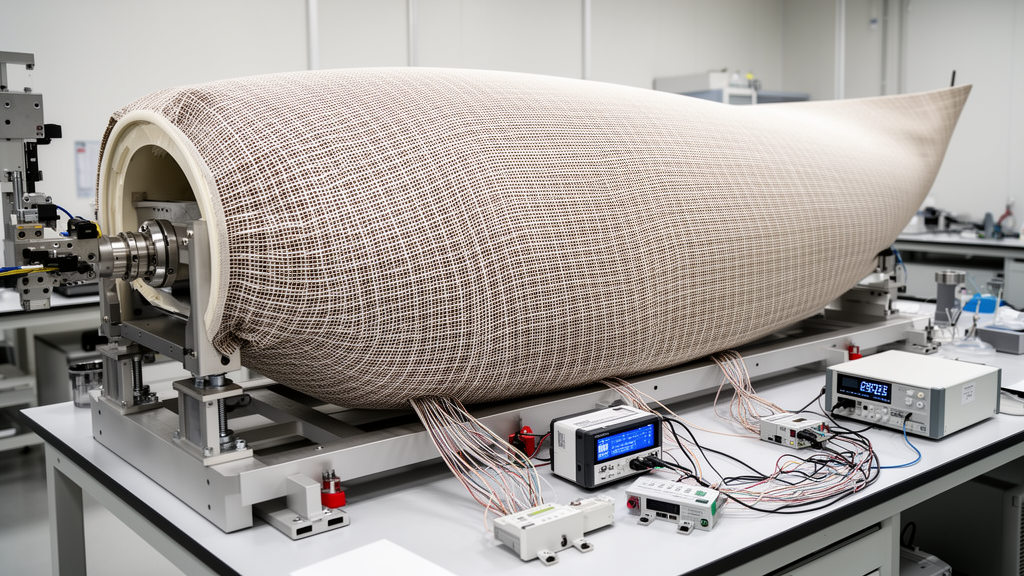
A flexible, textile-based piezoresistive sensor array has demonstrated full-field mapping of stress distributions on ship hull surfaces, including regions where localized loads concentrate. The 5 × 5 array reconstructed stress patterns that closely matched finite element simulations, with a reported coefficient of determination of R² = 0.96. When mounted on typical stress-concentrated areas of a ship hull, it captured both low-amplitude wave-induced cyclic stresses and high-amplitude slamming transients, according to the study published in the Journal of Materials Science .

The device is designed to overcome limitations associated with conventional structural monitoring systems. Strain gauges and fiber Bragg gratings are discrete instruments, meaning that widely separated measurement points provide sparse coverage of a hull. Their system complexity can also be high, and rigid sensors may conform poorly to curved hull surfaces.

The researchers addressed these constraints with a textile-compatible array built around grid-structured sensing electrodes. Its thin, flexible construction allows the device to cover a larger area while remaining mechanically compliant and capable of real-time signal acquisition. Each sensing pixel uses several functional materials.

The grid-structured electrodes were modified sequentially with MXene nanosheets and PEDOT:PSS. According to the study, this combination supports large structural deformation and abundant conductive pathways under pressure, allowing electrical resistance changes to represent applied loading. Screen-printed silver interdigitated electrodes provide the signal readout, while thin poly(vinylidene fluoride), or PVDF, encapsulation layers protect the active structure from water without compromising flexibility.

A row–column addressing system interrogates the 25 pixels, suppresses crosstalk between neighboring elements and supports reconstruction of the spatial stress distribution. At the individual-pixel level, the sensor delivered a reported sensitivity of 1,143.5 kPa⁻¹, a response and recovery time of 10 milliseconds and a detection limit as low as 1 pascal. The full-array comparison with finite element simulation produced the reported R² = 0.96 agreement between reconstructed and simulated stress distributions.

Marine durability was also assessed: the array retained more than 95% of its initial sensitivity after 15 days of salt-spray aging, and its baseline drift remained below 3% during dynamic seawater cycling. These results support the reported performance under the specified test conditions, but they do not establish equivalent durability across different hull designs, environmental conditions or complete operational lifetimes. The study presents a hull-mounted demonstration and a simulation comparison, providing a proof-of-concept for scalable, flexible monitoring of ship structural health rather than a vessel-wide performance record.

Subject of Research: Textile piezoresistive sensor arrays for ship hull stress mapping

Article Title: Large-area textile-based piezoresistive sensor array for hull stress distribution mapping

Article References: Xie, Y., & Zhang, Q. (2026). Large-area textile-based piezoresistive sensor array for hull stress distribution mapping. Journal of Materials Science, 61(40), 30976-30991. https://doi.org/10.1007/s10853-026-13667-y

Image Credits: AI Generated

DOI: 10.1007/s10853-026-13667-y

Keywords: ship structural health monitoring, textile sensors, piezoresistive arrays, hull stress mapping, MXene, PEDOT:PSS, real-time sensing, marine durability, finite element simulation, Large-area, textile-based, piezoresistive

News Source: Denise Maddox. (October 21, 2026). Research report: Large-area textile-based piezoresistive sensor array for hull stress distribution mapping. Scienmag.


Tags: finite-element simulationhull stress mappingLarge-areamarine durabilityMXenePEDOT:PSSpiezoresistivepiezoresistive arraysreal-time sensingship structural health monitoringtextile sensorstextile-based
Share12Tweet7Share2ShareShareShare1

Related Posts

Environmental volatility is associated with adaptive caution in visual search

Environmental volatility is associated with adaptive caution in visual search

October 21, 2026
Simulation and prototype test feedback-free scheduling for flexible 6G base-station cooperation

Simulation and prototype test feedback-free scheduling for flexible 6G base-station cooperation

October 21, 2026

Matrix origin determines how perlecan sugars steer stem cell fate

October 21, 2026

Trust and Human-Like Design Linked to Marketing Chatbot Use Intention

October 21, 2026

POPULAR NEWS

  • Cross-sectional study links social support, fear and health behavior after PCI

    Cross-sectional study links social support, fear and health behavior after PCI

    29 shares
    Share 12 Tweet 7
  • Retrospective Spanish study links COPD triple therapy to lower costs and emissions

    29 shares
    Share 12 Tweet 7
  • Environmental volatility is associated with adaptive caution in visual search

    29 shares
    Share 12 Tweet 7
  • Pilot trial finds combined dementia rehabilitation and caregiver support feasible

    29 shares
    Share 12 Tweet 7

About

We bring you the latest biotechnology news from best research centers and universities around the world. Check our website.

Follow us

Recent News

Cross-sectional study links social support, fear and health behavior after PCI

Retrospective Spanish study links COPD triple therapy to lower costs and emissions

Environmental volatility is associated with adaptive caution in visual search

Subscribe to Blog via Email

Enter your email address to subscribe to this blog and receive notifications of new posts by email.

Join 85 other subscribers
  • Contact Us

Bioengineer.org © Copyright 2023 All Rights Reserved.

Welcome Back!

Login to your account below

Forgotten Password?

Retrieve your password

Please enter your username or email address to reset your password.

Log In
No Result
View All Result
  • Homepages
    • Home Page 1
    • Home Page 2
  • News
  • National
  • Business
  • Health
  • Lifestyle
  • Science

Bioengineer.org © Copyright 2023 All Rights Reserved.