• HOME
  • NEWS
  • EXPLORE
    • CAREER
      • Companies
      • Jobs
    • EVENTS
    • iGEM
      • News
      • Team
    • PHOTOS
    • VIDEO
    • WIKI
  • BLOG
  • COMMUNITY
    • FACEBOOK
    • INSTAGRAM
    • TWITTER
Tuesday, October 20, 2026
BIOENGINEER.ORG
No Result
View All Result
  • Login
  • HOME
  • NEWS
  • EXPLORE
    • CAREER
      • Companies
      • Jobs
        • Lecturer
        • PhD Studentship
        • Postdoc
        • Research Assistant
    • EVENTS
    • iGEM
      • News
      • Team
    • PHOTOS
    • VIDEO
    • WIKI
  • BLOG
  • COMMUNITY
    • FACEBOOK
    • INSTAGRAM
    • TWITTER
No Result
View All Result
Bioengineer.org
No Result
View All Result
Home NEWS Science News Agriculture

Research report: Genetic Variability and Interrelationships of Methionine, Lysine, and Tryptophan in Indian Maize Inbred Lines

by
October 20, 2026
in Agriculture
Reading Time: 2 mins read
0
Research report: Genetic Variability and Interrelationships of Methionine, Lysine, and Tryptophan in Indian Maize Inbred Lines

Research report: Genetic Variability and Interrelationships of Methionine, Lysine, and Tryptophan in Indian Maize Inbred Lines

Share on FacebookShare on TwitterShare on LinkedinShare on RedditShare on Telegram

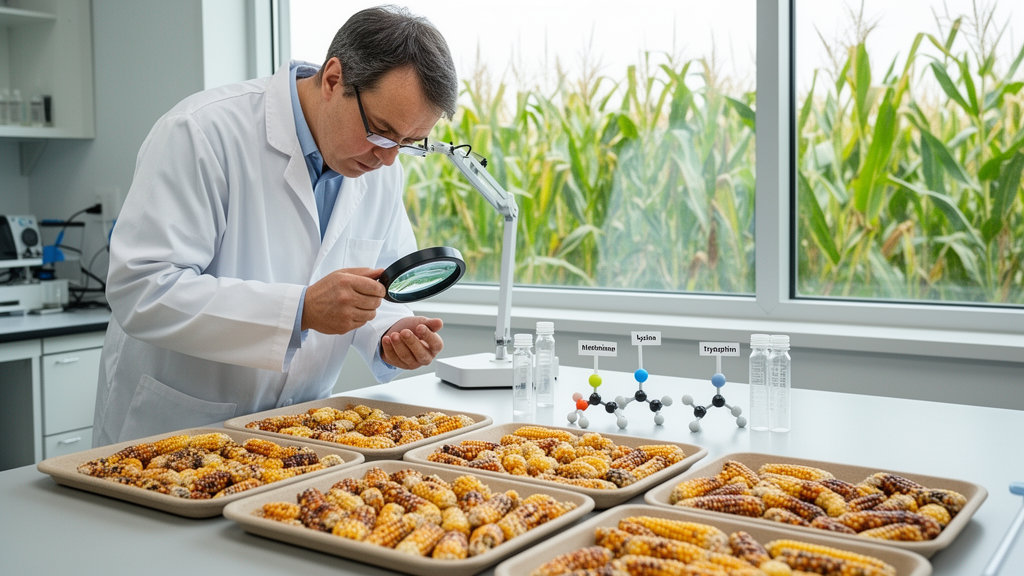
Analysis of 250 genetically diverse Indian maize inbred lines found significant differences among genotypes in their grain concentrations of methionine, lysine and tryptophan. Methionine content ranged from 0.034% to 0.269%, lysine from 0.114% to 0.384%, and tryptophan from 0.039% to 0.105%. The study assessed genetic variation in these amino acids and tested the relationships among their concentrations in the evaluated lines.

Maize grain protein generally lacks adequate amounts of lysine, tryptophan and methionine, which the researchers identified as a limitation affecting the crop’s nutritional quality. Prior work had focused more extensively on lysine and tryptophan, leaving less information about variability in methionine and its association with the other two amino acids. The present analysis therefore examined methionine content across the inbred-line collection and evaluated whether increases in one amino acid were accompanied by increases in another.

Five inbred lines—MIL-7-341-1-1, E6-36-1-C2, MIL-7-315-7, MIL-7-87-1 and E6-21-1—had methionine concentrations above 0.25%. These observations identify the genotypes as material with comparatively high measured methionine content within this study. The analysis also characterized each inbred line across the three nutritional traits, combining assessment of variation with identification of lines that showed enhanced individual amino-acid profiles.

The strongest measured relationship was between lysine and tryptophan. Their correlation coefficient was 0.77, indicating a strong, highly significant positive association across the 250 lines. In practical terms, lines with relatively high lysine concentrations tended also to have relatively high tryptophan concentrations in the evaluated collection.

The result indicates that the two traits moved together in this set of inbred lines, although the correlation alone does not identify the biological mechanism responsible for that pattern. Methionine behaved differently. Its correlation coefficients were 0.03 with lysine and 0.03 with tryptophan, representing weak, non-significant associations.

Methionine concentration therefore showed little linear relationship with either amino acid in the studied material. The results distinguish methionine variation from the more closely aligned variation observed for lysine and tryptophan, while remaining limited to the measured grain concentrations and genetic backgrounds represented by the 250 Indian maize inbred lines.

Subject of Research: Genetic variation and correlations among three amino acids in 250 Indian maize inbred lines

Article Title: Genetic Variability and Interrelationships of Methionine, Lysine, and Tryptophan in Indian Maize Inbred Lines

Article References: Sharma, J., Das, A. K., Chaudhary, D. P., Singh, A., Kaur, Y., Kumar, S., Devi, V., Sharma, P., Rakshit, S., Jat, H. S., & Kumar, R. (2026). Genetic Variability and Interrelationships of Methionine, Lysine, and Tryptophan in Indian Maize Inbred Lines. Indian Journal of Genetics and Plant Breeding. https://doi.org/10.1007/s44489-026-00053-w

Image Credits: AI Generated

DOI: 10.1007/s44489-026-00053-w

Keywords: Indian maize, maize inbred lines, methionine, lysine, tryptophan, grain amino acids, genetic variation, correlation analysis, nutritional quality, Genetic, Variability, Interrelationships

News Source: Alan Morgan. (October 20, 2026). Research report: Genetic Variability and Interrelationships of Methionine, Lysine, and Tryptophan in Indian Maize Inbred Lines. Scienmag.

Tags: correlation analysisgeneticGenetic variationgrain amino acidsIndian maizeInterrelationshipsLysinemaize inbred linesmethioninenutritional qualitytryptophanvariability
Share12Tweet7Share2ShareShareShare1

Related Posts

Lysine and cadaverine differentially regulate huperzine biosynthesis

Lysine and cadaverine differentially regulate huperzine biosynthesis

October 20, 2026
Fifty fundamental questions to unlock the grapevine microbiome for sustainable viticulture

Fifty fundamental questions to unlock the grapevine microbiome for sustainable viticulture

October 20, 2026

Research report: Synergistic effect of biostimulants and nitrogen fertilization on crop performance of barley (Hordeum vulgare L.) under rainfed conditions

October 20, 2026

Research report: Optimization of nitrogen source ratios for somatic embryo maturation in Pinus elliottii

October 20, 2026

POPULAR NEWS

  • Ultrasound-activated channel improves glucose control in diabetic mice within dose window

    Ultrasound-activated channel improves glucose control in diabetic mice within dose window

    29 shares
    Share 12 Tweet 7
  • Mathematical model predicts mobile-element competition shapes microbial defense evolution

    29 shares
    Share 12 Tweet 7
  • Research report: Genetic Variability and Interrelationships of Methionine, Lysine, and Tryptophan in Indian Maize Inbred Lines

    29 shares
    Share 12 Tweet 7
  • Lysine and cadaverine differentially regulate huperzine biosynthesis

    29 shares
    Share 12 Tweet 7

About

We bring you the latest biotechnology news from best research centers and universities around the world. Check our website.

Follow us

Recent News

Ultrasound-activated channel improves glucose control in diabetic mice within dose window

Mathematical model predicts mobile-element competition shapes microbial defense evolution

Research report: Genetic Variability and Interrelationships of Methionine, Lysine, and Tryptophan in Indian Maize Inbred Lines

Subscribe to Blog via Email

Enter your email address to subscribe to this blog and receive notifications of new posts by email.

Join 85 other subscribers
  • Contact Us

Bioengineer.org © Copyright 2023 All Rights Reserved.

Welcome Back!

Login to your account below

Forgotten Password?

Retrieve your password

Please enter your username or email address to reset your password.

Log In
No Result
View All Result
  • Homepages
    • Home Page 1
    • Home Page 2
  • News
  • National
  • Business
  • Health
  • Lifestyle
  • Science

Bioengineer.org © Copyright 2023 All Rights Reserved.