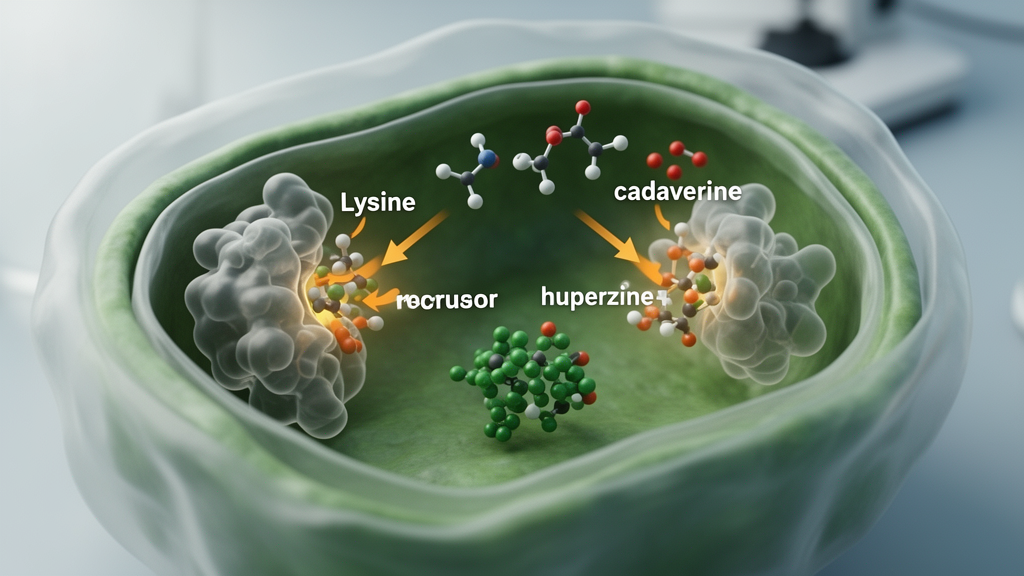
Supplementing axenic gametophyte cultures of the club moss Huperzia selago with lysine and cadaverine produced distinct, time-dependent changes in the accumulation of huperzine A and huperzine B, according to a controlled plant-culture study. Huperzine A reached its highest overall measured concentration at week 24 in cultures supplied with cadaverine alone, attaining 6.79 ± 0.10 mg g⁻¹ dry weight. Huperzine B accumulated more slowly and peaked at 0.97 ± 0.05 mg g⁻¹ dry weight at week 24 under combined supplementation with 5 + 5 mg L⁻¹ lysine and cadaverine. The results show that the two precursors did not exert a uniform effect across the huperzine pathway and that the strongest responses depended on both the compound measured and the stage of culture.
The researchers maintained H. selago gametophytes for 24 weeks on Whittier–Storchová medium. The treatments included L-lysine, cadaverine, or combined lysine-plus-cadaverine supplements at 5 + 5, 10 + 10, or 20 + 20 mg L⁻¹. Cultures were maintained either without plant growth regulators or in the presence of indole-3-butyric acid and kinetin. A two-way analysis of variance detected significant effects of culture time, medium composition, and their interaction on both huperzine alkaloids. Thus, the measured output depended not merely on whether a precursor was present, but also on when the culture was sampled and which supplementation combination was used.
Huperzine A showed its strongest response during the early-to-intermediate phase of the experiment. Its maximum in that period occurred at week 12 under the 10 + 10 mg L⁻¹ lysine-plus-cadaverine treatment, where it reached 5.70 ± 0.01 mg g⁻¹ dry weight. The overall maximum for this compound, however, was measured later, at week 24 under cadaverine-only supplementation. These observations separate the condition associated with the strongest early-to-intermediate response from the condition that produced the highest late-stage concentration. Huperzine B displayed a different pattern, with delayed accumulation and a peak at week 24 in the combined 5 + 5 mg L⁻¹ treatment. Plant growth regulators likewise modified the feeding response in a time- and variant-dependent manner rather than acting as a uniform stimulator across all conditions.
To examine the wider metabolic response, the researchers used LC–MS/IT–TOF profiling, which detected 27 signals corresponding to Lycopodiaceae alkaloids. Huperzine A and huperzine B were confirmed by comparison with authentic standards. The experiments centered on the gametophyte generation of H. selago, a member of the early-diverging vascular-plant lineage Lycopodiaceae. The study investigated a specialized metabolic network in which lysine and cadaverine serve as key entry metabolites. Because those compounds enter the Lycopodiaceae alkaloid network, adding them to the culture medium provided a controlled way to probe regulatory points in huperzine biosynthesis. The reported results support the view that the lysine-derived entry node is an important point of regulation, while also showing that the effects are compound-specific and time-dependent.
The findings establish precursor supplementation as an effective means of modulating huperzine biosynthesis in axenic H. selago gametophytes, rather than identifying one supplementation recipe as universally optimal. Huperzine A and huperzine B exhibited distinct temporal profiles under different treatments, and the response to plant growth regulators also varied with culture time and treatment variant. The authors conclude that axenic gametophyte cultures provide a tractable experimental system for studying specialized metabolism in early-diverging vascular plants and for refining strategies for the controlled production of pharmaceutically relevant alkaloids. Huperzine A and HupB are described in the study as potent acetylcholinesterase inhibitors, but the reported work concerns plant metabolism in culture and does not evaluate clinical effects or human exposure.
Subject of Research: Precursor regulation of huperzine A and B biosynthesis in axenic Huperzia selago gametophyte cultures
Article Title: Lysine and cadaverine differentially regulate huperzine biosynthesis in axenic gametophyte cultures of Huperzia selago (L.) Bernh. ex Schrank et Mart.
Article References: Szypuła, W. J., Markowski, M., & Wileńska, B. (2026). Lysine and cadaverine differentially regulate huperzine biosynthesis in axenic gametophyte cultures of Huperzia selago (L.) Bernh. ex Schrank et Mart.. BMC Plant Biology, 26(1), Article 1672. https://doi.org/10.1186/s12870-026-09868-x
Image Credits: AI Generated
DOI: 10.1186/s12870-026-09868-x
Keywords: Huperzia selago, huperzine A, huperzine B, lysine, cadaverine, axenic gametophytes, plant specialized metabolism, Lycopodiaceae alkaloids, precursor supplementation, plant growth regulators, differentially, regulate
News Source: Alan Morgan. (October 20, 2026). Lysine and cadaverine differentially regulate huperzine biosynthesis. Scienmag.