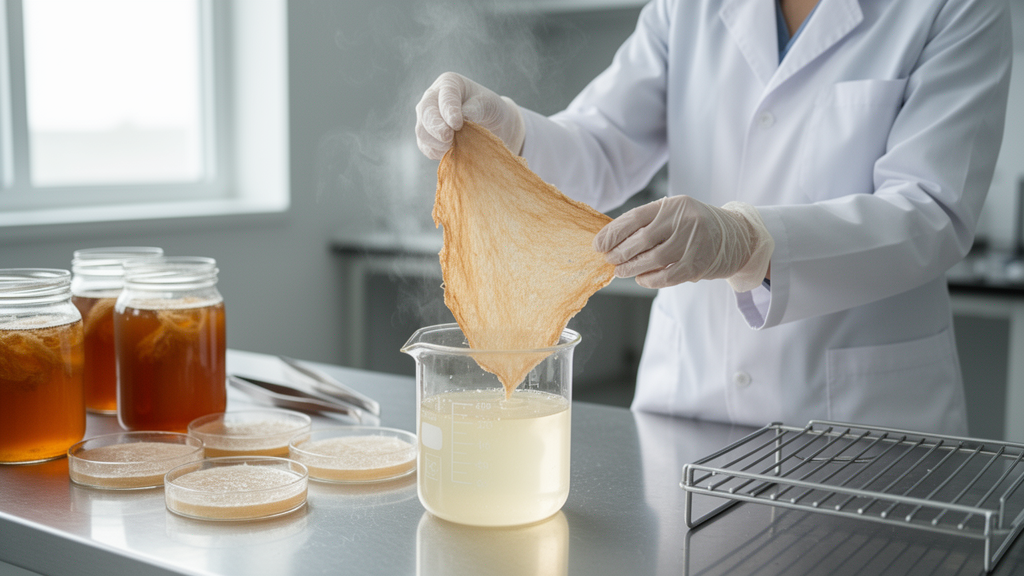
A leftover film from kombucha brewing could become a biodegradable alternative to plastic leather, and a new study shows that the secret lies in how gently it is bleached. Researchers in Brazil fermented kombucha for about six days, harvested the thick cellulose pellicle known as a SCOBY, and tested four combinations of hydrogen peroxide concentration and temperature to produce bacterial cellulose leather.
The Symbiotic Culture of Bacteria and Yeast, or SCOBY, is the rubbery disc that floats atop fermenting kombucha. Acetic acid bacteria within the consortium weave a pellicle of nearly pure cellulose, free of the lignin and hemicellulose that complicate plant-derived cellulose processing. Because bacterial cellulose is naturally clean, the team reasoned that mild purification should suffice, and they set out to map exactly how small changes in hydrogen peroxide strength and processing temperature ripple through the material’s color, water behavior, crystal structure, and thermal signature.
The experimental design was straightforward. Each harvested SCOBY layer, roughly 5 to 5.6 millimeters thick and weighing between 245 and 283 grams, was first sanitized in sodium hypochlorite for 48 hours, then immersed in hydrogen peroxide solution for another 48 hours at either 17.5 percent or 23.0 percent by volume, at either 40 or 50 degrees Celsius. After rinsing and oven-drying at the bleaching temperature for 72 hours, each treatment yielded a flexible, pale leather. Every condition was repeated twice from independent fermentation batches, and the leathers were then probed with scanning electron microscopy, colorimetry, water holding and vapor permeability tests, infrared spectroscopy, X-ray diffraction, and differential scanning calorimetry.
Yield told one part of the story. Bleaching at 50 degrees Celsius with the lower peroxide concentration produced the highest dry yield, reported in the conclusions as 17.5 percent hydrogen peroxide at 50 degrees Celsius, with the abstract citing a peak of 15.72 percent corresponding to 44.46 grams of cellulose. The authors emphasize that no single condition won on every metric: the optimal bleaching recipe depends entirely on whether the goal is maximum yield, maximum purity, or the best color and barrier performance.
Microscopy delivered the study’s most visually striking result. Under the scanning electron microscope, the three leathers treated with either 23.0 percent peroxide or with 50-degree heat showed surface erosion, grooves, localized ruptures, and salt deposits left behind by the hypochlorite and peroxide steps. Only the leather bleached with 17.5 percent hydrogen peroxide at 40 degrees Celsius displayed clearly preserved cellulose fibrils, a homogeneous surface without detectable salt deposits, lower roughness, and a faint fibrous texture exactly what pure bacterial cellulose should look like. The salt crystals, likely sodium chloride formed during hypochlorite degradation, clung to every sample and resisted even thorough water rinsing, prompting the authors to suggest that future protocols may need soaking or agitation steps, balanced against the risk of mechanically damaging the delicate pellicle.
Color and water behavior split along a different axis. Three of the four treatments achieved luminosity values above 92, indicating a bright white material, while the mild 17.5 percent peroxide treatment at 40 degrees Celsius lagged at 84.36 and showed the strongest yellow tint, probably because tea-derived residues were not fully removed under the gentlest conditions. In contrast, the 23.0 percent peroxide treatment at 40 degrees Celsius produced the best combination of whiteness, low water holding capacity, and low water vapor permeability, a profile the researchers link to a denser, more compact fibrous network confirmed by microscopy. All samples released water at similar rates after the first hour, approaching a plateau by 24 hours, and all showed low water vapor permeability overall, with only the 23.0 percent peroxide treatment at 40 degrees Celsius differing significantly.
X-ray diffraction added a cautionary note. All bleaching conditions yielded crystallinity indices below 65 percent, lower than the values above 60 percent typically expected for bacterial cellulose, indicating that bleaching increased the amorphous fraction of the cellulose. The lowest crystallinity appeared after treatment with 23.0 percent peroxide at 50 degrees Celsius, which the authors flag as too harsh for bacterial cellulose. Sodium chloride peaks dominated several diffractograms, and the team even reports features consistent with both cellulose I and cellulose II, suggesting that the combined hypochlorite sanitization and peroxide bleaching at elevated temperatures may have promoted partial structural rearrangement or degradation of the native cellulose lattice.
Thermal analysis reinforced the purity hierarchy. Differential scanning calorimetry revealed an early exothermic peak at 180 to 190 degrees Celsius in three of the four leathers, which the authors attribute to residual peroxide, inorganic salts, or oxidized functionalities such as carbonyl and carboxyl groups introduced during aggressive bleaching. Only the leather bleached with 17.5 percent peroxide at 40 degrees Celsius instead showed a small exothermic event in the 300 to 350 degree Celsius range, where typical bacterial cellulose degradation occurs, alongside the lowest water desorption temperature near 145 degrees Celsius. Infrared spectroscopy corroborated this picture: that same mild treatment preserved the characteristic cellulose bands, including markers of the I-alpha and I-beta crystalline forms, though a weak band near 1530 wavenumbers hinted at trace residual protein, an expected trade-off of gentler chemistry.
The broader significance extends beyond the laboratory bench. Bacterial cellulose leathers from SCOBY are renewable, biodegradable, and non-toxic, positioning them as partial replacements for petroleum-derived plastics in packaging, filtration, and coatings where moderate mechanical demands and sustainable end-of-life matter more than water resistance. This study demonstrates that the bleaching step, often treated as routine cleanup, is in fact a decisive control point: hotter or more concentrated peroxide buys whiteness but erodes fibrils, crystallinity, and thermal stability, while milder conditions safeguard structure at the cost of some residual color and protein. The authors call for future work incorporating tensile, puncture, tear, and abrasion testing, advanced surface analysis by EDX or XPS to identify residual deposits, and enclosed bleaching systems to limit oxidant evaporation. For now, the study's takeaway is that no single bleaching condition is best: the parameters should be chosen according to the intended application, whether maximizing yield, purity, or color and water vapor permeability, and further optimization is needed to achieve both high purity and high yield.
Subject of Research: How hydrogen peroxide concentration and temperature affect the purity, crystallinity, and properties of bacterial cellulose leather produced from kombucha SCOBY.
Article Title: Effect of Bleaching Conditions on the Physicochemical, Crystallinity, and Thermal Properties of Bacterial Cellulose Leather from Kombucha SCOBY
Article References: Cavalli, M. L., dos Santos, D. F., Pinto, V. Z., Cazarolli, L. H., dos Passos Francisco, C. T., & Bitencourt, T. B. (2026). Effect of Bleaching Conditions on the Physicochemical, Crystallinity, and Thermal Properties of Bacterial Cellulose Leather from Kombucha SCOBY. Discover Molecules, 3(1), Article 24. https://doi.org/10.1007/s44345-026-00066-8
Image Credits: AI Generated
DOI: 10.1007/s44345-026-00066-8
Keywords: bacterial cellulose, kombucha, SCOBY, bleaching, hydrogen peroxide, biodegradable materials, crystallinity, X-ray diffraction, FTIR, packaging, sustainable materials, fermentation
News Source: Bethany Barker. (October 29, 2026). Research report: Effect of Bleaching Conditions on the Physicochemical, Crystallinity, and Thermal Properties of Bacterial Cellulose Leather from Kombucha SCOBY. Scienmag.