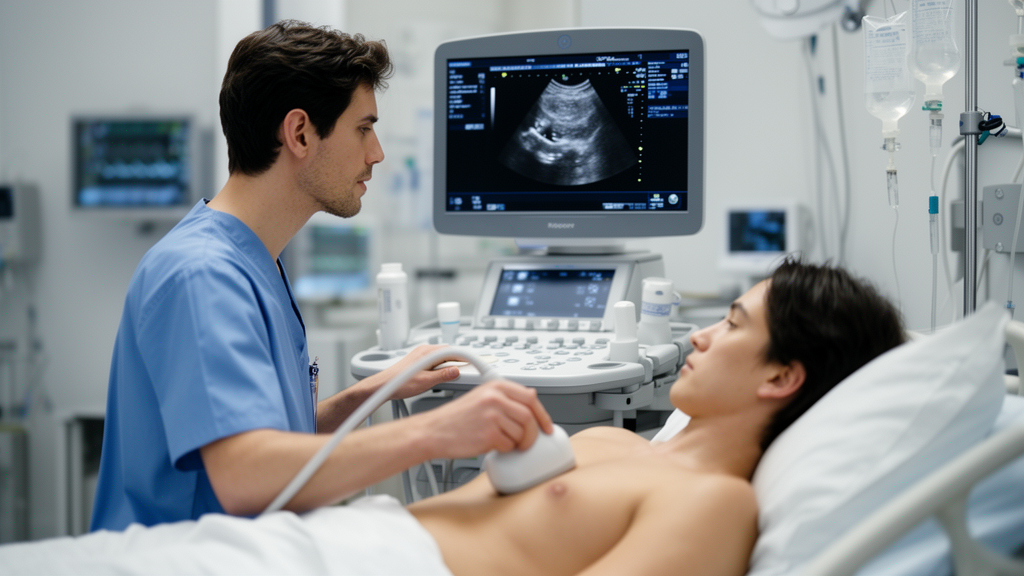
When a patient arrives in critical care with undifferentiated shock, the cause is often far from obvious, and the echocardiogram that would normally clarify matters may itself be misleading. A new review published in Echo Research & Practice by Claire Colebourn and Richard Fisher, two consultants who lead Critical Care Echo services in the United Kingdom, sets out a structured five-question approach designed to help echocardiographers already established in outpatient practice adapt their skills to the shocked patient. The guidance, published on 17 August 2026, is intentionally pragmatic and builds on the British Society of Echocardiography’s minimum dataset that experienced echocardiographers already know, rather than requiring them to learn an entirely new protocol.
The authors define shock as a clinical state of critical tissue hypoxia, arising from reduced oxygen delivery, increased oxygen demand, impaired oxygen utilisation, or a combination of these factors. Diagnosis rests on evidence of end-organ dysfunction, and although many shocked patients are hypotensive, a patient may be shocked despite normal or even elevated blood pressure. The causes of shock fall into four main categories according to the dominant mechanism: cardiogenic, hypovolaemic, obstructive and distributive. In practice, the review stresses, multiple causes frequently coexist in the same patient, and their relative contributions can shift as the illness evolves.
Echocardiography is described as the preferred first-line modality to investigate the cause of undifferentiated shock. Its role is to identify the causes of shock so that appropriate management can begin, to quantify the likely contribution of different causes to the patient’s clinical state, to identify and assess contributory chronic cardiac lesions, and to track progress over time. Crucially, the authors emphasise that decisions on patient management should never be taken on the echocardiogram in isolation; the study forms just one part of a comprehensive clinical assessment, and echocardiographers must work alongside the wider clinical team to integrate findings and inform treatment.
The five questions at the heart of the approach are deliberately simple. First, what is the stroke volume and cardiac output? Second, if the cardiac output is abnormal, what is the most likely cause or causes? Third, is left atrial pressure likely to be elevated? Fourth, is pulmonary artery pressure or pulmonary vascular resistance likely to be elevated? Fifth, how is the situation evolving? A similar question-and-answer framework has previously been used to guide echocardiographers assessing critically ill patients in the FUSIC HD EEP. The main body of the paper covers these questions for all shocked patients, while special considerations for particular presentations and pathologies are relegated to an appendix in the supplementary materials.
The first question receives the most detailed treatment. The authors recommend that stroke volume index and cardiac index should be reported for all shocked patients, using lower bounds of normal derived from the World Alliance of Societies of Echocardiography study, which drew normal reference intervals from 1450 patients across 15 countries. A cardiac index between 1.8 and 2.19 litres per minute per square metre should be reported as low cardiac output, and a value at or below 1.8 as critically low. Yet the review is careful to warn that cardiac index is not a binary marker of shock. In a study of patients with acute myocardial infarction, almost 90 per cent of those with clinical hypoperfusion had a cardiac index below 2.2 litres per minute per square metre, but roughly a quarter of patients below that same threshold showed no clinical features of impaired tissue perfusion.
The interaction between stroke volume, heart rate and cardiac output is another central theme. When stroke volume is low, a patient may mount a tachycardia to maintain tissue perfusion, so the cardiac index may appear acceptable even though it comes at the cost of increased myocardial oxygen demand and changes in pulmonary and systemic venous pressures. The authors therefore recommend reporting both indices together with the heart rate and rhythm, and reserving the phrase ‘cardiac output preserved’ for cases where the index is at least 2.2 but stroke volume is low and the heart rate exceeds 100 beats per minute. Conversely, patients with bradycardia may have a low cardiac output despite a normal stroke volume, because not all patients can mount a tachycardic response to critical illness.
The second question addresses causes, and it is here that the review highlights some of the most striking pitfalls of applying outpatient habits to the critically ill. Left ventricular ejection fraction should be reported, because severely reduced values correlate with poor outcomes in shock of both cardiac and non-cardiac causes, but the authors list several reasons why it can mislead. A low end-diastolic volume can produce a low stroke volume despite a normal ejection fraction; the measure is blind to blood flowing backwards through a regurgitant valve or through a ventricular septal defect; and low arterial elastance in distributive shock can make contractility appear normal, with dysfunction only unmasked when vasoconstrictors restore vascular tone. The relationship between ejection fraction and mortality in critical illness is described as U-shaped, with both severe impairment and hyperdynamic values of 70 per cent or above independently associated with worse outcomes.
Dynamic left ventricular outflow tract obstruction receives particular emphasis. Critical illness and the drugs used to support the circulation can produce the combination of hypercontractility and a low left ventricular cavity volume, predisposing to outflow obstruction in patients with or without underlying structural abnormalities. The authors recommend that all patients be evaluated for this condition and that its presence or absence be reported explicitly, because if it goes unrecognised there is the potential for vasoactive infusions to be increased, paradoxically worsening the shock state. Patients who develop shock after acute myocardial infarction should also be evaluated for an ischaemic ventricular septal defect, a rare but serious complication occurring in roughly one in 500 cases of STEMI, with short-term mortality approaching 100 per cent if untreated.
The third and fourth questions concern filling pressures and the pulmonary circulation, and both illustrate how standard outpatient algorithms falter in the intensive care unit. The ratio of early diastolic mitral inflow velocity to early diastolic annular velocity, known as E/e’, correlates reasonably well with invasively measured pulmonary capillary wedge pressure in general ICU patients including those with septic shock, and a value above 14 may be considered evidence of elevated left atrial pressure in this group. In cardiogenic shock, however, the correlation is poor and the measure is potentially misleading. The authors also note that the 2016 joint ASE/EACVI diastolic guidelines were indeterminate in approximately half of ICU patients tested, and that all three major guideline sets proved insensitive for identifying elevated wedge pressure in patients with cardiogenic shock following myocardial infarction. Left atrial size adds a further trap: the atrium has no time to dilate in acute illness, while a chronically dilated atrium may remain dilated during an acute drop in pressure, as in haemorrhagic shock.
For the pulmonary circulation, the review advises using the standard British Society of Echocardiography flow chart as a first step, but with caveats. When there is overt right ventricular systolic failure or severe tricuspid regurgitation, the tricuspid regurgitation maximum velocity may fall below the usual diagnostic thresholds for pulmonary hypertension, whereas a velocity exceeding 4 metres per second suggests that elevated pulmonary vascular resistance is unlikely to be purely acute, since the untrained right ventricle cannot generate such high pressures. A pulmonary artery acceleration time below 105 milliseconds is suggestive of elevated resistance when consistent with other findings, and should be corrected for heart rate in tachycardic patients. The paper closes with the fifth question, on evolution: serial studies may be needed as the dominant form of shock shifts, follow-up studies should refer to previous ones while accounting for measurement variability, and in patients with new cardiac dysfunction the authors judge it prudent to perform a convalescent study after the acute illness resolves, since many such patients recover function but not all do.
Subject of Research: A structured five-question echocardiographic framework for evaluating undifferentiated shock in critically ill adults
Article Title: A structured 5-question approach for echocardiographic evaluation of undifferentiated shock
Article References: Colebourn, C., & Fisher, R. (2026). A structured 5-question approach for echocardiographic evaluation of undifferentiated shock. Echo Research & Practice, 13(1), Article 30. https://doi.org/10.1186/s44156-026-00129-z
Image Credits: AI Generated
DOI: 10.1186/s44156-026-00129-z
Keywords: echocardiography, undifferentiated shock, critical care, cardiac output, left atrial pressure, pulmonary hypertension, stroke volume, ventricular function, LVOT obstruction, hemodynamics, intensive care, review
News Source: Ophelia Keating. (October 29, 2026). Research report: A structured 5-question approach for echocardiographic evaluation of undifferentiated shock. Scienmag.