


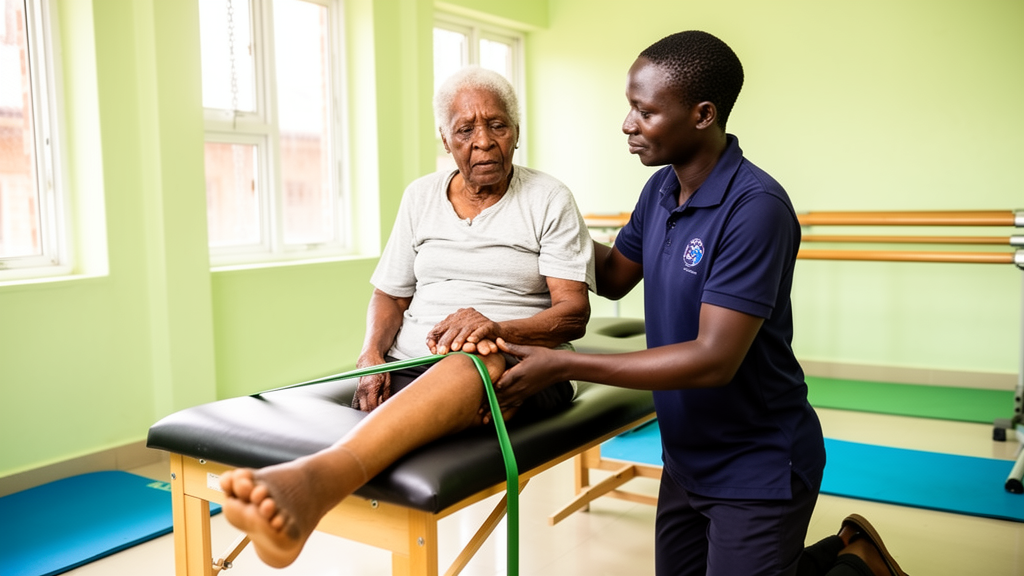
Kenya’s population of older adults is on course to quadruple within two decades, with the number of people over 60 expected to exceed 10 million, yet a new survey of Kenyan physiotherapists suggests that entry-level training in the care of older adults is uneven and, in some areas, strikingly thin. The study, published in the Bulletin of Faculty of Physical Therapy, surveyed registered physiotherapists and physiotherapy students in Kenya about how geriatric content was delivered during their entry-level education and how prepared they felt to examine and treat older patients.
The survey, developed in Qualtrics and distributed three times over three weeks in 2025 through social media platforms including WhatsApp and Facebook, in collaboration with the Physiotherapy Council of Kenya and the Kenyan Society of Physiotherapy, drew 177 responses. Most respondents, 82 percent, were practicing clinicians working across acute care and specialty hospitals, home health, and outpatient settings. Nearly half reported an entry-level qualification from a three-year certificate program, 34 percent held a bachelor’s degree, and 3 percent a master’s degree. Almost all, 93 percent, said their entry-level education lasted between two and four years.
The clinical stakes of the question are considerable. The study’s background notes that Kenya faces a double burden of infectious disease alongside a rising tide of non-communicable diseases such as cardiovascular disease, cancer, respiratory disease, and diabetes, conditions that are more prevalent in older adults. Physiotherapists play a role in preventing and managing these diseases by promoting physical activity and healthy aging, which makes the adequacy of their geriatric training a public health issue rather than a purely academic one.
Participants rated how well specific topics were covered in lectures and labs during their entry-level education. Examination of clients after stroke topped the list, with 63.71 percent reporting it was well covered, followed by osteoporosis and fracture risk at 44.72 percent, fall risk screening and balance assessment at 35.77 percent, screening and examination of Parkinson’s disease at 35.25 percent, and aging biology and physiology at 34.65 percent. On the treatment side, stroke management again led at 56.91 percent, with exercise prescription at 45 percent and physiotherapy management after fracture at 44.72 percent also well represented. The authors point out that Kenya carries the highest stroke burden globally and that stroke is the fifth leading cause of death in the country, which may explain the emphasis on stroke content.
At the other end of the spectrum, three content areas stood out as the least well covered: pharmacology at 19.17 percent, nutritional status at 18.55 percent, and screening for elder abuse, neglect, and self-neglect, also at 18.55 percent. Nearly 17 percent of respondents said pharmacology was not covered at all. The authors suggest this could represent an area for curricular improvement as Kenya’s healthcare burden shifts toward non-communicable diseases, where managing multiple comorbid conditions may make polypharmacy more prevalent. They also note, however, that reviews of medication management in Sub-Saharan Africa point to problems including unavailability, unaffordability, and distrust of medications, raising the question of whether pharmacology is genuinely underrepresented in education or roughly matched to current clinical conditions. Additional research, they conclude, is needed to determine specific curricular needs related to pharmacotherapy.
Overall perceptions of preparedness were moderately positive. Asked to rate their readiness to examine and treat people aged 65 and older on a scale from 0, meaning not at all prepared, to 10, meaning very well prepared, respondents averaged 6.95 for examination and 7.18 for treatment. An analysis of variance found no statistically significant difference in overall preparedness across entry-level qualification types, whether certificate, bachelor’s, or master’s, with a p value of 0.721.
The delivery format of geriatric education, however, did make a measurable difference. Most participants, 39 percent, reported that some lectures focused on older adults, 28 percent had taken an elective course on older adults, 6 percent had completed an entire course dedicated to older adults, and 10 percent reported no coursework specifically related to older adults at all. A further 17 percent said their exposure amounted to a mention or up to one lecture. The analysis of variance revealed a statistically significant difference in perceived preparedness based on delivery format: those who took an entire course on older adults averaged 8.29 on the preparedness scale, compared with 6.07 for those without specific coursework, a difference the authors report as statistically significant at p = 0.02. Participants who completed a dedicated geriatric physiotherapy course were thus more likely to report feeling prepared to work with older adults than those who did not.
Notably, only about 10 percent of respondents reported that the 5Ms were not taught at all, a figure the authors flag as a possible sign of demand bias, since a PubMed search found only five articles on the framework and physical therapy, all published from 2023 onward, and none combining the 5Ms with Africa. Respondents may have answered in ways that overestimated the education they received.
The authors are careful to enumerate the study’s limitations. The true response rate is difficult to establish because the number of people who received the survey is unknown; based on an estimate that roughly half of Kenya’s approximately 3,000 registered physiotherapists saw the outreach, the response rate would be about 11.8 percent, which limits generalizability. As a national survey, the results cannot be broadly extended to other nations or regions in Africa or beyond. The unincentivized, internet-based design may have introduced self-selection bias, and distribution through social media may have favored respondents with greater access to technology. The researchers, who were not from Kenya, also lacked extensive local contacts to facilitate distribution. Perhaps most importantly, most respondents were practicing clinicians, with 58 percent reporting more than five years of experience, and asking them to recall their entry-level education years later introduces recall bias. No formal, objective review of curricula, syllabi, course objectives, or clinical placement data was performed.
Positioned as the first study of its kind in Kenya, the work establishes a baseline that previously did not exist: Kenyan physiotherapists’ perspectives on aging, geriatric academic preparation, and potential areas for curricular improvement were unknown before this survey. The authors conclude that entry-level curricular evaluation and revision may promote contemporary geriatric physiotherapy practice, and they call on stakeholders in academia and professional organizations to promote current knowledge in geriatric physiotherapy as educational programs evolve. Their stated threefold goal is to help clinicians feel prepared to meet the needs of older adults, to promote best practices in geriatric care, and to incorporate primary and secondary prevention into physiotherapy practice. They also identify opportunities for more lab-based experiences in areas such as patient education, balance interventions, health promotion, and managing patients with cognitive impairment, noting that cardiovascular disease is the second leading cause of morbidity and mortality in Kenya and that physical activity and lifestyle modification can reduce cardiovascular risk. Future research, they suggest, should examine clinical outcomes and their relationship to perceived preparedness, and use objective curricular review to determine whether feelings of unpreparedness align with genuine gaps in training.
Subject of Research: Entry-level geriatric physiotherapy education and perceived preparedness among Kenyan physiotherapists
Article Title: Current state of entry-level geriatric physiotherapy curriculum in Kenya
Article References: Blood, K. M., Mierzwicki, J. T., & Billek-Sawhney, B. (2026). Current state of entry-level geriatric physiotherapy curriculum in Kenya. Bulletin of Faculty of Physical Therapy, 31(1), Article 36. https://doi.org/10.1186/s43161-026-00374-7
Image Credits: AI Generated
DOI: 10.1186/s43161-026-00374-7
Keywords: geriatric physiotherapy, Kenya, physiotherapy education, curriculum, survey, older adults, preparedness, entry-level training, non-communicable diseases, Physiotherapy Council of Kenya, stroke rehabilitation, health workforce
News Source: Beatrice Stafford. (October 29, 2026). Kenyan physiotherapists report gaps in geriatric training as population ages. Scienmag.



