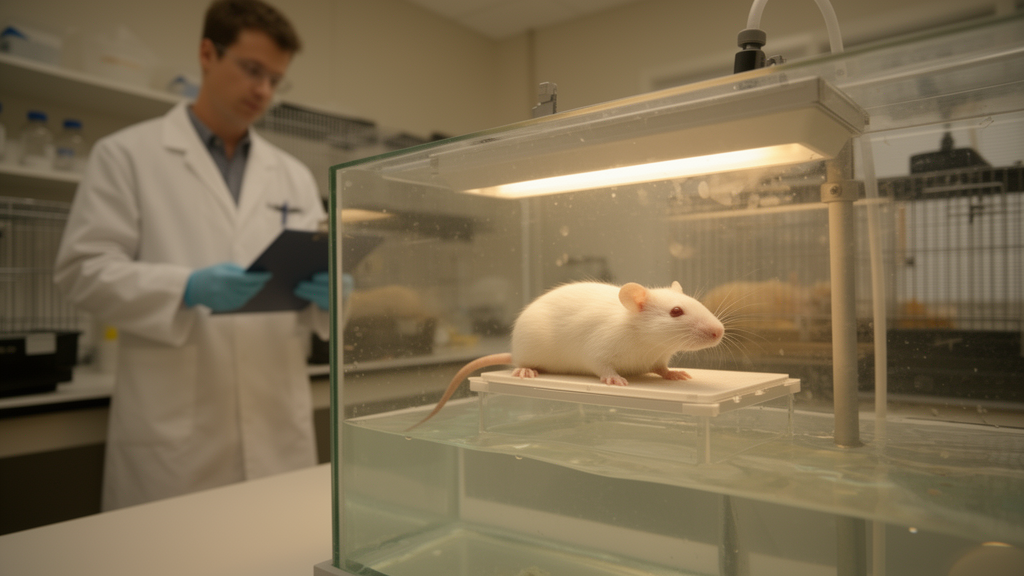
Fourteen days of REM sleep deprivation pushed rats of both sexes into behaviors resembling mania and obsessive-compulsive disorder, while altering the expression of five key molecular markers in the hippocampus, according to a new rat study published in Behavioral and Brain Functions. The work, led by Salar Vaseghi and colleagues, is presented as the first to implicate the proteins Arc, DAT, and GFAP alongside BDNF and CREB in these sleep-deprivation-induced behavioral phenotypes in both male and female rats.
The researchers deprived rats of rapid-eye movement sleep for six hours per day over a 14-day period. They then assessed locomotor activity, anxiety-like behavior, grooming, and sniffing using the open field test, and measured repetitive and compulsive-like responses with the marble burying test. Molecular changes were examined by measuring gene expression with real-time PCR.
The behavioral results were consistent across sexes: REM sleep deprivation led to hyperlocomotion, decreased anxiety-like behavior, and increased OCD-like and stereotyped behaviors. The effects were more pronounced in females, with the exception of anxiety-like behavior, where the sex difference in magnitude did not follow that pattern.
In the hippocampus, the expression of BDNF, CREB, DAT, and Arc was decreased, while GFAP expression was increased in REM sleep-deprived rats of both sexes. As with the behavioral findings, the molecular changes were generally larger in females, except for CREB, which did not show the same female-predominant effect.
The authors conclude that the study shows, for the first time, a possible role for Arc, DAT, and GFAP in the induction of OCD- and manic-like behaviors and stereotyped behaviors in both sexes of rats. They also note that the observed reductions in BDNF and CREB expression in REM sleep-deprived animals suggest a potential association between these molecular alterations and the behavioral changes induced by REM sleep deprivation.
The findings arrive against a backdrop of contested evidence. The authors note in their abstract that REM sleep deprivation has controversial effects on behavioral functions and cognitive abilities, and that recent evidence has shown it may lead to manic- and OCD-like behaviors in rats. The present study was designed to assess the effect of REM sleep deprivation in both sexes on locomotor activity, anxiety-like behavior, stereotyped behaviors, and OCD-like behavior, and to probe the possible role of the five molecular markers.
Looking forward, the authors suggest that interventions targeting these molecular pathways could offer promising therapeutic strategies for REM sleep deprivation-induced mood disorders. That framing remains a forward-looking proposal rather than a demonstrated treatment effect, since the study measured behavioral and gene-expression changes in rats rather than testing any therapeutic intervention.
As with all animal research, the results are limited to the rat model and the specific deprivation protocol used, and the study reports associations between gene-expression changes and behavior rather than established causal mechanisms in humans. The article is published open access, with the version shared early as a peer-reviewed, accepted manuscript that carries a permanent DOI and remains subject to further edits before the final Version of Record.
Subject of Research: Effects of REM sleep deprivation on manic- and OCD-like behaviors and hippocampal gene expression in rats
Article Title: The role of BDNF, CREB, DAT, GFAP and Arc in manic- and OCD-like behavioral phenotypes in both sexes of rats exposed to REM sleep deprivation
Article References: Vaseghi, S., Baghaeikia, S., Keyvani, T., Lotfi, G., Jalalian-Javadpour, M., & Ebrahimnejad, M. (2026). The role of BDNF, CREB, DAT, GFAP and Arc in manic- and OCD-like behavioral phenotypes in both sexes of rats exposed to REM sleep deprivation. Behavioral and Brain Functions, 22(1), Article 52. https://doi.org/10.1186/s12993-026-00359-5
Image Credits: AI Generated
DOI: 10.1186/s12993-026-00359-5
Keywords: REM sleep deprivation, rats, mania, OCD-like behavior, BDNF, CREB, DAT, GFAP, Arc, hippocampus, open field test, marble burying test
News Source: Juliet Wilcox. (October 29, 2026). REM Sleep Deprivation in Rats Tied to Manic- and OCD-Like Behaviors and Hippocampal Gene Changes. Scienmag.